Author Archives: Grant

Tito’s versus Sailor Jerry (new cliches in the world of marketing)

A few years from now I think we will look back on the artisanal trend and spot a cliche.

Artisanal products believe themselves to be intrinsically interesting. They are in fact massively self absorbed. They do not tend to carry culture meanings except about themselves. Artisanal products, it’s all about them.

Exhibit A

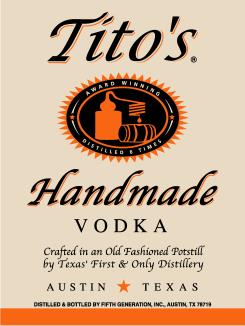
Tito’s is a small run vodka now being made in Austin, Texas. It was recently written up in Wall Street Journal Magazine. The first thing that Tito’s wants you to know about itself is that its hand-made. I am never sure what this means when it comes to certain products. It sounds more laborious than crafted. What does it matter how the grain was stirred? A machine or by hand, it can’t matter to the vodka. Right?

The WSJ Magazine article is a marketer’s dream. This kind of coverage for this kind of audience!  Who could ask for anything more? This is hand made marketing!

But the story reads as all the artisanal stories do.  It recites the new cliches:

1. This brand is made in tiny batches in an obscure place. Check.

2. It is made by some guy who used to work for a giant corporation. Check.

In the Tito’s case, the guy is Tito Beveridge, a geophysicist worked for an oil company. Every time someone tells me about an artisanal chocolate, the maker seems to be a former NASA  or airline pilot.  And I think we are supposed to marvel on how this individual is found his or her artisanal salvation.They have followed their bliss out of the big bad corporation into something kinder and gentler. I’m not sure but I think we prefer to think of our artisanal producers as large and ambling, if men, and little and pretty, if women.  Look, not a threat to anyone!  Nit wit, please. 

3.  It is always premium priced and incredibly high end, because well someone seeking their artisanal salvation is not going to look for it in price cutting or any thing so vulgar as market competition.  The artisan is, it turns out, too good for capitalism of any conventional kind. Check.

4.  There is always a long period in the wilderness when the artisan struggles to keep his or her dream alive.  What a brave, devoted soul!  And finally of course there is triumph. Because the Romance playbook tell us that all acts of self sacrifice result in an apotheosis. Virtue becomes celebrity.  (Pursue the intrinsic and the world will reward you with the extrinsic.)  Check.

5. There is an odor of vanity and self importance about the brand and it’s maker…and, sorry, it’s consumer.  We are all so very special.  (Bitter?  A little.  Being a month without a blog hurt me, clearly.)  Check.

Traditionally, marketing has been about meaning making.  And recently we have seen marketers define brands with meanings ever more subtle and interesting.  But the artisanal trend seems to run against the flow.  There is only one meaning contained in an artisanal brand, the artisanal one.

There’s no question that this myth is a potent meaning and it adds to our story telling at the bar at a time when we like to be telling stories at the bar.  But damn it if it isn’t always the same story.  For some reason, the artisanal trend gives us license to make the back story the front story, even when it isn’t very interesting and even when we have heard it before. I guess it’s better than connoisseurship ("so very peaty!") but for how long?   

Which brings me to Sailor Jerry’s.  I got to hear its creator at the recent Piers Fawkes’ PSFK recent conference in New York City, and it was pretty interesting.  Steven Grasse struck me as being a bit of a mad scientist, my highest compliment these days.  But the brand isn’t about him.  It’s about Norman Collins, the man they call the master of the old school tattooing. Here’s what the Sailor Jerry website says about him

If you really want a true classic tattoo, you’ll have to go back in time and cross the Pacific. When your tramp steamer hits the port of Honolulu, jump ashore and head set straight to Chinatown. Soon, you’ll hit Hotel Street. You’ll know this by the sudden progression of wide-eyed sailors, foul-mouthed roughnecks, and general sanctioned mayhem. And there, tucked away on a steamy side street, you’ll see the bright red neon glow of “Sailor Jerry’s”- the tattoo shop that marked the fighting men of the Pacific for nearly 40 years.

Now that’s what I call a story.  Not some NASA engineer looking for redemption but a rough neck who lived surrounded by mayhem and the low life. Not a brand but a brander. Please start your story engines now.  

References

Carrigan, Janelle.  2010.  Proof of life.  Wall Street Journal Magazine.  March.  pp. 30-31.  

McCracken, Grant.  2006.  The Artisanal Trend and 10 things that define it.  This Blog. November 9.  here.

The source for the Sailor Jerry passage here.

Acknowledgements

Thanks to Michael Margolis, I am thinking more about story telling these days.  See his website here.

Oh, thank goodness

Faithful readers will have noticed that This Blog has been down for a full month.

We were hit by the malware attach that caused Google and Firefox to warn away visitors.  

I have to say Network Solutions has been spectacularly unhelpful.

Use "Network solutions" and "malware" as your search terms in Twitter, and you will see that this attack is "epidemical" as they used to say in the 18th century.  The nightmare continues for many.  Network Solutions as acted with the cavalier disregard of the public utility it once was.  Bad brand, bad!

We have abandoned it and good riddance.

But we didn’t get off scotfree.  We lost all the blog posts since December 18th, 2009.  This too is thanks to Network Solutions which managed to delete the entire database.  Yes, that’s 1.5 million words, and many years of work, made to disappear in a puff of digital smoke. Bad brand, very bad brand.

Were it not for a backup at Foliovision, I would have lost the whole thing.  Good brand! Excellent brand.  (No, but really.  Foliovision has earned my undying gratitude.  Highly recommended for anyone thinking of making the transition from TypePad to WordPress.)  

It looks as if we were going to lose the list of Very Good Blogs, but, happily ,David Armano referenced it a couple of months ago, and this gave us a back up.  Thank you, David. 

So we are back in action.  Thanks for your patience.  And thanks to people who wrote in to give me the head’s up on the malware attack.  

Special thanks to Ana Domb for helping me get This Blog back in place.

Blank looks for a new comedy and culture

There are two facial expressions I haven’t seen on TV before.  One is a look of suppressed speech.  The other is perplexity.  Both show TV characters going blank.

If you’re a fan of The Office or Modern Family, you know the looks I mean.

Suppressed speech blank

Jim or Pam (in The Office) stare blankly, as if to say, "I know exactly what I think but I can’t say it."  Michael Scott or Dwight Schrute are up to something embarrassing, stupid or juvenile (usually all three) and comment is unnecessary. It is in any case forbidden. Michael is the boss and Dwight is a lunatic. Provoking them is a bad idea. Better to stare blankly. (Occasionally they Jim or Pam will blank to the camera, because they know we know exactly what they mean.)

Perplexity blank

Phil or Claire Dunphy (in Modern Family) stares into the middle distance, as if to say, "I have no idea what to think.".  A little cloud appears between the brows.  They are nonplussed. They have done something embarrassing, stupid or juvenile, and now they are perplexed. Occasionally, Phil or Claire will blank to the camera, because, well, they know we know they have no idea what they mean.)

Four questions:

1) Is this new?  There is a standard sit com facial repertoire, that includes, laugh out loud, smirk, grin, frown, grimace, and operatic outrage.  There is every kind of facial posturing. And, yes, there are blank looks.  In fact there’s a long tradition here that includes Jack Benny, Lucille Ball, Jackie Gleason, Don Adams, Edith Bunker right up and through The 70s Show, Frasier, and Seinfeld,

But this blank?  The one that says says, "I am not saying.  I’m not reacting"?  Yes, I think this kind of blank perhaps is new. Is it customary to seeing sit com characters biting their tongues? The point of situation comedy is to loosen tongues and let fly. Conventional sit coms were positively disinclined to silence a character in this way.  This blank is new.

2) What does "blank" stand for? In the first case, The Office case, the blank is a way of acknowledging how utterly and hopelessly over the top is the behavior of a Michael Scott. Without these characters registering a real world reaction, this comedy would tip into its own lunatic world and cease being exceptional. The blank exists to refresh the standard by which Michael Scott is appalling. This blank exists to prevent a "Dunder Mifflin" world from terraforming in which the bizarre is ordinary.

The Modern Family blank is confessional.  The character is saying, "I understand that I have completely failed in the responsibilities of a social actor, to manage social impressions.  I am undone."  We are now looking at the person behind Goffman’s mask. The character is saying, "I stand before you without credibility." (How much fun must it be for a theatrical actor to play a social actor who is no longer capable of action?)

3) Why is this facial expression now a ubiquitous part of some sit coms?  I’m not sure.  I welcome reader speculation.  Some of it has to do with the mockumentary convention that has characters aware of the cameras and playing to it.  It’s also an expression of the comedic moment championed by Sacha Baron Cohen’s Borat and the antics of Michael Cera, Jack Black and Seth Rogen as directed by Judd Apatow.  Call it squirm comedy.  It excavates social rules by breaking them.  And there has to be someone standing around to observe the mayhem (to make sure it remains departure and does not "freeze" into norm).

Plus squirm comedy pushes characters into appalling situations.  (Think Ben Stiller in Something About Mary.)  And now in a sense they have played out the string of the scene. There is no recovery. There is no next.  And this means there is no way of way to end the scene, except to show the character just standing there.  The social actor can’t act anymore.  The writer has written herself into a corner.  The only thing left to do is blank.

4) But here’s the really hard question.  Why should our culture find this funny now? Readers (and I think it is now clear I have the most interesting and brilliant readers) start your engines.

Last note:

Those of you who haven’t seen Modern Family might want to take a look.  It’s now a critic’s darling and according to TV By The Numbers it is the no. 1 scripted show in its time slot for 6 weeks in a row and nows ties with American Idol as the No. 1 program among men 18 to 34.  

Really last note:

I just want to say how grateful I am for reader comments. I haven’t been at all good at responding to them lately. Things are hectic. But this doesn’t mean that I don’t read them. And it doesn’t mean that I don’t treasure them. Thanks a million.

Totally last note, and this time I mean it: This post reposted December 23, 2010.  It was destroyed by Network Solution neglect.  I just came across it floating around on line.  Hurray!

The Mystery of Capitalism

I am always surprised that no one bothers to tell the story of capitalism.

No, the stories we prefer to tell our children is that capitalism is a dangerous, soulless, relentlessly exploitative exercise.  Indeed, this story is so preferred as our received wisdom that it is exceedingly rare to hear anyone recent Adam Smith’s magical insight, that good things can and do come from people pursuing their own, sometimes narrow, objectives.

The anti-capitalism view is an ideological fixture of our education systems at every level, from grade to graduate school.  We could call it orthodoxy if it were not so much like boilerplate.  It’s not so much argued as assumed.

Capitalists are sanguine.  Apparently, they don’t feel they have to tell the story of capitalism.  Somehow capitalism will teach its own lessons.  Once people escape the magic kingdom of education, the truth will dawn.  Once they have spend a little time in the marketplace, the penny will drop.  Or, as the English like to say, "if a man’s not a Marxist at 20, there’s something wrong with his heart.  But if he is still a Marxist at 30, there’s something wrong with his head."

When Peter Robinson interviewed Gary Becker, Professor at the University of Chicago and winner of the Nobel Prize, recently, the master surprised Robinson be announcing, "Markets are hard to appreciate."   Robinson asks for clarification and Becker obliges:

"People tend to impute good motives to government. And if you assume that government officials are well meaning, then you also tend to assume that government officials always act on behalf of the greater good. People understand that entrepreneurs and investors by contrast just try to make money, not act on behalf of the greater good. And they have trouble seeing how this pursuit of profits can lift the general standard of living. The idea is too counterintuitive. So we’re always up against a kind of in-built suspicion of markets. There’s always a temptation to believe that markets succeed by looting the unfortunate."

And I think this gets at some part of the heart of the problem.  Capitalism is, as Becker says, counterintuitive.  It tells a bad story.  In fact, it isn’t a story.  It is anti-storyish.

Capitalism doesn’t have heroes.  It doesn’t have people called to higher motives.  It doesn’t have noble sacrifices for the good of others.  It doesn’t, usually, have daring action on a public stage.

No, capitalism is just has some guy who owns a handful of dry cleaning outfits in a small town in New Hampshire.  He works hard, supplies a service, pays off his loans, coaches Little League, goes to church, gets his kids through college, and spends his very few disposable hours on the golf course.

Script!  Casting!  Someone call the studio!   This is appalling.  It doesn’t matter that out of these mundane activities in lots of towns big and small, played out by millions of people across the US, something remarkable will come.  This just isn’t a story anyone wants to listen to.  So no one much wants to tell it.  Not Hollywood.  Not our mythmakers.  Not our story tellers.

The economist has spoken.  It is a little clearer why we do not tell the story of capitalism.  It just doesn’t tell very well. But if the anthropologist may join in here.  Can we at least acknowledge that there is something fabulously odd about a culture that depends on capitalism but that will not ever acknowledge it in the stories it tells itself about itself.

References

Robinson, Peter.  2010.  Basically an Optimist–Still.  The Wall Street Journal.  March 27 -28.  p. A13.

Note: This post reposted December 23, 2010.  It was lost due to Network Solutions incompetence and only just tonight resurfaced on the net.  

DNA, string theory and what might have been

Dear Grant McCracken,

The automated search has found a new match that meets your current mtDNA search criteria:

Jeffrey Blankenship, 0 mutational difference.

Every so often I get an email from a company called Genebase.  It informs me that they have found a match.  Good news! An addition to their database matches my DNA signature.

Yesterday, Genebase informed me that I was a match with not only Mr. Blankenship.but Marshall Eltzey, Carlos White, and Delmar Albert Dyreson.

Delmar Albert Dyreson!  Tell me more!

That’s the problem.  Genebase tells me almost nothing about the people to whom I am matched.  Take Delmar Albert Dyreson.  Genebase says only that he is living and male.

But I want all the details!  Where does Mr. Dyreson live, what does he do for a living, what’s he like as a person?

I don’t want to befriend Mr. Dyreson.  I just want a glimpse of his life.  And why?  Because if we really have DNA in common, Mr. Dyreson is an opportunity to see what might have been. If the universe exists as endless variations of itself, why not make this the grounds for variation?  At least for imaginative purposes.

Yes, of course this is fanciful.  But people have used much smaller similarities to identify with one another.  How about: "our parents both came from the old country.  We kinda feel like brothers."

Mr. Dyreson and I have a more substantial connection.  None of that "sons of the soil" crap for us.  We are actually made of the same stuff. And on the strength of this connection, I can dream.  What might my life had been if I can been born into his family, country, language. Sure, it’s a footless enterprise.  I don’t really learn anything about myself.   But it’s fun.

A Google search tells me that there was a Delmar A. Dyreson at the 601st meeting of the American Mathematical Society held in New York City in 1963.  Interesting?  Not really.  But I do notice Dyreson institutional address is given as New Mexico Highlands University.   Somehow this man found his way to the deep obscurity of the high desert, a place that vibrates with a spirituality that evades even the most speculative math.  Much better, thank you.  I’ll take it from here.

Delmar, sir, if you get this message, let’s compare notes.

Reference

McCracken, Grant.  Transformations.  Identity Construction in Contemporary Culture.  Bloomington: Indiana University Press. here.

Note: this post was lost due to Network Solutions incompetence.  It was reposted December 26, 2010.  

Chief Culture Officer goes all Portuguese

Helena Oliveira (pictured) was kind enough to interview me for the Portuguese magazine VER.

If your Portuguese is a little rusty, here’s the interview in English.

Helena Oliveira: What is a CCO and why does the organizational world needs one?

Grant McCracken: A CCO is the senior manager in charge of reading culture outside the corporation in order to spot the revenue opportunities and the dangers it represents.

How can we convince the C-Suit that cultural insights are valuable to the modern business and especially for their own companies?

In the book I cover lots of examples of how corporation found opportunity by reading culture, and crafting products and services that speak to culture.  Nike, Starbucks, Unilever, Coca-Cola, HBO, Method, and Disney are compelling cases in point.  I also look at Quaker, Best Buy, Levi-Strauss, PepsiCo and General Motors.  In each of these cases, the corporation failed to see how culture was changing and how they were sliding out of touch. The collective penalty for the failure of the first three corporations: $ 3 billion.   (My apologies for how US centric these examples are.  I wrote the book in a great hurry and worked from the examples I had at hand.  For the follow up, I hope to work in European examples.  I hope your readers will let me know what European examples, good and bad, I could use.) 

Cultural characteristics are very difficult to change. What are your main advices to transform a “dead or a ill company” into a living breathing corporation?

They are hard to change.  But I think the more responsive they become to the culture outside the corporation they more lively and responsive they become, and they more fun they are as a place to work.  We all know a lot about culture.  It might be movies, music, sports, or television shows.  It’s time to put this knowledge to work for the corporation.   it’s time to share it with one another.  It’s time to use “the whole self” when we come to work.

Should a CCO start his job looking to the inside culture of a company and then adapt it to the outside one or are the cultural trends of the outer world the first to be analyzed?

There’s no reason we can’t do both.  But my preference is to find out what knowledge people inside the corporation have of the culture out there and then figure out how to fill the gaps. 

What are the main tools a CCO should have?

We want to cast the net wide.  We need to know what’s happening in the film world, mainstream, indie, local and global.   We need to know what is happening in culture at the margin and the mainstream.  I am hoping that companies will build a “big board” that identifies and tracks the trends and shifts that matter.  So that at any given moment the C-Suite can say “here are the three big opportunities and three dangers out there now.  This is when we think they will reach our markets.  Here are the innovations we have ready when they do.”  it’s a little like weather forecasting.  (As in, “This is when we think this high pressure zone will reach us.”)  Except in the culture case, we can do something about it.

Who are the most “qualified” persons to take charge as CCO? Do you really think that this is an opportunity to create a new career for Humanities and Social Sciences grads? (I wish J)

I think we will find unexpected people rise to the occasion.  There are Gen Xers and Gen Yers who are ready to go.  They have deep knowledge of culture and only need to fill in the gaps in their business training and cultural knowledge.  I think the agency and strategy world will produce some interesting players.  They need only get their analytics out of the “black box” in which agencies tend now to keep them.  I think the world of journalism and publishing will produce some great candidates.  Every great editor is already playing CCO for his or her readers.  I wonder if people in the entertainment business may step up: agents, producers, and actors are often great readers of culture.  They only need to cast the net wider.  With some supplementary training, CMOs are ready to go.

You mention that the business schools must be reinvented? How?

As it stands, business schools pretty much ignore culture.  At least the American ones do.  I would be very interested to hear what is happening in Europe on this question.  It is a huge opportunity for a business school to take the lead here.  Culture is the next new “white space” or “blue ocean” for the business world.  When I was teaching at the Harvard Business School, (then) Dean Clark used to say that what kept him up at night was the possibility that a school “out there” would challenge HBS’s position with some innovation he couldn’t anticipate.  I think he thought the challenge would probably be a disruption of a technological nature.  But it could just as easily be a shift to culture.  And with all due respect to my former employer, this is a change HBS may not see coming. 

What are the main problems you see in the modern business world?

I think we are too much dominated by the assumptions of economics.  We see customers and consumers as engaged in narrow pursuit of interest and ourselves as the suppliers of value narrowly defined.  I like the way AG Lafley, chairman of CEO, has asked us to broaden our perspective, to dolly back to a bigger picture, and see that consumers are shaped by forces larger than interest narrowly defined.  (See p. 36 of his book The Game Changers.)  They are creatures who live in culture, who consumer culture, who produce culture.  They are living and breathing in this respect as well.  Time for the corporation to cultivate a bigger picture of how we create value.

You’ve “elected” Steve Jobs as a great CCO, although he’s quite known as a “difficult” person. (I’m also a big fan of Jobs and he’s undoubtedly one of the great leaders of the last decade). My question is: what is the “responsibility” of a CEO in shaping the culture of an organization? And what other well-known CEOs would you point as great CCOs?

Steve Jobs is a great leader.  But he’s also a guru who doesn’t let us know the method of his genius.  Too often the corporation depends on a guru who insists that we trust their intuition, their creative genius.  Certainly we want them to share this intuitive and we are grateful for their genius, but a CCO would help us “reverse engineer” some of this inspiration so that we can subject it to scrutiny, so that the investment markets can have a look and make their bets accordingly.  “Just trust me” is not a perfect approach to building investor confidence. 

I remember that maybe a decade ago Jack Welch was celebrated as one of the great leaders ever and GE’s culture was also a sort of a business case study. What are the main differences – in cultural terms – you’ve identified in organizations during your career?

Corporations have been saying the “consumer is king” since 1912.  And most "b to c" operations are more or less attentive to who the consumer is and what the consumer wants.  The fact of the matter is that this consumer exists on a great ice flow called culture, a vast body of meanings and rules that make their worlds, their tastes and their preferences make sense.  It’s time we had a systematic understanding of what this is.

Organizations are also facing some cultural complexities between the Xrs, Yrs and the “net generation”, or the “grown up digitals” as Don Tapscott puts it. How should these different generations “behave” for the good of the company?

I think each of these generations has its strengths and its passions when it comes to reading and acting on culture.  As it stands, the corporation is very often run by boomers who sometimes suppose that their culture is everyone’s culture.  The example I use here is that until recently Mercedes use Richard Thomas as the voice over for TV spots.  This guy is famous, his voice is known, because he starred in a TV show called The Walton’s which ended in 1980.  Half the world has no idea who he is.  It’s time for the corporation to reach out and take advantage of the cultural intelligence it has on tap.  When the CEO of Best Buy discovered that he had lost an investment of $700 million dollars he said, something like, every kid working for me on the floor of Best Buy knew this was a bad bet.  How come the C-Suite didn’t get the memo?

Please define the difference between “fast” and “slow” culture and dispersive/convergent  ones.

Fast culture is all the fad, fashion and trend that pours through our culture at any given moment.  Slow culture are the deeper foundations, the cultural meanings and rules that change more slowly.  Trend hunters and cool hunters tend to focus exclusive on fast culture.  The corporation also needs to know about slow culture

Ours in increasingly a dispersive culture.  We have more definitions of what it is to be a husband, an employee, a manager, a man, a celebrity, a leader.  That’s just who we are.  We are fantastically inventive and more and more tolerant (and sometimes embracing) of the variety that results.  In Canada, we have a favorite image for chaotic situations.  We refer to a “mounted policeman riding off in all directions at once.”  That’s our culture now.  We are riding off in all directions at once.  Happily, there are also convergent moments, moments when we arrive upon a fleeting consensus about a share approach.  In the 60s, at least in the North American case, there was a shared counter culture.  In the 8os, the convergence was the preppie thing.  In the 90s it was the alternative thing.  At any given moment we are shaped by both our divergence and our present convergence.

Reference

See Helena’s translation in Ver here.

Jeff Bewkes and the end of influence

I attended the Advertising Research Foundation meetings today and had a chance to listen to Jeff Bewkes as interviewed on stage by Guy Garcia.

Bewkes is now the CEO of Time Warner, but his remarks were devoted especially to his days at HBO.  And well he should. Over the course of 10 years, Bewkes and his colleague Chris Albrecht changed TV extraordinarily. They changed a lot of American cutlure in the process.

So when Bewkes began talking about the HBO program The Wire, I leaned in.  As did everyone in the audience of 300 people. The oracle was about to speak.

Two things struck me.  It sounded as if Bewkes was saying that HBO quite deliberately broke with the rules of mass media. Traditionally, TV shows have proceeded extensively. They seek a nice broad proposition in the hopes of attracting as large an audience as possible.  The Wire seemed to proceed intensively.  It traded away lots of viewers for a more vivid, visceral relationship with a smaller audience.

Normally, this would look like self indulgence and a kind of ratings suicide, except that something in the world had changed. There was now a new kind of viewer, more mobile, more questing, more prepared to find a show wherever it was and then patient enough to let it build a connection.  In this sense, one of the necessary conditions of the rise of HBO was the rise of a new audience out there.  Whether anyone at HBO was reading Henry Jenkins was not made clear over the course of the interview, but I must assume someone was.

But then a second, more seditious thought occurred to me.  And this was not proposed by Mr. Bewkes, and no one should blame him for my moment of delirium.  I thought to myself: listen (I have to get my own attention somehow), this new, more mobile, more literate viewer holds a more revolutionary promise.  If and when most viewers are active and engaged in this way, wouldn’t this spell the end of influence?

Here’s what I was thinking.  As and when viewers become more free wheeling, more curious, more prepared to stop in at obscure places and to bear with difficult shows, the "early influencer" matters less and less.  Viewers will be possessed of the ability to find their own shows and make their own choices.  They will not look to others to identify and vet shows for them.  Every viewer, or at least more viewer, would act as "masterless" men and women, making their viewing choices by their own lights.

And this would mark an interesting development in the world of media and marketing.  After World War II, the assumption was that in an era of mass media, it was really enough to fill the advertising and production cannons and eventually our messages and show would find their audience.  We might emulate those above us in the status hierarchy, but really the very point of the era of mass media was that it was now possible for Hollywood and marketers to make direct contact.  But as audiences fragmented, it was increasingly necessary to have some viewers leading other viewers.  Someone to play the role of the early adopter. Hence the work of Gladwell and the buzz students.  Hence all that talk of activating chains of influence.  Early adopters were now key to the viewing community, and increasingly key to the advertising research community.

But this is perhaps a temporary condition.  As viewers get better and better, influencers matter less and less.  In a weird way, we will return to the world of mass marketing.  Not because there are fewer, louder media, but because they viewer is so mobile, so charged with his or her own taste, so motivated by his or her interest in what TV has to offer, that the only person most viewers will be listening to is themselves.

It’s just a thought, really.

Note: This post was lost in the Network Solutions debacle.  It was reposted on December 26, 2010.

Trend watch: from Woody Allen to Monk

I’m old enough to remember cocktail chatter in New York City in the 1960s.

It was usual for people to talk about their neuroses, their hang ups, their therapists, and their tortured pursuit of mental health.  The paradigm was Freudian and the exemplar was Woody Allen, a man who managed to turn his symptoms into a comic style and cultural touchstone.  Cocktail chatter feasted on this cultural motif, because it was more intelligent than comparing Zodiak signs, plus it was funny, human, disarming, and, usually, more revealing than comparing Zodiak signs.

Here’s the thing.  I can’t remember someone talking like this for some decades.  Apparently, people stopped using the Freudian, the Allenian model. The trend is dead. This fundamental pattern of self and social revelation has changed.

When and why did this happen?  And why didn’t someone tell me?  (I could just have gone back to Zodiak signs.)

The immediate causes for this trend are not mysterious: the decline of the Freudian paradigm as an cultural influence, the rise of pharmaceuticals, our inability to spend a day or two a week in analysis, the renewal (and triumph?) of that long standing American impatience with reflection.  (Reflection takes stillness.  We prefer movement.)

But I wonder about another possibility.  Did we abandoned neurosis as an explanation (and a party game) because new explanations rose to capture our attention?  Specifically I’m interested in cocktail chatter that refers to our attention disorders or our location on the Autistic spectrum. These days our explanations are more neurological than psychological.  And our exemplar is (perhaps) Tony Shaloub as Monk.

And why should these new explanations have appealed to us?  There are some easy answers here too. We are more and more aware that the incidence of attention disorder and Asperger’s syndrome.  By this time, everyone knows who Temple Grandin is and we "get" her condition in a way we never did before.

If the Allenian model was confessional and humanizing (e.g., "These are my failings"), the new model prizes involuntary intelligence and an almost mechanical responsiveness.  The new failings make us wittlessly capable automata.  In the new regime, our weaknesses arm us as problem solvers.  But there is nothing much performed or willed about this behavior. Monk’s intelligence is an obligatory intelligence.  He doesn’t chose to do it.  It acts itself out in him.

In the old regime, cocktail chatter claimed human qualities that made the speaker more scrutable, more transparent, more human, I always thought.  The new cocktail chatter has us claiming qualities that are a little machine like.  And it makes perfect sense that we should find this flattering, that this is a comparison we would wish to encourage.  After all, since the fall of the Freudian regime, machines in the digital domain have made astonishing strides.  Who wouldn’t welcome comparisons with a powerful machine based intelligence and the virtually (eventually) sentient machine?

We might say that if the old regime made us more human, the new one makes us less.  But this of course accepts the terms of the old regime.  If cocktail chatter is anything to judge by, we are now in the process of working out new models and metaphors.  Whither and why?

References

McCracken, Grant.  2004.  Our new porousness and "latent inhibition" diminishment.  This Blog.  May 24.  here.

McCracken, Grant.  2004.  The Monk in nous.  This Blog.  June 25.  here.

Note: This example was lost in the Network Solutions debacle.  It was reposted December 26, 2010.

Lara Lee (What a Chief Culture Officer sounds like)

Lara Lee was until recently a principal associate of Jump Associates and less recently the VP of Enthusiast Services at Harley-Davidson.  

I first heard her speak at MIT in 2009, and was impressed with her intelligence and clarity.  I thought, “This may be what a Chief Culture Officer sounds like."  

I interviewed her in San Francisco on January 21, 2010.  All the quotes below are from this interview.

Here I am, this young, Caucasian woman from the East Coast, suddenly in Singapore trying to speak to you in Mandarin and help you fix your business problems. And you are the owner of a fish processing company who buys from Indonesia and sells your finished product to California.

This is Lara Lee.  Miles from home.  Twenty-three years old.  Trying to get the job done.

Lee may be out of her depth but she has an advantage.  She can see into the world of her Singapore client.

I seem to be able to relate to all sorts of different people, and I think that stems from a natural curiosity and a lot of natural empathy.

Still, she is up against it.  Especially back at the office in Singapore.

People were very friendly on the surface, but I found actually a lot of resistance to my presence just beneath the surface. I was 23 years old and highly educated and flown across the world to come and work in this nascent consulting group. It was like "What is she doing here?" "Why do we need her?"

Lee solved this problem as she did the fish processor’s problem, with curiosity and empathy.

I came to understand how all the social skills you use in the wider world … show up in the business world.  And that was sort of a mini epiphany.  I became fascinated with finding out how to make those emotional connections in the context of business.

For Lee, empathy makes everyone transparent, colleagues, customers, consumers alike.  Empathy, it turns out, is an all-access pass.

Lara Lee makes it looks easy, seamless, obvious, but her career is, I think, a small miracle.  In the early 1980s, when fellow students were pursing Japanese language training, Lee wondered whether Chinese might be the better bet.  (Now, of course, she looks prescient.  At the time, she was the only Chinese major at Brown.)

That Lee is doing business at all is remarkable.  A lot of kids coming out of Brown in 1985 regarded business and global culture as the enemy.  (This remains an article of faith in many Liberal Arts programs.)  Lee demurred.  She believed that business was where cultures meet.  Lee has what the Victorians used to call an “independent cast of mind.”

[More to come!  Came back soon to hear how Lara Lee served as a CCO at Harley Davidson.]

This post was lost in the Network Solutions debacle.  It was reposted December 26, 2010.  

Simultaneity vs. seriality: what to do now that we have no attention span

I saw a dandy presentation in Boulder by Steve Clouthier.

It had a strange structure. Steve began with one image and stayed with that image for the entire 40 minutes of his talk.

When he wanted to make specific points, he would drop down on to one of the sections of this image, and an entire world would open up.  Finished there, he would climb back up to the entire image.

Steve’s presentation was given as if from Google Maps.  He was working from 31,000 feet. When he needed to give us a finer view of his topic, he would drop down into it.  And then return.

What I liked about this was that it broke from the seriality of a Powerpoint presentation.  You know, the one that forces us to move from slide to slide…and away from the "big picture."

The image shows me giving a talk at MIT.  I am projected my talk as a tree diagram using Mind Manager.  This approach is a little like Steve’s.  It shows the entire argument at any given time.  And this allows the viewer to go back through and check all the subarguments, test the argument in it’s entirety.  It also has the advantage of tattooing passages from the image on my very bald head.  I am happy to serve the argument any way I can.

There are small and large advantages to the simultaneous view.  In certain liberal arts circles, the idea is to "release" the argument, using powers of evocation as much as denotation.  Arguments that are designed to unfold in this way are not well served by simultaneity.  Indeed, simultaneity is a little too effortful and obvious.

But this style really works in business schools and other institutions that prize themselves on clarity. This was one of the things I noticed moving from the Museum world to the Harvard Business School and then back to the Liberal Arts at McGill. In Museum circles, it is perfectly okay to speak discursively. And no one ever asks for clarification, as if this was perhaps a confession of intellectual insufficiency or just a matter of being a little obvious.

But at Harvard there was no shame at all in asking people to restate some part of the argument. The person making the request would almost always then look away and listen to the restatement with the utmost care. No shame at all. I guess you couldn’t ask for this sort of thing indefinitely without throwing your intellectual abilities into question.  But once or twice a session was perfectly ok.

And that’s, I think, because every argument is not so much an evocation of theoretical verities, niceties, or, indeed, advances, but a little machine.  And the listener was entitled to the specs for this machine. And a demonstration of how it works.

At McGill, once more in the embrace of the liberal arts, I was returned to the world of the argument as flight of the pigeons. One turn over the audience and everyone pretty much knew what you meant.Specific details and propositions were entirely up to the listener. Nothing so obvious as restatement was ever permitted. I mean, really.

But there is another reason, I think, to encourage the use of Steve’s approach.  (The software in question, he tells me, is Prezi.) Seriality assumes an attention span, and I haven’t had one of those for some years now. And it’s not just me, I don’t think. How many of you "come to" in an auditorium thinking, "oh damn, what is this talk about again?" The great thing about simultaneity is that you don’t have to ask this question.  It’s all up there on the screen.

Simultaneity is good for the big picture and it’s good for scrutinizing the finer points of the argument. And it’s a good way to deal that problem that some of us have with that…er…what was I saying again?

References

See more on Prezi here.

Note: this post was lost due to Network Solutions incompetence and restored December 26, 2010.  

Edinburgh notes

Am in Scotland today.

It is unforgettably beautiful…except that I failed to remember this beauty from my last trip 20 years ago.

Staying at the Balmoral hotel and was reminded of the British struggle to do hotels well. I used to think this was due to the British loathing of anything that looks like servitude.

But this morning as I struggled with a badly designed shower I began to wonder this isn’t also about the ancient problem of hotels in a hierarchical society (as Britain once was so ferociously.)

Travelers are people out of place. It is hard to know what their status is. Besides which hotels are obliged to treat them well, better that is than there standing merits…and that’s annoying for just about everyone.

Now that the UK is more equalitarian, hotels are less vexing for both purposes. So why can’t someone install a shower that is not an act of status belittlement?

Note.  This post was lost due to Network Solutions incompetence and was restored December 26, 2010.  The comments were all lost but I do recall that Virginia Postrel recommended I have a look at Sandoval-Strausz, Andrew K. 2008. Hotel: An American History. Yale University Press.  It is a wonderful book, highly recommended, and entirely germane to the discussion here.  

Details: Too arty photo is from Waverly train station in Edinburgh

Melville Herskovits: the Elvis of African-American studies

PBS has "must-see" viewing tonight.  (It’s on at 11:00 on my PBS station in NYC.  Check the PBS Independent Lens website here for local listings and more details.)

It’s a documentary called Herskovits at the Heart of Blackness.  Melville Herskovits (1895-1963) established the African Studies Center at Northwestern, the first at any American university, and he wrote The Myth of the Negro Past, which help re-defined black history.

Harvard history prof, Vincent Brown, calls Herskovits the "Elvis of African-American studies."  (Coincidentally, this wins our "best metaphor" award for Winter 2010.)

Here’s what the Independent Lens says about the Herskovits accomplishment:

When a white, Jewish intellectual named Melville Herskovits asserted in the 1940s that black culture was not pathological, but in fact grounded in deep African roots, he gave vital support to the civil rights movement and signaled the rise of identity politics.

Pictured: Vincent Brown, Professor of History at Harvard and project advisor, Christine Herbes-Sommers, Executive Producer, and Llewellyn Smith, Director and Producer of Herskovits at the Heart of Blackness.

Note: this post was lost in the Network Solutions debacle.  It was restored December 26, 2010.

The Secret Script at USA Networks (aka the enmeshed male)

I know you have watched something on USA Networks.  After all, it’s a hit machine.  It has give us Burn Notice, Royal Pains, White Collar and In Plain Sight.  

Bonnie Hammer (pictured) is the woman in charge. Ms. Hammer has a formula and I accepted this as the secret of her success.

But a couple of days ago, I was thinking about these programs and I noticed a similarity I had not seen before

See if you do too.

Burn Notice is about a former spy who has been booted out of the intelligence community and must now rely on his best friend, his sometime girl friend, and often his mother to continue in a low rent of espionage.

Royal Pains is about a doctor who was drummed out of his prestigious job as a New York City surgeon and must now rely on his brother, his girlfriend and a rich fella to eck out of living as a concierge doctor, low rent medicine indeed.

White Collar is about a jewel thief who has been fished out of jail by the FBI and can now do nothing on his own without the approval of his handler.  He still gets up to crime but it’s now a far cry from the old days of a glamorous thief.

In Plain Sight is about a woman who works as Witness Relocation sheriff and because she, her mother, her sister are emotional train wrecks of one kind or another, she manages only with the help of her long suffering partner, her boss, her secretary and her boyfriend.

See a pattern?  It is most clear in the case of the first three shows.  A man riding high is brought low.  He now survives by dint of his wits and only because he relies on people he never relied on before.  This man is now thoroughly enmeshed in a small group of friends and relatives. Without them he is nothing.

Ok, let’s say you’re Monni Adams, of the Peabody Museum at Harvard.  Professor Adams is famous for having detected and then explained patterns in Indonesian textiles.  Explain, please, why this new pattern is so much in evidence in these USA Network shows.

What is happening in American culture that might help explain this new vision of our masculinity?  After all, American culture has long been home to a notion of the unconstrained, rogue male.  Consider all those tradtional TV heroes and movie stars, men who answered to no one.  Why a new pattern? Why an enmeshed male?

Usual rules apply.  Best answer gets a copy of Chief Culture Officer.  Forgive me if I am a little slow getting to my "grading."  It is easier to stage these contests than to adjudicate them.

References

McCracken, Grant. 2009.  The Hammer Grammer.  This Blog Sits at the Intersection of Anthropology and Economics.  August 31.  here.

Recycling: adding value by adding meaning

As a comment to yesterday’s post, Jon Foulkes said,

So an extension to this idea: where the bag isn’t just handed down, but can tell you what it’s been up to. Could make second-hand stuff much more desirable than new.

Brilliant.

Most things that are used are seen to be diminished by use. Depreciation is not just an economic concept. It’s a cultural fact. Once something has been owned by someone it is soiled, profaned, yuuky, somehow. We continue to have the idea that things come from the factory in a state of grace. Ready for ownership. Ready for us. Any ownership diminishes them.

But what if these products were blank, storyless, tedious. What if objects straight from the factory seemed somehow orphaned, smaller and less interesting for the fact of their pristine condition.  If we care about recycling, we want objects to be better at absorbing and recording and reporting their histories. Of course, some objects will be incapable of telling stories: bottles and newspapers for instance. But clothing, furniture, technology, these could be storyful. And they could spared the landfill for one or more cycles of ownership by the stories they bring us.

There are three problems here. One is technical: how to make the object capable of recording and then retelling its story. One is cultural or rhetorical: how to choose and craft the best stories, the narrative that creates the most value. And the last is economic: how to figure out how to think about what kind of value this is, and how it can be measured, distributed, captured and stored in the marketplace. Oh, we do have our work cut out for us.

References

Shannon South offers to turn "your Dad’s jacket" into a purse at her reMade USA website here.

Note: This post was lost in the Network Solutions debacle of early 2010.  It was reposted December 26, 2010.  

Tumi and the case of the talking suitcase

Yesterday, I puzzled a few readers.

Let me be more clear (and less alarming). The best way to do this is to talk by example.

Let’s begin with the Tumi bag I bought in Seattle last week.

What I want is a stream of messages from this piece of luggage. It can come in the tweet stream on my iPhone. Or it can print out in the handle of the bag itself. We are assuming the bag is equipped with wireless capability and GPS.

I like the idea of learning on the taxi to the airport that my Tumi bag is, in truth, a little afraid of flying. I like the idea of learning that when in Seattle last week it really liked that carpet in the elevator (pictured here). My Tumi could have an entire, entirely poetic, vocabulary for hotel surfaces. I like the idea that it is noticing things I don’t.

I love the idea of the hearing my bag murmur (by way of twitter) that the man at the check-in desk wasn’t really very polite. Or, more dramatically, that he has only 5 days to live. (The idea of a piece of luggage claiming mystical knowledge of the future is especially charming. Perhaps that’s just me.) I like the idea of luggage that’s a little bad tempered, put upon, inclined to grumble, quick to take offense.

I am not asking for a full time writer standing by. There are only so many hotels in Seattle. When GPS signals that I am staying at the Sorrento, I would be easy enough to determine where the bag is and what it is "seeing." When I am in any moving vehicle on the road, chances are it’s a cab. In other words, it wouldn’t be very hard to feed locational cues into a machine based grammar which could then generate messages so situationally sensitive they have the hum of veracity.

The larger issue is straight forward. We already charge inanimate objects with meanings. We do this routinely through the branding process. The question is are there other kinds of meanings that could be brought into play. They would be more companionable message, more customized and customizable, and, more to the marketing point, they would make Tumi a brand with whom I have a deeper bond. There is no brand loyalty like this loyalty.

How about this as an anthropological indicator. I don’t name my luggage at the moment. (In fact, I don’t think I name anything that’s inanimate.) But if my Tumi luggage were expressive in this way, I pretty certain I would give it a name. Maybe this is what we should be shooting for. Naming. If and when the consumer names the product, that’s when we know something remarkable has been accomplished in the way of meaning manufacture. We have so animated the product that consumers no long see goods as inanimate.

Less alarming. No?

Note: This post was lost in the Network Solutions debacle of 2009.  It was reposted Feb. 2, 2010.