It is widely noted that Millennials are a tolerant bunch. They accept diversity and the rights of minorities. The younger you are the more likely you are, for instance, to take for granted a gay couple’s right to marry. Tolerance is a demographic wave. It will eventually triumph.
This is the outcome of a variety of historical and cultural influences. In the present day, the most effective players perhaps are Hollywood and the elementary-school system. These institutions took on entrenched hostility, racism, anti-semitism, homophobia, and xenophobia. And, mostly, they prevailed. A task of no small difficulty. An accomplishment of some real significance.
But there is, I think, a flaw in the Hollywood-School approach. And it’s the inclination to treat tolerance as an act of generosity, as something that fills the world with the light of human goodness. This approach is designed to show how deeply satisfying is the act of tolerance and in most cases to make us reach for our hankies. Tolerance…is…just…so…beautiful. (Snuffle, snuffle, honk.) We are not only doing the right thing, we are generously compensated for our good behavior.
But consider this second approach to tolerance:
Dutch tolerance was never “nice”. It was, as Shorto remarks, built not on admiration or even celebrating difference, but precisely on indifference, on letting others live their lives regardless of what one might think of their practices and beliefs, as long as they did not interfere with the business of society and of business itself. It was a shoulder-shrugging tolerance.
(This is Philipp Blom in his Times Literary Supplement (April 30) review of a new book by Russell Shorto called Amsterdam: A history of the world’s most liberal city. Little, Brown)
Shoulder-shrugging tolerance may be the more powerful, durable, dependable form of tolerance. And it is one promoted by J.S.Mill. (Though I’ll be damned if I can find the passage in question.) The idea, Mill says, is not that we are supposed to like the people of whom we are tolerant. The liberal idea is that we are supposed to endure even those we find dubious, difficult or repellent.
Forget the self congratulation. Stow the hankies. We are obliged to be tolerant all the time, and not just when it feels good or makes us look good. Real tolerance is not always “nice.”
Now, this might be merely a point of principle were it not for the eruption of a certain illiberality in American culture. Politics have turned into a shouting match. There are no limits to things we are prepared to call one another. Character assignation is the order of the day. And this comes from people who would insist that they are the very souls of liberal toleration.
I will use one example from my own experience. When even well educated, tender-hearted Canadians discover that my wife is American, they let fly with extended rants that drip with a bitter tongued indignation. It doesn’t seem to matter that my wife and I are standing right there. A small but apparently invisible point of courtesy. But what is also missing, and I mean utterly invisible, is the Millean idea that we are obliged to respect even those we dislike. Do these liberals understand liberalism?
And here’s perhaps the oddest twist. Even Millennials, our best and brightest accomplishment in the liberal ascendancy, can be discovered trashing the opposition…even as they insist that they are liberal to the very core. Apparently, Hollywood and the school system missed the “Dutch” part of the story.
We can guess at what happened here. Hollywood of the old fashioned kind sometimes struggled to tell a story unless it had a swelling orchestra in the background. Big emotions, yes. Shrugging, not so much. So “hanky” liberalism was bound to get on the studio “docket” while Dutch liberalism was not.
The same might be true for elementary school. Hanky liberalism is a great story to tell. It makes the teller look so very noble. The “told,” too. Hanky liberalism carries a rhetorical pay load. It says, “embrace this idea and we’ll adorn you in nobility.”
Shrugging liberalism, that’s a less pretty story. But to the extent that it delivers the more durable form of liberalism, it’s the more urgent one.
Acknowledgements
To Wodek Szemberg with whom I was talking about tolerance just a couple of weeks ago in Toronto.
The photo. showing a magnificently elaborate shrug, is an outtake from the Pharrell Williams’ Happy video here.
We break our usual Saturday silence to bring you this astonishing quote from John Wren.
It was issued yesterday as the head of Omnicom discussed the failure of the proposed merger with Publicis.
Apparently, the causes went beyond tax and regulatory challenges.
“We knew there would be differences in corporate cultures of Omnicom and Publicis. I know now that we underestimated the depths of these cultural differences. I want to emphasize these were differences of corporate not national culture.”
Very smart lawyers were working on the tax and regulatory issues. If only they had had an anthropologist working on the cultural ones.
Lots of people comment on advertising only to condemn it. The Frankfurt School lives on like Frankenstein.
But I’m not one of those people. Generally, I like ads. They’re little production houses. They use some part of their culture. And they create some part of their culture. This makes them anthropologically fascinating. (Here’s a post on advertising I recently did with Bob Scarpelli.)
But today I’m pointing an accusing finger at this ad from DirecTV.
“Are my wires ugly.”
“No, buddy, no! Your wires are what make you you, little man.”
Advertising is often an act of metaphor. We find a meaning in one part of our culture and place it somewhere else. Meanings are released. Humor, sometimes, is occasioned.
So where do you think this meaning comes from? It comes from the world of disability and the conversation where the father seeks to reassure his challenged son.
You think I’m being too sensitive? Try asking a father who has had to have this conversation. Try asking a son who has suffered this anxiety.
And while you’re at it, try exercising a little cultural sophistication. It is, actually, what you do for a living.
This ad isn’t funny. It’s an act of marketing thuggery. It assigns very bad meanings to the brand. DirecTV as a brand that finds humor in disability? DirecTV as a brand that would play upon the insecurities of a child and a father haunted by both? DirecTV as a brand that ridicules a family that must confront ridicule as a matter of course?
Wow. Hats off to these marketers for this tone-perfect mastery of contemporary culture, for their virtuoso ability to find meanings and make meanings for the brand. This is marketing malpractice of the first order. This is marketing thuggery.
Acknowledgements
Normally, I would name the agency and the creatives responsible for a great ad. In this case, I will say merely that I think the offending agency is Deutsch.
Over the weekend, I gave a talk at the Royal Ontario Museum, my old stomping grounds.
My task: to cover some of the changes that have happened in culture since I left the ROM in the early 80s.
How our culture defines women, that has changed immensely. But how immensely? How far have we got. I presented the following images as a way of suggesting that we have actually stopped defining women as women.
I ended this part of my talk with this slide:
And as I ended with this conclusion, a little voice in my head said “but is this true?”
It sounds plausible. Even as it is riddled with problems.
Someone is sure to object that gender is defined by nature. They are obliged to explain how many variations there are on the “women” theme in the world.
“Exactly!” others will say. “There is no single way of being female, but there are 12 (or 120) variations. So when you tell me someone is a woman, I can assume that she is defined by one of the 12 (120) variations. So gender still defines identity.” This might work. It might be a better argument.
But I think if we look at the trajectory, it probably fair to say that we are at least moving towards a time when knowing that someone is a woman won’t tell us very much about her.
Here are the slides with which I set up the slide above.
I started with Charlie’s Angels. Remember. These characters all came with an “identity.” One was the sexy one. One was the sporty one. One was the classy one. As if a woman had to choose. (Or viewers were so dim, you didn’t dare confuse them with anything more complicated.)
The next slide was this one: Sex and the City. This characters are still defined by a kind of character genre. (One is the sexy one. One is the classy one.) But the characters are more full blooded, more individuated.
Next up, I used this slide. When Charlie’s Angels was recast and presented as a movie, we got characters who were less defined by character (and gender) and still more individuated.
Perfect. These characters are not standing on ceremony. They are not constrained by gender expectation. They are not constrained by much of anything.
I ended with Girls. These women are wrestling with gender issues to be sure. But they are not much constrained by them. As Mary Waters says of ethnicity in America: it’s a matter of choice, not biology, history or community. These women have chosen who they are. And they are largely and increasingly free to choose who they are.
And today we end with a new feature. A poll to see what you think. Please vote!
I read somewhere recently that Judy Greer has a way to categorize her fans. So when she sees them in public, she can tell who she’s dealing with.
Perfect, I thought. It’s about time celebs turned the tables. We spent a lot of time talking about them. They dominate TV, many magazines, and much of the chatter on-line. It’s about time they started studying us.
A celebrity lab by celebrities for celebrities would be a good idea for strategic, entirely self-interested reasons. However much it may feel like their celebrity is inevitable, fame is something conferred by the fans. And what the fans give, the fans can take away. Ask Alec Baldwin, Gwyneth Paltrow or Matt Lauer.
Celebrities could start with a typology of fans. And there is a lot to categorize. Some fans are deeply scholarly. They can recite the biographical details, film titles, dialogue. Some merely prize a particular film character. “I loved you in A Walk on the Moon!” Others just happen to be in love with the Star Wars or the Spider Man franchise and you are sudden, irresistible opportunity to make contact. Still others are merely excited because they are in the presence of someone famous. Distinguishing one from the other would be a good thing. Having a strategy for each of them would be better still.
There is also, of course, a dark side, fans who may or may not harbor ill intent. Some make a great noise but are essentially harmless. Others are stalkers in training. And still others are so dangerous, the right thing to do, the only thing to do, is to take cover as quickly as possible. Early warning here would be inestimably valuable.
The celebrity could assume that everyone they meet in public is a nut job and armor themselves with beefy security guards. But in fact public appearances, even impromptu ones, are part of the job, the way you renew your celebrity. Really, the celeb has no choice to expose him or her self to interactions with the public.
So celebrities really need a way to tell who they are dealing with, on sight, in real time. This person I see before me, the one grinning ear to ear and making a high pitched sound, is this a goof ball or a psychopath? A typology would help.
I got to see celebrity at work when I was the chauffeur for Julie Christie for the filming of McCabe and Mrs. Miller. She was so famous at this point that Life magazine had declared 1965 “the year of Julie Christie.”
One afternoon, Julie and I were in a candle store. We happened to be standing beside some guy who couldn’t decide whether his gift candle should be lemon or lime. Julie volunteered that the lemon might be quite nice. The guy turned to thank her for this advice but as it dawned on him that the speaker was the most famous woman in the world, he found he had no words. He walked out of the store, both candles in hand.
This is the best case of celebrity. Your charisma protects you from contact, smoothes your path, charms your existence.
But there were other moments when people would come up to us and barge into Julie’s personal space. I didn’t quite know what to do. You couldn’t tell whether this was a friend she didn’t recognize or a hostile she ought to fear. Scary as anything. And there would be this unpleasant moment when we would have to wait for the person to throw off a little more information, so that we could figure out who they were and what they wanted. And in that several seconds, we were vulnerable.
So some system for identifying strangers and a set of strategies for dealing with them would have been a very good thing. Go, Judy, go. And if you need a team of anthropologist to work on this problem, call me. I could put together a set of teaching materials and conduct a lab. It would be like teaching in the Harvard Business School classroom again except I wouldn’t have to memorize anyone’s name.
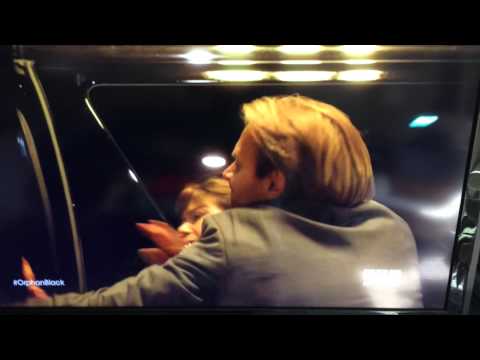
Readers of this blog know that I’m a fan of the show Orphan Black on BBC America (Saturdays at 9:00). It resonates with the transformational and multiplicity themes so active in our culture now. See my post here.
I finally got to see Episode 1 of the new season (2) this morning and I was captivated by this scene.
Apologies for the quality of this clip. I shot it with my phone. Perhaps the show runners Graeme Manson and John Fawcett would consent to put the original up on YouTube. (In fact, the last moment of this clip shows Manson and Fawcell in a Hitchcockian turn. Manson is the camera man. Fawcett is the the man in the glasses.) (See the whole of this episode on the BBC website here.)
I think this clip touches on a couple of recent posts, especially the one on Second Look TV and the one on “magic moments.” You decide.
But the real opportunity here is to comment on a truth in anthropology. My field is, among other things, a study of choice. There are so many ways of being human, of acting in the world, that people must choose. (There is a famous story about a Russian actor proving his virtuosity by delivering the word “mother” in 25 distinct ways.) How will we say a word, make a greeting, or carry ourselves? We have to choose. There are, for instance, lots of ways to do a “high 5.”
We have to choose from all the choices and once we choose we are inclined to stabilize the choice and use it over and over again. It may shift with the trend, and we alert to these shifts, but for the moment, an invisible consensus says, this is how we do the high 5.
But this is not only a personal choice. We make these stable choices as the defining choice of a nationality, ethnicity, gender, region, class, status, and so on. Eventually, this choice becomes a style, a signature way we express ourselves. It is a way we are identified by others.
Hey, presto. Imagine an actress’ delight. With styles, she has a device with which to tell us who her character is and what her character is doing in any given part of the narrative.
Tatiana Maslany, the Canadian actress who plays the clones, has the exceptional task of delivering the “truth” of each clone even as she must make them identifiably different. But of course she is going to use style.
In this scene, she is giving us Alison, the suburban clone. The minivan, pony tail and jump suit label that identity, but then comes the hard part. To show Alison in all her Alisonness. And still more demandingly to show Alison under duress. (Sarah, the street toughened con-artist clone, can handle herself in a fight. The trick is to show Alison making her response up as she goes along.)
There is lots to like in this scene and, reader, please exercise your “second look” privileges to go back and scout around.
I love the moment when we see Alison spraying and blowing. She is after all a multitasking mom.
I love the ineffectual last tweet that comes when she gets pitched into the waiting van, expiration meets exasperation meets astonishment. Who is this man?
I love the small gesture with which Maslany gathers her composure before leaving the van, squaring the shoulders and fixing her pony tail.
And then the wonderful look of dismissal she gives her captor as she closes the door of the van. Alison is back in possession of her suburban self possession. What’s nice about this among other things is that it shows the Alison beneath the Alison. Yes, her self possession has been shaken by this event but where most of us would be wordless and traumatized, Alison is back.
That last moment of the clip, the one in which we see a brief, Hitchcocking appearance from the show runners, I like as well. There was a time when it would be ridiculous to talk about these showrunners and the movie making master in the same breath. But TV is getting so good these days, the comparison is not far off, and closing all the time.
It’s usual to talk about this Golden Age of TV, but that suggests the TV is now completing its glorious ascendancy. And this just seems wrong. With performances like Maslany’s and shows like Orphan Black, I think it’s more likely that TV is just getting started.
Thanks to the anonymous reader who discovered a naming error. (Now corrected.)
A couple of months ago, I had the good fortune to have lunch with Napier Collyns. Mr. Collyns is one of the founders of the Global Business Network and a man with a deep feeling for the rhythms and complexities of capitalism.
I came home and banged out this little essay. It’s an effort to think about the possibility that “value” goes from the material to the immaterial. A company might begin by making hammers but sometimes it ends up making value that is less literal and more broad.
Does capitalism have thermals?
A bigger picture may be called for when we think about capitalism. In his famous essay, Marketing Myopia, Theodore Levitt encouraged people to ask, “What business are you in?” The question had a strategic purpose: to rescue managers from their literalism.
In the early days of the railroads, managers were preoccupied with laying thousands of miles of track. The next generation devoted itself to making a magnificent delivery system for industrial America. With the rise of the automobile, the truck and the plane, things changed. But the conceptual shoe didn’t fall for management until Levitt gave them a big picture. “You’re not in railroads, you’re in transportation.”
There is perhaps an inevitable developmental pressure. As the world becomes more complicated (and capitalism routinely makes the world more complicated), the ideas with which it is understood must become more sophisticated. One minute we’re laying track. The next, we’re wondering how to compete with things that fly.
The only way to grasp the intellectual challenge is to generalize. This helps break the grip of literalism, the one that says, trains are trains and planes are planes. No, says Professor Levitt, trains and plains are the same thing but only if we move to a higher vantage point.
A second thermal comes in the shape of commodity pressure. In every market, incumbents eventually draw imitations (aka “knock offs”) into play. The incumbent is faced with two choices. It can engage in a “race to the bottom” that occurs as incumbent and imitator sacrifice margins until everyone finds themselves mere pennies above cost. (Thus does the innovation has become a commodity.)
Or, the innovator can climb the value hierarchy, moving from simple functional benefits that the imitators can imitate to “value adds” they cannot. Thus did IBM find itself challenged by off-shore competitors who offered bundles of software and hardware at 40% of what IBM was charging.
Customers snapped up these cheaper alternatives, only to discover that the commodity player was not supplying the strategic advice and intelligence that came with the IBM version of the bundle. Now IBM had to learn to talk about this value, and to make more of it. They were obliged to cultivate a bigger picture.
Here’s another “thermal.” Premium players traditionally defend themselves from commodity attack by creating higher order value that almost always comes in the form of idea and outlook. Thus Herman Miller, the furniture maker, confronted by an off-shore competitor that was prepared to make chairs for much less, redoubled it’s effort to sell not just chairs but new ideas for what an office could be. This thermal intensified as new commodity players have emerged from China, India, and Brazil.
Paramecium, Inc.
We could argue that capitalism has thermals from almost the very beginning. In this beginning, enterprise were inclined to be structurally simple, a single cell mostly oblivious to the world outside itself. Call this “Paramecium Inc.” or Level 1. The enterprise makes hammers. It assumes someone out there wants hammers but the focus of attention is on the hammer.
Eventually someone comes along and says, “actually, what the company makes matters less than what the consumer wants.” Thus spoke Charles Coolidge Parlin in 1912 when he asserted that the “consumer was king.” Closing the gap between company and consumer has been a work in progress. New methods, theories, and resolve have come from the likes of Peter Drucker and A.G. Lafley, and somehow the gap persists. But at least the Paramecium is evolving, reckoning with things outside itself. This is Level 2.
In time someone says, “we need to think more systematically about our competitors.” This is the long standing focus of Economics, but in the late 1970s, Michael Porter offered a new approach and strategy proved influential. Here too the organization is sensing and responding to the world outside itself. It is scaling not so much up as out. We are now at Level 3.
With each new Level, we “dolly back” to see more of the world. Our “paramecium” is increasing aware of itself and the world outside itself. This is a movement from the narrow to the broader view, from the local to the global, from the provincial to the cosmopolitan.
Level 4, collaboration, has several moments. The enterprise, once less solipsistic, can entertain partnerships. The organization that once insisted on a crisp, carefully monitored border now consents to something that looks more porous. The Japanese influence helps here. So did the “outsourcing” movement. Most recently, with the advent of new media and digital connections, collaboration expands to include still more, and more diverse, parties.
In Level 5, we are encouraged to see that the enterprise must reckon with the meanings, stories, identities, subcultures, and trends with which people and groups construct their world. Noisy and rich in its own right, culture supplies some of the “blue oceans” of external opportunity and the “black swans” of external threat. A great profusion of consultancies and aggregators springs up to cover culture.
Level 6, context, was once merely a field or container for all the other levels. But now the field has come alive, no mere ground but now a source of dynamism all its own. In this bigger picture, the enterprise can feel itself a tiny cork in a veritable North Sea. Disruptive change comes from all directions. Strategy and planning become more difficult, and some enterprises descend into a simple adhocery. The world roils with deliberate change and its unintended consequences.
There is an intellectual challenge at Level 6. Making sense of a world that is so turbulent, hard to read, and inclined to change is difficult. Indeed identifying the unit of analysis is vexing. Are we looking at “trends,” “stories,” “scenarios,” or “complex adaptive system?” Should the enterprise do this work by hiring x, y or z?
“Context” is a wind driven sea. The horizon keeps disappearing, navigational equipment is dodgy, the world increasingly unfamiliar, inscrutable and new. We are to use the language of T.S. Kuhn, post –paradigmatic.
The movement of levels 2 through 4 has been conducted under expert supervision. But Levels 5 and 6 are vexing partly because there is no obvious intellectual leadership. Even the “experts” are challenged. The problem created by Levels 5 and 6 are simply unclear and we continue to disagree on even simple matters.
Reading this through, a couple of hours after publications, it occurs to me that there is for some corporations a Level 7. This is where the corporation embraces its externalities and takes an interest in the larger social good that can come when the corporation thinks about what value it can create for creatures other than itself.
I was in a strategy session a couple of years ago when a guy from Pepsi, I believe he was actually the CMO (let me check my notes), actually said, “I am committing my organization to solving every environmental problem it has in its purview and can get its mitts on.” Wow, I thought, this is capitalism writ large.
My blog subtitle used to be “This blog sits at the Intersection of Anthropology and Economics.” This was both too grand and untrue. Fine for politicians but not websites.
So now it’s “How to make culture.” For the moment. Also thinking of “New Rules for Making Culture.” Is that better? I can’t tell. Please let me know.
Yesterday, I was blogging about the new rules of TV. And in the last couple of weeks I’ve been talking about advertising, education, late night TV, game shows, culture accelerators. Less recently, I’ve been talking about marketing, comedy, language, branding, culturematics, story telling, hip hop, publishing, and design thinking.
All of this is culture made by someone. And all of it is culture made in new ways, often, and according to new rules, increasingly. Surely an anthropologist can make himself useful on something like this. Anyhow, I’m going to try.
I have four convictions. Open to discussion and disproof.
1) that our culture is changing. Popular culture is becoming more like culture plain and simple. Our culture is getting better.
I have believed in this contention for many years. Certainly, since the 90s when I still lived in Toronto. (It was my dear friend Hargurchet Bhabra who, over drinks and a long conversation, put his finger on it. “It’s not popular culture anymore. Forget the adjective. It’s just culture.”)
This was not a popular position to take especially when so many academics and intellectuals insisted that popular culture was a debased and manipulative culture, and therefore not culture at all. Celebrity culture, Reality TV, there were lots of ways to refurbish and renew the “popular culture is bad culture” argument. And the voices were many. (One of these days I am going to post a manuscript I banged out when living in Montreal. I called it So Logo and took issue with all the intellectuals who were then pouring scorn of popular culture one way or another.)
My confidence in the “popular culture is now culture” notion grew substantially this fall when I did research for Netflix on the “binge viewing” phenomenon. To sit down with a range of people and listen to them talk about what they were watching and how they were watching, this said very plainly that TV, once ridiculed as a “wasteland,” was maturing into story telling that was deeper, richer and more nuanced. The wasteland was flowering. The intellectuals were wrong.
2) This will change many of the rules by which we make culture. So what are the new rules?
I mean to investigate these changes and see if I can come up with a new set of rules. See yesterday’s post on how we have to rethink complexity and casting in TV if we hope to make narratives that have any hope of speaking to audiences and contributing to culture. Think of me as a medieval theologian struggling to codify new varieties of religious experience.
3) The number of people who can now participate in the making of culture has expanded extraordinarily.
This argument is I think much discussed and well understood. We even know the etiology, chiefly the democratization (or simple diffusion) of the new skills and new technology. What happens to culture and the rules and conventions of making culture when so many other people are included, active, inspired and productive? We are beginning to see. Watch for codification here too. (As always, I will take my lead for Leora Kornfeld who is doing such great work in the field of music.)
4) We must build an economy that ensures that work is rewarded with value.
I have had quite enough of gurus telling us how great it is that the internet represents a gift economy, a place where people give and take freely. Two things here. 1) The argument comes from people who are very well provided for thanks to academic or managerial appointments. 2) This argument is applied to people who are often obliged to hold one or more “day jobs” to “give freely on the internet.” Guru, please. Let’s put aside the ideological needle work, and apply ourselves to inventing an economy that honors value through the distribution of value.
I have made this sound like a solitary quest but of course there are many thousands of people working on the problem. Every creative professional is trying to figure out what he or she can do that clients think they want. I am beginning to think I can identify the ones who are rising to the occasion. They have a certain light in their eyes when you talk to them and I believe this springs from two dueling motives I know from my own professional experience, terror and excitement.
(with thanks for Rick Boyko, pictured, for the conversation from which the idea for this blog post sprang.)
Last week Bob Scarpelli and I offered some thoughts on the “magic moment” in advertising. The magic moment is the small detail that helps bring an ad suddenly, unexpectedly to life. Here’s the original post.
We can’t quite say how the magic moment works. What’s worse, we can’t plan for the magic moment or even anticipate it. It just happens.
It is this unpredictable quality that prompts some people in the ad biz to insist that the magic moment is off limits. It cannot be part of the industry’s value proposition, or the way any particular agency sells its ware. After all, if the magic moment is pure serendipity, it can’t be created, managed, predicted, or, least of all, promised. It is a gift from the gods and the gods pretty much do what they want.
Even if a client hires the best agency, with the most robust planners, strategists and creatives, there is just no telling whether a magic moment will manifest itself.
I admire how scrupulous this is. I admire an industry that will not promise what it cannot deliver. But there is another way to make the argument.
Yes, magic moments are serendipitous, but that does not mean they are beyond our grasp. We can increase our chances of summoning the magic moment. We can call it out of the heavens. There are no absolute assurances. But we can increase the odds.
And this is precisely why those who hope for magic moments will spend the time and money to hire the right agency, director of photography, casting director, and actors. These people cannot deliver magic moments but they will act like one of those “listening arrays” with which we scrutinize the heavens.
It turns out magic moments are not truly random. They don’t happen to stupid, talentless hacks. And this means talent does play a role. And this means, at the very least, are chances of a magic moment go up when we are dealing with people with the talent, imagination and intelligence. (And that’s what we pay them for.)
There is some connection. Somehow, talent plays nursery to genius. Agencies and creatives matter. We can summon magic, even when we cannot promise it. In that famous phrase, the gods favor the well prepared.
We may have merely increased the chances of a magic moment by, say, 40%. For the creative community, this looks meager and nothing like a sales pitch. They can’t imagine ever selling anything this way. But for the statistically gifted brand manager, 40% is an opportunity to assess the risk and justify the expenditure. Believe me, what the brand manager does not want to hear is, “Oh, this is completely mysterious. We have no idea how it happens. Just pay us.” But we are wrong to think that “40%. Our chances go up 40%” means little more. Forty percent is something to reckon with.
My conclusion: the ad agency should be selling itself with the magic moment. This should be a way to discriminate agencies from no agencies and good agencies from bad agencies. And it should be the grounds on which agencies justify their fees and the fees attached to recruiting the best talent. We are not guaranteeing magic moments. But we are increasingly their likelihood.
I had a look in on Let’s Make A Deal this morning.
Wayne Brady is the host. Drew Carey is the host of Wheel of Fortune. Both are “graduates” of Whose Line Is It Anyway? Improv has come to day time television
The use of improv comics is a great way to animate a game show genre, now decades old and in danger of becoming formulaic, in spite of all that ingenuity and enthusiasm coming in waves off an extremely “amped” audience.
An improv comedian can turn a split second into something funny and fresh. Hey, presto, new blood for old shows. On Whose Line It is Anyway? Brady was fearless. Clearly, it doesn’t bother him that he was called upon to work without a net. No script. No direction. No advance warning. He could handle anything the show threw at him.
But here’s the question. Even as we acknowledge what Brady gives to the show, we have to ask what the show is taking from him. What is it like for someone this good at novelty to be stuck in something that is rarely very novel at all? I wonder if he feels like those World War II aces who were called upon to pilot space capsules in the early days of NASA. Accustomed to maximum control, they were now, in their language, “spam in a can.”
This is a tension in the entertainment biz. How do we deliver the soothing samenesses that come from genre and formula without creating something that ends up being stupefyingly dull? As it is, Let’s Make a Deal skews way too far in the direction of formula. This doesn’t just test the patience of the TV audience. It must also test the endurance of the host. For someone who can turn .5 seconds into comedy riches, 60 minutes of predictability must feel like an eternity. Five times a week.
Image courtesy of Creative Commons and Wikipedia. Author attribution: DaniDF1995
This just in. We learned moments ago that Stephen Colbert will replace David Letterman on late night television.
We can identify the cultural significance of David Letterman . He came to prominence on the back of a cultural trend, the Preppie revolution. Letterman was the guy who liked to stand in a window in Rockefeller Center and proclaim through a bull-horn, “I’m not wearing any pants.” This was preppie humor, a frat boy prank.
Below is my cheat-sheet treatment of the Preppie revolution as it appeared in Chief Culture Officer.
I would love it if people would give offer a brief account of the cultural movement that brought Stephen Colbert to prominence and the shift in culture his rise represents for us. Don’t feel obliged to give a detailed account. We can make this collaborative. Just take a different piece of the puzzle and I will try to piece together when all “results” are in.
Here’s the passage from my Chief Culture Officer:
The preppie convergence began to form visibly and publicly around 1980, but we if we were astoundingly well informed and gifted, we could have seen it coming ten years before. Doug Kenney founded in National Lampoon in 1970 with staff from the Harvard Lampoon. And we could have tracked the success of this convergence as this publication began to scale up. National Lampoon published parodies of Newsweek and Life, the 1964 High School Yearbook Parody (1974), and a well received issue entitled Buy this magazine, or we’ll shoot this dog. By the end of the 1970s, Lampoon circulation had reached nearly a million copies per month. And by this time even the dimmest trend hunter had it on their radar.
Sales is one thing. We should also be alert to the migration of talent. In the case of the preppie convergence, we needed to be paying attention when the world started raiding the Lampoon for talent. Kenney left to write movies. Michael O’Donoghue left in 1975 to become head writer for Saturday Night Live. P.J. O’Rourke left to write for Rolling Stone. The National Lampoon spoke with the voice of the ruthless private school boy. Apparently this was now in demand.
We should have noticed when the preppie convergence began to colonize the movies. We should have been paying attention when the preppie thing migrated to the movies. Kenney created Animal House in 1978 and Caddyshack in 1980. The first featured Tim Matheson, the second Bill Murray. The prep also appeared in Bachelor Party (1984), played by Tom Hanks. Perhaps most famously, the prep turned up in the 1982 NBC series Family ties in the character of Alex P. Keaton, played by Michael J. Fox. He also appeared in the 1982 late night comedy show in the person of David Letterman who gave voice to prep form by standing in a window of Rockefeller center and announcing with a bull horn, “I’m not wearing any pants.” (Preps loved to be vulgar and clever at the same time. It’s a frat thing.)
Everyday language began to vibrate with new phrases: “go for it,” “get a life,” “get a grip,” “snap out of it.” It was easy to see how these spoke for the new convergence. People were impatient with the old pieties. That was 60s idealism, and people were done with that.
Convergences must shake the webs of the publishing world. (Or they cannot be convergences.) One of the best sellers of the period was Lisa Birnbach’s The Preppy Handbook in 1980. This was 200 pages of detailed instruction: what to wear, where to go to school, what sports to play, what sports to watch, what slang to speak, how to be rude to a salesperson, and how to mix a Bloody Mary. If the National Lampoon had supplied the new character of the decade, here were instructions of a much more detailed kind.
The consensus was visible in public life. Suddenly Harvard Yard, never especially presentable in its architecture, appointments, or personnel, filled with glossy teens in down vests, Norwegian sweaters, and Top-Siders, all newly minted by L.L. Bean. Some of them were the children of Old Money following ancestral footsteps into the Ivy League. But most were kids from Boston University who believed that the Yard was a better lifestyle accessory.
The convergence began to recruit ferociously. A young woman remembers.
As a teenager [my mom] was pulling The Preppy Handbook out from under my [sleeping] cheek. These were the mid-80’s, and I just lapped up all that puppy/yuppie/J. Crew catalogue/Land’s End stuff. I didn’t want to live in Wisconsin; rather, I wished my parents played tennis and would send me away to Phillips Exeter. In fact, I waged a two-year send-Ann-to-Exeter campaign (“or, hey Choate would be O.K. C’mon, at least consider the University School of Milwaukee!”). I wished we summered on Martha’s Vineyard and wore penny loafers without socks. I wanted to ski in Vermont during Christmas vacation like my copy of The Preppy Handbook recommended. […] I wanted to live far away from Wisconsin and my family and come home only at Christmas. As pathetic as it sounds, deep in my soul I wished I owned a navy-blue blazer with my school’s crest embroidered on the lapel and wore grosgrain ribbons in my hair. I daydreamed about the day when I would go to East to college, and I believed I would.1
The preppie convergence would sell a lot of cars for Chrysler (Jeeps) and, eventually, a lot of SUVs for everyone. It would sell clothing for L.L Bean, Land’s End, J. Crew, Ralph Lauren, and eventually Tommy Hilfiger and the Gap. It would sell a ton of furniture for Ethan Allen and eventually Sears. Downstream, it sold a lot of watches for Rolex and a lot of cars for BMW. Eventually, it would serve as the foundation for Martha Stewart and her brand of status. It would shape and still shapes what boomers wear on the weekends.2
The tide turned again. Repudiation was coming. We might have seen, as I did, graffiti on a Tom Cruise movie poster that read, “die Yuppie scum.” Another was Gordon Gecko in Wall Street (1987), a film Roger Ebert hailed as a “radical critique of the capitalist trading mentality.” The prep hero was now tarnished. (Life soon imitated art, with the fall of Michael Milken, the junk bond trader indicted in 1989 for violations of federal securities and racketeering laws.) The third was the movie, Heathers (1989) in which teens excluded by snobbery take a terrible revenge against the preps. The fourth was the publication of American Psycho in 1991. This was, among other things, a vilification of the prep. At this point, the big board should be flashing with warning signals. Something new had made it up out of the college campuses of the world, past all the little gates, and on to the big screen. Pity us if this is our first warning.
I was doing research with teens in 1990 and, almost to a person, they were saying, “well, I guess you could say I’m a Prep, but I don’t really think I am.” Or, more forcefully, “The last thing I want to be called is a Prep.” This was coming from kids who were still wearing buttoned down shirts and Top Siders. Teens were moving on, some to the emerging subculture of rap, some to a brief revival of the hippy regime, still others were taking an “alternative” turn. We do not have access to this data, but we can assume that sales figures for Ralph Lauren, Rolex, BMW, and the other “flag ship” brands of the decade fell sharply. Presumably, furniture and textile stores suddenly found it difficult to move their “duck” and “sailboat” motifs. What convergences give, they take away.
2 For the connection between the prep or yuppie movement and BMW, see Greyser, Stephen and Wendy Schille. 1991. BMW: The Ultimate Driving Machine Seeks to De-Yuppify Itself. Harvard Case Study, 9-593-046, December 27, 1993. Steven Greyser is an Emeritus Professor at the Harvard Business School. Wendy Schille was a research associate at HBS at the writing of this case.
I am doing a Culture Camp in London June 13. Here’s the description. Please join us!
CourseDescription
This culture camp is designed to do two things:
1) expand your knowledge of the big changes transforming culture.
2) develop your ability to put this knowledge into action.
Culture is at the core of the creative’s professional competence. It is the well from which inspirations and innovations spring. It’s one reason startups and corporations need the cultural creative. This culture camp is designed to enhance your personal creativity and professional practice.
1. Knowledge of culture
We will look at 10 events shaping culture.
Half are structural changes.
1.1 The end of status as the great motive of mainstream culture.
1.2 The end of cool as the great driver of alternative culture.
1.3 The movement between dispersive cultures and convergent cultures.
1.4 The movement between fast cultures and slow cultures.
1.5 The shift from a “no knowledge” culture to a “new knowledge” culture.
Half are trends:
1.6 transformations in the domestic world (aka homeyness to great rooms)
1.7 transformations in the scale and logic of consumer expectation (from the industrial to the artisanal)
1.8 shifts from old networks to new networks (especially for Millennials)
1.9 shifts from single selves to multiple selves (especially for Millennials)
1.10 [this one is ‘top secret’ and will be revealed on the day]
2. Using our knowledge of culture
2.1 how to discover culture (using ethnography)
2.2 how to track and analyze culture (using anthropology)
2.3 how to hack culture (making memes)
2.4 how to build a brand
2.5 how to make ourselves indispensable to the corporation
Culture Camp is being sponsored by Design Management Institute and coincides with their London meetings. It is also being sponsored by Truth. (Special thanks to Leanne Tomasevic.)
The image is from Yanko Tsvetkov’s Atlas of Prejudice 2. I am keen to stage the culture camp in Tomato Europe, Wine and Vodka Europe, Olive Oil Europe, and of course Coffee Europe. Please let me know if you are interested in participating or sponsoring.
Culture Camp will be held 9:00 to 5:00 on June 13 at the Royal Institute of British Architects, 66 Portland Place, as below. (Register for the Culture Camp here. You don’t have to be a DMI or RIBA member to do so.
Ads like this are springing up in Toronto as people contemplate the prospect of another term for Mayor Rob Ford.
Ridicule is the order of the day. A decade ago, this would have taken place in Toronto bars and pubs. (In this once Scottish Presbyterian outpost, spirits and mockery used to meet every day after work.) But, hey presto, nowadays people can do a pretty good replica of the campaign sign.
What changed? Well, everything, mostly. The technology is there. Anyone can find a printer willing to bang out campaign signs. But the important change was the willingness to ape the experts and make culture for ourselves. People were once cowed. Making a campaign sign, not just for politicians anymore.
When culture was official, we didn’t dare presume. We didn’t dare make it or fake it or board it or hijack it, borrow it or make off with it, or “have a little fun with it.” We didn’t dare hack it. Now we do.
Phil Jones inserted himself in someone else’s real estate ads.
Goofy realtor smile. Matching shirt and tie. Bad mustache. Ill fitting wig, and all. Phil missed nothing.
People have made their own memorials on Brooklyn Bridge.
D-I-Y memorials. Hacking public space for private purposes? That’s something.
UNICEF hacked the vending machine
A Harvard student hacked the tour of the Yale campus.
Andre Levy, a Brazilian living in Germany, managed to hack the coin of the realm. His art now goes everywhere.
The hacking thing begins, for near-history purposes, with the advent of Punk. Irreverent fans watched a band on stage and said, “Oh, I could do that, only like, way, way worse!”
And remember that jewel of the digital world in the 1990s when everyone was wowed by All Your Base Are Belong To Us? I remember several people saying, “Oh God, anyone can make an ad!”
That’s another difference. Our standards have gone up. We can all dispatch a campaign sign, a painted coin, even a rehabilitated vending machine. This used to be the kind of thing that only MIT engineering students could pull off. Prankster acumen, even this is being democratized.
The spirit of hacking is everywhere. It manifests itself even in your niece who bangs out NCIS fan fic effortlessly and with no sense that she is trespassing on anyone’s creative patch. Every consumer is now a producer, or near enough.
Everyone is in possession of the skill and the gumption to hack culture. It’s just a question of imagination. More and more, the public world looks like an opportunity for intervention. And for the rest of us, everyday will call for the wariness we exercise on April Fool’s Day. Could this be what it seems? Or is my culture being hacked.
Post script
Thanks to Leora Kornfeld for letting me know about Toronto campaign signs.
Speaking of hacking Toronto politics, there is a great experiment taking place on Twitter. It’s the work of someone (I will name him if he lets me) who has taken the name of Bert Xanadu and the persona of the Mayor of Toronto circa 1973. Follow him as @moviemayor. It’s like Groucho got a Twitter account.
For more on hacking culture, see my book Culturematic.
giving a keynote in London for the Design Management Institute.
Here’s the title and the abstract.
Title:
A revolution in the works
how design leaders can master the coming cultural disruption
Abstract:
Some 40 years ago, Robert Venturi asked the design community to decide whether it could “learn something from Las Vegas.” In this talk, Grant McCracken will ask whether there is something to be learned from television (of all things). Based in research he did for Netflix in the fall, McCracken will argue there is a revolution brewing in popular culture that will transform design and design leaders in a fundamental way. This is perhaps the trend of all trends, the most disruptive change in our midst: popular culture is becoming culture. No creatives or creativity will remain untouched. Our question: How can design leaders use this change to make change?
[This piece was originally posted in 2005. It got displaced in a transition to TypePad and this meant it lost its connection to the Samuel Pepy’s Home Page, a connection for which I was grateful. This reposting will generate a new link and I’m hoping Duncan Grey, keeper of the Samuel Pepy’s Home Page, will post the link.]
Samuel Pepys (pronounced “peeps”) kept a diary for ten years, 1660-1669 (http://www.pepys.info/index.html ). He helps us understand the great fire of London, some of the plague years, the aftermath of the English civil war, and the English navy.
Equally important, he helps us see what life was like. We hear him kicking himself for “carrying my watch in my hand in the coach all this afternoon, and seeing what o’clock it is one hundred times.” A man fretting.
For recording the great and little events of the day, Pepys has been given immortality. We read him still.
There is no shortage of diarists these days, not with billions of blogs on line. But will bloggers find immortality? No. This is not just because there are so many of us. The trouble is we assume the things readers will want to know in 100 years.
There are, for instance, countless blog entries from people experiencing the flu. But what history will care about are all the details that struck us as too obvious or banal to mention.
What the “flu” was like, what we took as “medicine.” The “pharmacy” we got the medicine in. The conversation we had with that man in the lab coat. The advice we got from friends. What we wore while recuperating. What we watched on TV. What was illuminated by that faint light in the “refrigerator.” The idea, for instance, of “comfort food.” (What was it? What comfort did it give?) What we talked about on the “phone.” What “emails” we wrote. What happened to personhood? What was it like to be us, as we lost momentum, as our affairs went into suspension, as our life began slowing to come undone. Where did the mind turn in this rare inactive moment. What fretting did we do?
In 100 years, the flu will be an exotic experience. (We read Pepys for his accounts of the plague; we know longer know what this was like.) Historians will hold conferences on the experience of sickness and curing. And they will consult our blogs mostly with unhappiness.
A conference paper in the year 2103:
We have 3.74 million references to “flu” in the blogs of the early 21 st century. We have the medical accounts of what it was and what curing was. But we do not know what it was like as an experience.
These bloggers were talking to one another. They were not talking to us.
But I am happy to report that I have discovered one web log that offers a meticulous record, one might even say Pepysian account, of one flu in one life.
Using the weblog entries of one Sarah Zupko , I intend to show how the “flu” worked as a social, cultural, emotional, physiological and medical event in the life.
With this as my platform, I will seek, then, to illuminate key aspects of everyday life. Sarah Zupko ’s account of the flu she suffered in the 14 th week of their year 2003, in conjunction with other records we have at our disposal, help us to see how the “self” was constructed, maintained and, in a word, lived.
In an odd way, we owe this now vanished virus a debt of thanks. Under its duress, Zupko was moved, meticulously and with rare sensitivity, to reveal not just what it was to be “sick” but what it was like to be a creature of this historical and cultural moment.
Blogs for their time
There are two strategies here.
The first is simply to document everything we can and let history do the sorting. In the case of “blanket documentation,” we don’t need to choose because we seek to capture everything.
1. The blanket documentation: a week’s regime
(do this once a year)
Monday:
Recording place:
Photo documentation:
Home, work, neighborhood, local store(s), other places we go,
Do 5 level of documentation from broad to the individual object
(Clothing, furniture, art, fridge magnets & other possessions)
Photo documentation
Prose documentation
Link the two, prop a photograph of your favorite sweater in front of the computer and describe where it comes from, where you found it, things that happened as you wore it, what it means to you know, how it interacts with other articles of clothing, the last time you wore it and anything else it brings to mind
Thursday:
Recording media:
Music, movies, television, websites
The regulars
The occasionals
The discoveries
Prose documentation of and for each.
Friday:
Recording people:
Diary entries:
Video documentation
Do interviews with everyone who will put up with one. Set up your video camera (if you have one) and leave it standing in the living room (if you have one). When someone comes over, sit them down and ask them these questions… and anything else that occurs to you, and capture anything else that occurs to them.
Saturday:
Review, reflect, spot holes, capture the things we’ve missed
Sunday:
Review, voice over commentary on each of your bodies of evidence. There are two imperatives here:1) capturing the assumptions that did not get onto film and that do not normally get into blogs; 2) showing the interrelationships of all the pieces we have know documents. What are the wholes that organized the parts? What was the lived experience of this world
There will be moments when you’ll think to yourself, “Oh, what’s the point, this is so obvious.” But think about what you would give to have account like this from your life, say, 20 years ago. If would be a dear possession. Think about what you would give to have this account of your father’s life when he was the age you are now. Think about what you give for an account of your great, great grandfather’s life. By this time, you have materials that historians would be pestering you to have a look at.
The “as if from a glass bottom boat” documentation
This is the second strategy. This is the documentation of a single thing, person, place, object, event. It could, for instance, be the flu. Now the trick is to tear ourselves away from the familiarity that, blessedly, makes so much of our experience intelligible and manageable. Only thus can we deliver what historians want (and what we will be pleased to have in 20 years).
There are a couple of aids here. One is surprise. Surprise occurs when assumptions are violated and it represents an opportunity to capture what these assumptions are. I was standing in Grand Central Station last week and a man passed me wearing a burgundy red fedora. It was too stylish to be a prank, too odd to be a simple act of style. It forced me to think about hats and to see the conventions that govern them.
Another is humor. This too depends on violated assumptions. Victorian jokes now strike us as not very funny. And this is because we no longer share the cultural assumptions they assumed and on which they operated. Take a moment of humor and supply the archeology on which they rested.
A third is what the Russians called deformalization. The banal example here is repeating a word over and over until it becomes strange to the ear. (Try saying, “saying” thirty times and see if it continues to deliver meaning as it once did.). The trick here seems to be just concentrating on something for long enough that its “taken-for-grantedness” begins to fall away. Think long enough about a kitchen and this begins to happen with surprising ease. (CxC assumes no responsibility for the dislocation that will follow.)
A fourth might be called the Goffman effect. Erving Goffman sought out the company of people who had forgotten or misremembered the rules of everyday life. They stood too close to him.(Ah, so there is a rule that says we must remain 12 to 16 inches from a conversational partner.) They gave too little eye contact or too much. (Ah, so there’s a rule…) They shouted or whispered. And so on. The trick here is to treat social error as an indicator of social convention.
(A fifth is the alienating effects of drugs and alcohol, but CxC is forbidden from recommending this path to illumination.)
What we really need here are pen pals in mainland China , correspondents who read our accounts and say, “sorry, I still don’t see how this person, place, event, or thing made sense to you.”
Storage
Once you have performed your Pepys scrutiny, burn it on a CD or DVD and send one copy to the youngest responsible member of your family, with careful instructions that they are to do the same in 20 years. Send the other to the Smithsonian. Congratulations, you are now immortal.