
With the Nextpedition, AmEx appears to be taking a Culturematic approach, taking out the predictable and adding in surprise.
See the post by CLICKING HERE.
With the Nextpedition, AmEx appears to be taking a Culturematic approach, taking out the predictable and adding in surprise.
See the post by CLICKING HERE.

My local library recently did a sleep over. Not for local kids. But their toys.
Brilliant. Here, I thought, was a brilliant little Culturematic to change the way people, and especially kids, thought about their library.
Please come to HBR and see the full essay. Click here.

Please come have a look at my essay on (what I take to be) a new profession for people educated in the humanities and social sciences.
I am arguing that they can serve as “assumption hunters.”
Please come have a look. You can find the essay by CLICKING HERE.

In Boston this January?
Come sit in on my course.
Here’s the outline.
MIT CMS.S62
Special Subject: Comparative Media Studies
Time Machine: Building a model for predicting culture
Grant McCracken
Wed-Thu, Jan 18-19, 25-26, 1-2, 03-05:00pm, 4-231
Pre-register on WebSIS and attend first class.
Listeners allowed, space permitting
Prereq: Permission of instructor Qualitative and quantitative skills.
Level: U 3 units Standard A – F Grading Can be repeated for credit
As our culture becomes more diverse and changeable, cultural prediction becomes more urgent and difficult. The point of this course is to build a model for making predictions. We will proceed in a practical way, taking on “real world problems.” How quickly could we have seen the influence Alice Waters and Chez Panisse were to have on American culture? Could we have predicted a shift in Hollywood that demoted the likes of Schwarzenegger and promoted the likes of Michael Cera? To build the model, aka “big board” or “time machine”, we have to solve theoretical and methodological problems: what is the unit of analysis, what are the best markers of adoption, what are the best metrics, how can we make and monitor predictions, how can we represent data according to best “infographic” practice? To my knowledge, a model like this has no precedent. Think of the course as something out of the early Soviet space program. The engineering will be dodgy. Failure is not unlikely. The process will be messy and frustrating. But the outcome is sure to be illuminating and instructive. Plus your heroism is guaranteed.
Contact: Grant McCracken

Here’s my recent post on the HBR website.
It’s about a clever renovation at the St. Regis hotel.
This is, I believe, a great example of creating innovation through a knowledge of culture and a shift in perspective.
See the full text by CLICKING HERE.
I love people who tweet from inside their lives.

Here, first image, is someone tweeting from inside a visit to the printer. (Read from bottom to top.)
[I apologize for the quality of this image. I am using Skitch and WordPress, and this appears to be the best I can do. Click on the image for clarity.]
Confined to 140 characters, a tiny keyboard, and the discomfort of texting while waiting and standing, this can’t be ethnographic in any conventional sense. But what it lacks in cultural background, it makes up in vividness and emotion.
Here, in the second image, is “Johann Gutenberg” reporting the frustrations of having to sit in a meeting that presumes to rally the troops with vapid, brainless generalities. As Johann reminds us, it’s like being forced to witness the death of your own intelligence.

“This close to heckling.” Brilliant.
How many millions of times has this impulse gone repressed in corporate America. Well, why just corporate America? Educational, medical, governmental America, too. There is no shortage of stupid people keen to colonize our consciousness with their personal limitations.
In a more perfect world, we would know who WWGD really is. (I am betting he or she is not really a 15th century goldsmith, not unless someone got their time machine working.) We would also know the person who staged the Sales 101 meeting. The light of public revelation can sometimes discourage stupidity. Not always but sometimes.
I believe Twitter sprang from a technology designed for emergency personnel, people who needed to send tiny messages in the heat of the moment to solve very immediate problems. But it is learning to serve other purposes, and in some cases, and the right hands, it becomes a new observation platform for the study of American culture.

My wife works at a place called Sterling Brands. Recently, the company next door, a fashion merchandizer, left some mannequins by the freight elevator.
In no time at all, Sterling people had “liberated” the mannequins, spirited them into the office and pressed them into service. They dressed them, reassembled them, animated them, reassigned their identities, and generally made them live. The office bloomed with good ideas.
CLICK HERE for the way I wrote this up for the Harbard Business Review Blog.
These mannequins worked as a kind of culturematic for Sterling. They served as a spontaneous experiment. No one could say ahead of time what people would do with these mannequins or the kinds of interactions and provocations they would create. But stuff happened. Creativity flowed. The intellectual and the social capital of the firm grew. The mannequins proved amazingly productive of meaning…considering the fact they just stand there.

The cancellation of the NBC show Prime Suspect is a puzzle worth working on.
There are three good reasons why the show should have succeeded.
1) It was really good television, with writing, acting and work so good that Pam and I just looked at one another after one episode, and said, “Wow.”
2) It had a British precedent, starring Helen Mirren no less. This served as a kind of trans-Atlantic proof of concept. These British shows are not always reliable but they help suggest that a show can work…because it has worked.
3) It had an American precedent. The cable show The Closer worked roughly the same territory (female officer endures hostility of male colleagues before solidarity is established) and it won a large and devoted audience.
So why did Prime Suspect not flourish. Who or what killed it?
There is some suspicion that the problem has to do with our sexism, and more specifically our reluctance to embrace the lead character (as played by Maria Bello).
One internet observer said that the entire show was killed by Bello’s choice of headgear. In his opinion, the thing that killed Prime Suspect was the hat.
But I think we have moved beyond this. Hats may be “unfeminine.” They be “unflattering.” But they are not a deal breaker. Viewers, and critics, are larger, less sexist, than this.
In a nice essay, Melissa Silverstein suggests another reason. She wonders whether American viewers are not yet ready for “a female character that is not 100% likeable. No matter how far we have come on TV with female characters we still are not there with having women who are not likeable.”
This could be right. Refusing to be entirely likeable is an act of self authorship. The sexist model says that women should conform to social expectation whatever that expectation is. To refuse this is to exercise a self determination some viewers might find threatening.
But there’s another possibility, and that’s that Prime Suspect didn’t work because the Bello’s character didn’t care what we thought of her. Detective Jane Timoney gives off what I now think of a very New York quality: as if to say, I am who I am and if you don’t like it, too bad. This is sometimes offered belligerently by New Yorkers, but more often it comes across as the sober understanding that not everyone is going to like you, and while you wish that were otherwise, hey. (“Hey” is the New Yorkers all-purpose word, and here it means, roughly, there are things in the world I can change, and things in the world I can’t, and this is just one of the things I can’t change. It’s a kind of resignation.) This is unexceptional claim when made by a male New Yorker. In a sexist culture, it is something else when made by a woman.
To be sure, this is a little like the likeable problem but it’s a more radical proposition. Not being entirely likable means that I harbor a quality or two you don’t like. Not caring what you think means that I don’t care if none of my qualities appeal to you. This self position is, for the purposes of this show, radically feminist to the extent that it says “social expectations and the sexist model are a matter of indifference to me. I’ve moved on.”
This is even more radical than the image of femaleness we are going to get in the forthcoming movie, The Girl with the Dragon Tattoo. This woman presents herself in a post-sexist language (tattoos and studs and haircuts) but she is engaging sexism by resisting it. The Bello/Timoney performance cuts itself away from the old regime. It leaves the debate. And this is a more radical gesture, a more damning, refusal that any tattoo or stud. And this is to say that Bello/Timoney took up just about the most radical feminist one can take. Perhaps it’s not surprising that Americans were taken aback. All of us are post-sexist to some degree. Only a some of us are post-sexist to this degree.
We have a series of experiments at work in our culture, as our best actresses take on roles and use them as laboratories of a kind. ”Can I be like this?” the actress asks. “Can/should/will women be like this?” everyone wonders. And Prime Suspect gives us an answer. Eventually our culture will catch up to Bello/Timoney. At the moment she is ahead of the curve.

Resolved: that big companies are better at innovation than small ones
PRO
Schumpeter in the Economist reports new research on innovation and the corporation, specifically the work of Michael Mandel of the Progressive Policy Institute
Mandel proposed three explanations for the big corporation as an engine of innovation:
1. The best path to economic growth is the creation of a new product category or operating system. Only big companies, like Apple and Google, can create these. (Plus, small companies may or may not be able to live in the shade of these giant oaks.)
2. Big companies do better in global marketplaces.
3. Only large companies have the scale to address big problems, and many of our our current problems are big problems (education, health care, environment).
Schumpeter adds three more:
4. Big companies have the resources to find and afford the best talent.
5. Big companies are learning to be more porous and more nimble.
6. Big companies now come scaling up out of small ones at a ferocious pace. Some of them remember their origins. They get large without growing out of their smallness.
CON
As Schumpeter notes, conventional wisdom holds that large companies are too slow and clumsy to be creative, that small is beautiful.
Indeed this wisdom is so conventional we tend more to assume than prove it. I wish I could recite all the evidence that supports the CONTRA case.
The only thing I can report is that several people inside the corporate and consulting world have told me how deeply frustrated they are by the corporation’s inability to innovate.
Indeed, to judge from these unscientific results, this is now a critical moment in the history of the corporation. Some few years ago (less than a decade) the corporation decided that innovation was the thing and it devoted itself to centers, institutes, laboratories, skunk works and a range of strategies and tactics meant to deliver innovations out like a major leaguer firing sunflower shells round the dugout.
Many corporations are now on notice: innovation is much harder than it looks. Much, much harder despite vast amounts of money and managerial initiative.
A truth is dawning:
that the corporation can sometimes act like a gravitation field from which new ideas and products cannot escape. Someone has great ideas. Entire teams can have great ideas. But the corporation itself acts like a dark star. It does not create alternatives to itself. It consumes them.
How we do innovation in the corporation must remain high on the todo list for 2012.

Some time ago, I was trying to think about the structural effects of the digital age.
What happens to our sense of self, I wondered, now that we have access to new media and new networks?
I came to the conclusion that selves were becoming “cloudy.”
The world rewarded me with a stoney silence.
No one, apparently, was prepared to buy the idea.
Fair enough. You win some, you lose some. I bow to the world’s judgment.
But today I came upon J. Andrew Hickey’s post entitled The Information Generation.
I was immediately taken by this remark:
Then again, maybe I am too “connected”. Half of my daydreaming is spent in my head, the other half online. To an outsider – typically someone over forty – it must look strange. Blue links highlighted. Flashing windows. Twenty tabs open. Music playing. Headphones on. Lukewarm coffee on desk. Occasionally, I feel less like a person, and more like an amoeba that feeds on tweets, notifications, and followers.
Fair enough. Not a “cloud” then, but an “amoeba.” What matters is some way to capture the new distributedness, porousness and malleableness of the self.
For more of Hickey’s very thoughtful contemplation of what it’s like to live in a digital age, CLICK HERE.
The magnificent image is called Radio Silence. It’s made by Tatiana Plakhova.
For my thoughts on the “cloudy self,” CLICK HERE.

I am a long standing enthusiast of the idea that the TV show called The Wire would make an excellent course for kids in high school. It has richness, drama, complexity.
The thing I like most about it is that it contains many worlds, and this helps make the points that:
A) you have to shift out of your assumptions to capture any of other world, and certainly any of these worlds.
B) you have to shift into the assumptions of any one world to “get” that world.
C) you have to shift from one set of assumptions to another to “get” a show like the Wire or indeed the real world.
(My assumption: if there is a single thing, a single intellectual or cultural capital, that drop outs are unlikely to understand, it’s that there are many worlds outside their own and that with the application of the right ideas, these worlds are penetrable and indeed occupy-able. The cost of a suspended education is limited mobility: social, cultural and career.)
A couple of days ago, I found myself thinking that the only way to construct this teaching “material” is to extract the right footage from the Wire and insert this footage into a map of Baltimore. Mapping helps show that the worlds exist in the world and coexist in the world.
And today, when I was staring at the sign above, I thought, “why not take footage for each world and insert it into a navigable map on line, perhaps Google maps.” This would give us a virtual space a student could wander until he/she/they discover the various worlds and the footage that helps to grasp these worlds and the assumptions that form and inform them.
Mark Warshaw, Mauricio Mota and I have been talking about this project for several years now. Please get in touch with us, if you have ideas and especially if you have funding.

With thanks to Alf Rehn for copy editing the original.
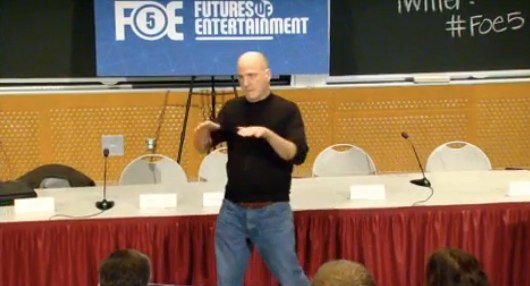
My remarks at the recent Futures of Entertainment conference at MIT are now up. Click here to see it.
It starts slowly. And I now look at the hand surfing with a little embarrassment. In this photo, I am captured trying to demonstrate the mutuality of meaning and value. (My idea of a special effect.)
I was opening up the second day, and Sam Ford has asked me to contemplate what we had heard in the first day.
FoE is always an exercise in severely compromised air traffic control. The moment you think you have a fix on the array, a new idea, fashioned according to unprecedented aerodynamic properties appears in the heavens, and you have to factor this in.
As you will hear, I fix upon the distinction between value and meaning.
We are inclined to think of these as mutually exclusive categories. Value belongs to markets, to pragmatism, to self interest. Meaning belongs to creativity, to exploration, and self expression.
But I think it’s a false distinction. It keeps us from creating two things:
1. a model that would show us how value and meaning interact in our world.
2. a market that would allow us to source new value to fund new meaning.
Have a look at the video to the full argument and please let me know what you think.
I am especially interested to hear from people in the capital markets on the question of whether we could indeed create venture funding and investment markets for cultural projects. (Whether and how we could kickstart kickstarter, so to speak.)

Thanks to Andrew Hazlett, I paid a visit to Shorpy.com today, to do a little “armchair time travel,” as Andrew calls it.
Before long I was staring dumbing at this photo.
Of course, my first reaction is wonder at the sheer beauty of this automobile.
It’s only when I page through the comments that I come across this detail. According to someone called Anonymous Tipster, this auto is a “nicely optioned 1940 Packard.”
It’s only several comments later that Tipster reveals the more telling detail:
“Those speedlines on the Packard look like someone’s attempt at customization.”
At first sight, I accepted the Packard whole. Now I can see as additional those little horizontal lines that appear to issue from the front and back wheels.
The Packard ceases to be “something from a mysterious past” and “a car the likes of which we will never see again.” Now it’s someone’s possession, the bearer of their conceit, their play, their ambition.
Who was this person who felt that his/her Packard just wasn’t fast enough? Who felt it had to be made to look faster, actually moving even when standing still?
And where is this design convention from? Those little lines, I mean. I bet people from some cultures would be unable to read these as speedlines. I bet these come from a graphic design and probably a cartoon tradition, which tradition probably comes from the furiously inventive popular culture of the first half of the 20th century. In effect, our owner was making his or her car look faster by making it look like a cartoon. (Who says this was a rational, technocratic culture?)
My armchair travel brings me first to the car, then to the invisible owner of the car, and then to the culture that helped provide the owner’s customization. Quite a lot of movement for a man stuck in a London hotel room. Thank you to Andrew and Shorpy for this opportunity to get out and about.
To see the photo in context, go to shorpy.com by clicking here.

I am holed up in a London hotel room, sick as a dog.
Paging through, the Times Literary Supplement, I came across this passage:
Throughout his thirty-nine years Vian made up life as he went. When the world declared that his invention did not fit, he spun his own planet, in a parallel orbit, where the laws of Boris applied.
People like Boris are interesting studies for anthropologists, Because most of us are quite fully formed by our culture. It supplies ways of seeing, feeling and acting, and we commit to these.
We do not make up life as we go along. We don’t spin our own planets. And when the world is unhappy with one of our innovations, generally we say, “Oh, sorry! What was I thinking?”
People like Boris should be impossible. So should have been Oscar Wilde, Beau Brummell and that guy you went to high school with, the one who was his own world.
We need to know about how these people invent themselves and then a world.
Reference
Campbell, James. 2011. The Prince of Saint-Germain. TLS. November 11, p. 17