Archive for January, 2005
Beat the system!
Posted by: | CommentsFrom Alex Tabarrok at Marginal Revolution, a link to the Face Analyzer, ‘the only automated face reader in the world. Submit a picture of yourself on line, and the Face Analyzer will rush to conclusions about your character and intelligence.
Here are the ratings Alex got.
Intelligence: 3.9 (out of 4 maybe but out of 10? I am crushed).
Ambition: 3.7 – low. Low ambition? I’ll show them!
Gay Factor: 1.0 – very low. Good, I think. Maybe. Not that there is anything wrong with that.
Politeness: 3.2 – low. Stupid Face Analyzer. What do you know.
Income: 10-30 thousand. Hah!
Promiscuity: 6.1 average. My highest score. Don’t tell my wife.
Alex is right to be unhappy. The Face Analyzer is sure to be used by college admissions and hiring committees everywhere.
Technology to the rescue. Dont like your face analyzer score? You can beat the system! Use the transformational software from the University of St. Andrew: The Face Morpher. Change your gender, age, race, or aesthetics. Watch those Face Analyzer scores soar!
I offer myself up a test subject. I took this image

and asked the Face Morpher to give me what it calls the Afro Caribbean treatment:

Then I asked it to give me the El Greco treatment

I cant help feeling that looking like Derek Walcott and Isaiah Berlin will be good for my test score and my career opps. Of course, I cant find out because the Face Analyzer is jammed. This is what happened when you get a nod from Marginal Revolution, as I know from my own experience.
Watch this space.
Yours truly,

Acknowledgements:
Thanks to the ever-interesting Steve Portigal for the link to the Face Morpher.
The Face Analyzer can be found here
culture and commerce: more muddles in the models
Posted by: | Comments
Theres an article by Clive Thompson in New York Magazine called The Rise of the Microneighborhood.
Examine almost any area of Manhattan these days and youll find it balkanized into a set of breakaway microneighborhoods. (41)
Im an interested, eager reader of Thompsons work: interested because he is a fellow Canadian and in my clannish way I want all Canadians to flourish (except Robert McNeil, of course, Do You Speak American? is so tedious, it should be declared anti-intellectual) and eager because he is a bona fide talent.
But this is outing disappoints.
First, theory has yet to catch up to data. Thompson offers glib explanations for microneighborhoods, saying that the phenomenon is “very much a creature of real-estate opportunism and fuelled by overheated marketing and ‘todays rampant cult of branding. (42)
Then he spends the rest of the article teasing out the many, conflicting factors that help decide whether a new neighborhood gets named and whether the naming takes. We begin to see that declaring a new microneighborhood is a performative undertaking, to borrow Austins term. That is to say, “wishing (or in this case, saying) makes it so but only when several “felicity conditions are satisfied: who is there in the first place (owners, customers, street people, etc), how is persuaded to move in, whether and how the neighborhood is bounded, how investment and value clusters and how long it clusters for.
In sum, the microneighborhood is an “emergent and dynamic phenomenon, the success of which is driven as much by a shifting complex of factors and not only “real estate opportunism and the rampant cult of branding. As Thompson notes in the case of BeBeMo, the naming game sometimes fails.
Its all inside. If Thompson need only conceptualize the factors he describes for Manhattan, to give us a more robust and illuminating explanation. It is in any case time for us to move on from those canards of “opportunism and “cults, so obligatory in the 1990s, to something a little more nuanced. Lets start with the notion that culture (in this case the organization of urban space) and commerce (in this case, real estate investment) do not so much collide as interpenetrate.
Second, this development in the organization of urban space is part and parcel of a larger trend that escapes Thompson altogether. (This cant be true. I should say it escapes mention, not Thompson.) Have we not see a balkanization of music, film, fashion, and just about everything else in popular culture? Is there any reason why the real estate market should resist ths notion? Plainly, Manhattan is turning itself into a real life demonstration of Zenos paradox, but this is one of the signatures of our culture. Can we not see this trend as driven by larger cultural forces?
Third, there is a failure of reflexivity here. Isnt Thompson doing with “microneighborhood precisely what the New York real estate agent is doing with “NOLITA: trying to be the first one name and claim the next new thing? Isnt this the name of the game, at least as New York Magazine plays it: scouring pop culture for the next new “neighborhood. Both Thompson and agent are seeking glory, profit, and, yes, branding advantage for themselves. Indeed, so much of New York City is in on this game, it seems wrong to sneer at real estate agents for doing it and a little odd to hold the journalist apart.
References
Austin, J.L. How to Do Things With Words. New York: Oxford University Press.
Thompson, Clive. 2005. The Rise of the Microneighborhood. New York. January 2, 2005, pp. 40-43.
Acknowledgements
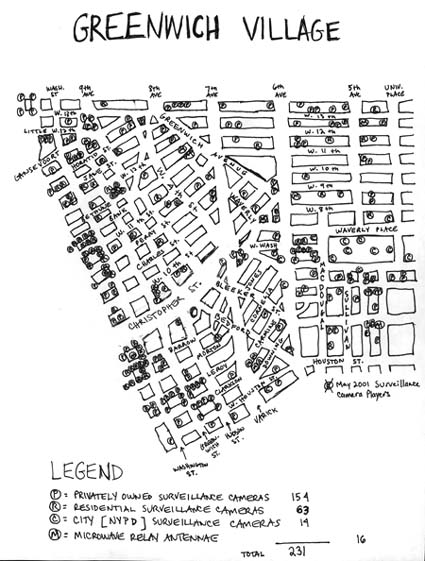
Thanks to NotBored for the map of Greenwich village and the regime of cultural surveillance of which New York magazine and real estate agents are both part.
Tunneling and Economics
Posted by: | Comments
Some of us are trying to tunnel into economics. Others are tunneling out.
Ben Ho is an economics graduate student at Stanford. He notes:
There are economic theories of language, love, persuasion, morality, bias, family, discrimination, leadership and more. [ ] My current research is about apologies. The most daunting part of getting a doctoral degree is that you have to become the worlds expert in some area, however small, of human knowledge. An easy way of accomplishing this is to pick a topic no one else has thought to attempt. The economics of apologies fits the bill, either because I am so creative and clever to come up with it or because no one else has been crazy enough to think it worth studying.
Tunneling is, as Ben notes, high risk and high gain. Theres a good chance that the disciplinary “wardens will open fire from the watchtower, unleash the dogs, and announce, after a few days, “let the swamps do it! And thats the end of you. In Bens diagnostic, youre “crazy or at least malarial.
Not always. There is a small chance someone will say, “A tunnel! Great. Lets scram! In this event, you are considered “creative and clever for having found a way out. At the very least, you get props for inspiring someone to use the word “scram.
The “wardens of anthropology insist that anthropology and economics must keep their distance. (Good fences, blah, blah, blah.) No tunneling! Economics is bad because it insists on methodological individualism and a means-end rationality.
Rational actors making choices? Anthropology isnt interested in individuals but in communities. It isnt interested in choices, but in meanings. It resents the fact that Economics gives itself all the things that enable rational choice: meanings, codes, the conventions of the marketplace, the definition of “value, the content of “interest, the pragmatics of “advantage.
The wardens also believe traditional societies embedded their economies in cultural and social context. The arrival of a less embodied marketplace must spell the end of society and culture.
Two small problems with the warden point of view:
1. It turns out that commercial cultures are more generative, more inventive, more, in a sense, cultural (or at least more culture) than non commercial ones. Non commercial cultures may be kinder, gentler, and more reciprocal, but they are, truth be told, a little like provincial theatre: sleepy, repetitive and a little dull. Yes, we look fondly on this aspect the human experience, but something in us wants to call for a play doctor. And what about casting? And can someone do something about those costumes, please?
2. It turns out the marketplace is not the end of culture but a way of doing culture that we are only now beginning to understand. Somehow, markets make culture not by fiat, not by time-out-of-mind tradition, but in something like real time out of the choices of rational individuals, lots and lots of individuals.
Hayek was among the first to call attention to the emergence of large-scale order from individual choices. The phenomenon is ubiquitous, and not just in economic markets: What makes everyone suddenly drive SUVs, name their daughters Madison rather than Ethel or Linda, wear their baseball caps backwards, raise their pitch at the end of a sentence? The process is still poorly understood by social science, with its search for external causes of behavior, but is essential to bridging the largest chasm in intellectual life: that between individual psychology and collective culture. Steven Pinker on Reason-on-line
Back to Ben. Anthropologies are good at thinking about how the tiny interpersonal exchanges of everyday life (glances, gazes, comment, and, yes, apologies) serve to create “large scale order. They badly need the help of an economist who can help them understand how these exchanges work as economies. Ben Ho has our best wishes. We suggest he also take a flare gun.
References
Hayek for the 21st Century. Reason on line. January 2005. http://www.reason.com/0501/hayeksidebar.shtml
Ho, Ben. 2005. Consider an economics theory of apologies. The Stanford Daily, January 7, 2005 here
McCracken, Grant. 2004. The Economics of the Gaze. here
McCracken, Grant 2004. More on Gaze economies. here
McCracken, Grant. 2004. Just looking around in Manhattan. here
Democrats’ new strats
Posted by: | Comments
CNN has parted company with Tucker Carlson and plans to end “Crossfire.
Given the opportunity to explain, Jonathan Klein, the new president of CNN, said he wants to do “roll-up-your-sleeves storytelling, not “head-butting debate. He agrees with Jon Stewart: partisan talk shows are “hurting America.
Kleins motive? I wonder if its that the Liberal Left keeps losing the debates. Time to roll up the forums on which this frequent embarrassment is allowed to happen.
There is a clear division of media by ideology. The Liberal Left has long controlled American storytelling, especially narrative television and the film world, mainstream and alternative. Its good at story telling and it uses it often to prosecute a “critical angle on things (think Judging Amy and American Beauty).
The Right is good at debate and better at “holding forth. This gave it an advantage in the 80s world of radio, and increasing presence in the world of Talk TV.
Is this a new strategy for the Liberal Left and Democratic party, a way to reposition following the election loss of 04? Go with what you know? Stop picking fights you cannot win? (Of course, its possible that the viewership numbers are not strong for Carlson and Crossfire. The Times article is unforthcoming on this key point.)
But heres what makes me suspicious: Kleins choice of phrase when he refers to “roll-up-your-sleeves storytelling. I take the phrase “roll up your sleeves to be a short form for “lets get practical, lets get serious, lets set aside the posturing and engage with the world.
So whats “roll up your sleeves story telling? Two choices: a) a contradiction in terms, or b) a rhetorical effort to position CNN as the party that does “real,” hard headed journalism as against those posers who merely talk.
If its “B, we are looking, perhaps, at two nascent Democrat strategies: Getting out of debates you cannot win and painting the venues so abandoned as clueless and unworldly.
The world might let you get away with the first strategy. But the second? Please. Let’s hope this is just Klein shooting from the hip. Because strategy “B” is not a strategy. It’s a delusion. And this must be the natural weakness of the story teller: to fail to see the limits of the story telling.
References
Carter, Bill. 2005. CNN Will Cancel Crossfire and Cut Ties to Commentator. New York Times. January 6, 2005. subscription required here
blogging: what it’s for, how it pays
Posted by: | Comments![]()
What is blogging for? How does blogging pay? I have a couple of "answer candidates.
1. What is blogging for?
I have a friend whose mom, an avid gardener, retired to West Africa. If Mom doesn’t like the look of her new garden, she only has to replant, and, hey presto, she has something new and fully formed in a couple of weeks. Things grow so fast, Mom has taken to experimenting. "What would happen if we made everything blue? Twelve days later, she knows.
Blogs are experiments. Each of them says, in effect, what happens to this way of thinking if we apply it to a variety of topics for an extended period? Do the ideas flourish or wither? Do they evolve or merely repeat? Do they scale up in their complexity, or, forgive me, bog down.
If things go well, I guess, blogs go off like an alpine ecosystem: tiny flora make a platform for minor flora which make a platform for major flora. Pretty soon, there’s a forest on a slope. Actually, in the best case, blogs "terra form." By steadily converting ambient resources, own and others, they create a sustainable intellectual space where none before was possible. They make their own worlds, and so prove the possibility of these worlds. They "discover" worlds by creating them.
To be sure, we can’t intervene or experiment as my friends Mom does. Bloggers are notoriously resistant to external influences when these are unsolicited. But then we probably don’t have to intervene. There are so many blogs out there, any thing we might want to try is probably happening on a "naturally occurring" basis. Curious about a libertarian take on the politics of the opera world on the eastern seaboard? It’s out there somewhere.
One of the key questions here ("loose concept/sliding metaphor" alert) is whether the blog is actually ventilating. Anyone can build a little world sui generis. Just bang away at our favorite topics often and at length, and Bob’s your uncle. But good blogs inhale data before they exhale comment. And we expect them to address the big issues in a timely fashion (the presidential elections, say) even as they show a certain imagination and versatility in finding issues not now on reader’s radar.
A friend at Cambridge did his thesis on the epic poem and he was particularly interested in the notion of the "sustain." Could the poet sustain themes in large and small over the vast architecture of a poem? And this is an issue for blogging. Some people are entirely without themes and pretty completely episodic. Others are the captives of a few mighty themes and their slavish repetition. All of us hope for a sweet spot: a body of smart and various themes that organize without compressing discourse, that give us analytic range without costing us focus, that give the blog an exoskeleton without specifying what it must look like day to day.
To put the matter more honestly: every little blog is buffeted by the high winds of a dynamic culture even as it has its favorite "go to" ideas with which it is most comfortable making sense of the world. This is, I think, pragmatic sweet spot of the blogging world. The real challenges here, I guess, is constantly to cultivate and enlarge the "go to" ideas without taking on or forswearing too much of the world in the process. Our sweet spot should be the smallest, most powerful ideas that illuminate the largest, most various parts of the world most cleanly. I do realize there is a notion of parsimony here that the "po mo" party no longer cares about or thinks possible. But it is worth pointing out that it is precisely this parsimony that gives a blog its claim to something like an identity and a readership.
Finally, blogs are tests. Can the blogger sustain a discourse that is recognizable but cannot be anticipated, in which utterances play back constantly in the reformation of the code from which they come, over a set of applications that is neither too small or too large, out of which emerges a way of thinking that draws from, touches on, but does not duplicate other players in the field, in the creation of an "idea space" that is disciplined and reckless, venturing and themed, marshaled and fecund, and finally, getting some where? This is hard, and this is the test of blogging.
And the test of the test is the sheer daily press of blogging. We have to do it every day, or just about every day. And this means we are, as journalists are, forced to go with what we have, forced to live with the imperfections of the moment and the limitations of our "art." You can’t be precious. You have to go with what you know. This puts you in intimate contact with your own limitations, and now you have an additional carrying cost: a certain self loathing. But constant bloggers are a lot like journalists, professional athletes, theatrical performers. It isn’t perfect? Of course, it isn’t perfect. Just do it. "Good enough for television" is a phrase most bloggers would recognize.
Tomorrow, the second question: how does blogging pay?
Herding cats: a new model for management
Posted by: | Comments
Unilever is up against it. In 2003, it needed 234,000 employees to net $3.5 billion. P&G needed half that number of people to net nearly twice as much ($6.5 billion).
One strategy is to rationalize the famously sprawling structure of the company. This is a good thing. Far flung companies are not just expensive to run. They can be ponderous and unresponsive.
Another strategy is to insist on global approaches. Country managers for Dove are no longer able to modify packaging, formulation or advertising. Knorrs soup and bouillon cubes, a $2.7 billion annual business, is no longer produced and designed as locally as it once was.
Economies of scale are a good thing too. But you cant read todays Wall Street Journal without thinking that Unilever is playing out a traditional view of management.
Simon Clift is head of marketing for Unilevers home and personal care division. In the WSJ piece, he says, that there used to be so many local players in the new product development process, it was “like herding cats. There were no strategic priorities at all. Clift has imposed a new regime: “Recently a major region wanted to launch a new packaging for Ponds face cream. We said, No. Gone are the days when you can decide packaging locally.
The trouble is that some consumer taste and preference comes increasingly from its local context. (We may define “local variously: national, regional, urban, ethnic, linguistic, cultural, subcultural, neighborhood, class, age, lifestyle, etc.) In this various marketplace, giving the local player some control over the formula, the package and the advertising is probably a good thing. Ironically, Unilever appears to move away from this approach just as the rest of the world is thinking hard about whether “herding cats might actually be a new model for management.
There is a “paradigm problem at the root of this. The old management model was an Enlightenment project. The manager sought rationality for a corporation that, left to its own devices, devolved into superstition, localism, the unsystematic, and the increasingly variable. Efficiency escaped this organization like heat from a New England barn. There were many enemies of great strategy. Local knowledge and practice was one of the most pernicious.
The new model says that the corporation must forsake its Enlightenment pursuit of single rationalities and find a way to respond to the variability of the marketplace. How does the corporation read and capture local variation and build this back into the products and services that go to market? This will be messy and difficult. It will take a thorough rethinking of some Enlightenment impulses and a reinvention of the management handbook. But it will happen. Local variation is growing, and it is now one of the great competitive opportunities in industries, sectors and product categories where just about everything else has been tapped.
The “herding cats model of managements discourages some aspects of ‘the vision thing, and the idea that corporations must be run with a great thundering idea that come from on high, obliging every subordinate to demonstrate fidelity to Rome, and make themselves the vessels through which the idea passesin one direction only. (Actually, the Catholic church was pretty good in some cases in absorbing local practice and there may be something we can learn here.)
We are now looking for something a good deal more dialogic, where the locality streams intelligence back from the periphery and accommodation out into the world. No, this wont be that awful California “sharing and caring regime that says that everyone must be heard and every idea is precious. The dialogic is sometimes mistaken for the idiotic, but lets not make that mistake here.
The solution has to be some center periphery model that says, first, that the center is constantly fed intelligence and inspiration from the periphery, and, second, that the centre responds with something like “strategic vistas that establish parameters within which the locals may make choices. There has to be a fail safe provision here as there is in the Delphi system. Locals must be given the option of insisting on their own course of action but these exceptions must be very carefully justified and they must pay out if the exception is ever to happen again.
The corporation is the most nimble, adaptive, transformative thing in our worlds. But it is only beginning to master the full range of its responsiveness.
References:
Ball, Deborah. 2005. Despite Revamp, Unwieldy Unilever Falls Behind Rivals. WSJ. January 3, 2005, pp. A1, A5.