Tag Archives: marketing

Nike vs. Skechers: How to battle a brand titan

What does the Marketing 101 tell us about fighting titantic brands?

We have several options.

One is to to play the "size" card.  We use our smallness to be more nimble.  As trends in consumer taste and preference change, we change too…faster than the titan can. If we’re really lucky, we will catch one big trend, early, and ride it to market shared.  (Think Snapple.) 

Another option is to play the "intensive" card.  The titan is trying to be all things to all people.  We try to be one very particular thing for one particular niche.  

The last is to create a competitor so unprepossessing, unattractive, and dubious that no us takes you seriously…until it’s too late.

This appears to be the Skechers strategy.  I haven’t done a thorough search, but it looks like Skechers took the low road.  Product design, the advertising, naming, the product proposition, they all scream awkward and untutored.

Now, of course, this could be an expression of the limits of the Skecher team.  But it could be something craftier.  I mean, it’s almost as if Skechers is being deliberately gauche. 

What a good strategy.  This is the only way to take Nike on.  Talk about a formidable marketing team.  Yikes.  The chances of competing face to face, well, you’d have to get up pretty early in the morning.  Actually, you wouldn’t be allowed ever to go to bed.  No sleep ever.  And you’d still lose.

Not to get too "little grasshopper" about it, but the only way to take on Nike is to use their strength against them.  They expect the competition to look like them, to hold to the same standards, to exhibit the same formidable professionalism.  So when Skechers comes shambling into the arena in sweat pants and throwing around dubious fitness claims, the Nike people must have said, "Please."  It was like a Double A baseball team wandering into Wrigley Field.  Clueless was the perfect Trojan horse, the way to sneak into the market without setting off alarms.  

This is always the weakness of a formidable enemy.  Their self love prevents them from taking certain enemies seriously.  It’s said that one of the reasons the German mercenaries fighting the American revolutionaries lost the first few engagements was that they had a hard time taking seriously farmers wielding ancient weapons and pitch forks.  By the time they summoned their professionalism, the Americans had won just enough engagements to create the impression that they could take the whole thing.  (Which I believe they did. Check your own particulars.  I’m a Canadian.)

Again, I haven’t done the research.  I am just judging things from the externals only.  I mean Skechers stealing a market from Nike.  It’s like learning the Bridgeport Bluefish just gave the Yankees a whipping.  It seems not just unlikely.  I would have said it was statistically impossible.  But it is precisely when things are impossible that hidden assumptions give the cunning competitor a way in.

References

Townsend, Mike. 2010. “’Toning’ shoes gain traction.” MSNBC. September 6. http://www.msnbc.msn.com/id/37510162/ (Accessed September 30, 2010).

time colonies, time colonists: next new thing in marketing?

Until his death in 2000, Dennis Severs lived in London’s east-end in a house that had no running water, no electricity, no toilet, no shower, no toaster, no TV, no modern conveniences of any kind.  

Mr. Severs had done his best to take up residence in the 18th century, and he and his butler managed a pretty good job of it.

You could tour Mr. Severs’ house and as a limited version of time travel, it was a lot of fun.  I got a closer to the 18th century, even if I never felt I was moving away very much from the present day.

Historical recreations like the one by Mr. Severs, Colonial Williamsburg and Upper Canada Village give us a vivid sense of difference. When I was at Upper Canada Village, one of the visitors asked one of the staff, "So what’s it like to live without a car?"  The answer, "What’s a car?" gave everyone a nice little shock.  

The question is this: how and how long would we have to live in a historical recreation to begin to to lose touch with the present day in a useful way.  Human beings are wonderfully adaptive. We begin to recalibrate immediately. A couple of hours and we are sliding out of many assumptions and arrangements.  A couple of days, and we are well down the slippery slope and this close to Stockholm syndrome.   

The reason this is useful for marketers is the shock of reentry.  So much of good marketing is "getting our head out of the bucket" and "thinking outside the box" and otherwise relieving ourselves of the assumptions that prevent us from seeing what is "right before our eyes."

As Andy Grove puts it in his very interesting Only the Paranoid Survive: 

“All business operate by some set of unstated rules and sometimes these rules change—often in very significant ways.  Yet there is no flashing sign that heralds these rule changes. […] The trouble was, not only didn’t we realize that the rules had changed—what was worse, we didn’t know what rules we no had to abide by.”

Time travel really helps here.  Spend a couple of days in the 18th century and we would be gifted with sight.  Indeed, a couple of days in the 18th century would be worth its weight in ethnographies, focus groups and brain storms.  Things would just become ever so clear. Grove’s "unstated rules" wouldn’t be unstated anymore.

Hurray for someone.  There must be many people who would like to live in the 18th century or the 7th one for the matter.  I mean, who wants to live in the real world?  Most of us do it out of necessity and under protest.  Or we could take turns staffing the past, on our vacations possibly.  Every so often someone from the present day would come wondering in, clearly unclear on the rules in place.  Patiently, we would ask her "what’s a car?" and ever so gradually the visitor would begin to watch her unstated rules explode like overheated party balloons.  

References

Artley, Alexandra, and John Martin Robinson. 1985. The New Georgian Handbook. London: Ebury Press.
 
Grove, Andrew S. 1999. Only the Paranoid Survive: How to Exploit the Crisis Points That Challenge Every Company. Crown Business, location 362 in Kindle format.
 
Severs, Dennis. 2002. 18 Folgate Street: The Tale of a House in Spitalfields. Chatto & Windus.
 
Next time:
 
Time colonies and travel for consumers.
 
(I am hoping I can pull this off.  At the moment all I have is the new Arcade Fire album on the suburbs and their magnificently interesting website that let’s us go home again.  The album may be hackneyed but this website, Negro, please.
 
Here’s the Arcade Fire http://thewildernessdowntown.com/
 
If you have other examples, for crying out loud, let me know.  Press time approaches.  
 
Acknowledgments
 
Thanks to Anne Moscicki for the Arcade Fire reference and to Jenson Bennett for the Andy Grove reference.  

Low Fidelity culture

A couple of days ago, Addy Dugdale observed a paradox:

One of the things that excites people most about technology is that it is seen as a gateway to the future. So how does that explain the recent glut of lo-fi adverts, software, and user interfaces that seem to be being spewed out by so-called hi-tech companies?

Addy offers into evidence a Rube Goldberg ad from Google Chrome.  Very low fi indeed.   It show tests begin performed on the speed of Chrome versus the speed of sound, lightening, and a potato being fired from a gun.  The lab looks like a mechanic’s garage in the 1950s. It is manifestly the world of an enthusiastic amateur pretty much flying by the seat of her pants.  It’s all very duct tape and “there, that should hold it.”  This is the kind of lab where you really only feel  comfortable in full body armor. 

Addy’s right.  The paradox is palpable.  On the one hand, we have digital perfection, a search engine that returns millions of results with great speed and precision.  On the other hand, we have a world of improv and accident where anything can happen and usually does. 

We have seen this paradox before.  Sara Winge pointed out a couple of years ago that many of her friends who work in the digital world spend some of their spare time works on projects by hand.  There is additional evidence everywhere, including magazines like Craft and now a book from Make editor Mark Frauenfelder called Made by Hand: Searching for Meaning in a Throwaway World.

Addy gives us this useful glimpse of another cultural producer of this Lo-Fi effect for which I’m grateful.  (I hadn’t seen it before.)

The high priest of lo-tech sensibility is, without doubt, Michel Gondry, whose devotion to the handmade and hand-drawn knows no bounds–don’t forget, he directed a episode of Flight of the Conchords, starring the ultimate amateurs, Bret and Jermaine. Gael Garcia Bernal’s character Stephane in The Science of Sleep, whose set design was part Rube, part craftsy, says this: "I think people empathize with what I do, because it comes from here [my heart]." Gondry’s 2008 movie Be Kind Rewind explores the whole hand-made theme. A viral for the Tomorrow Awards, a competition that celebrates technological excellence in advertising is pure Gondry.

I think there are three drivers of this paradox. 

The first is a simple nostalgia.  That 50s laboratory was a nightmare of inefficiency.  Indeed, in the 1950s nothing worked especially well.   The mechanical world was shot through with imperfection and accident.  Thanks to several factors, now it works pretty well.  And because human beings are in our very souls contrary, ungrateful creatures, we now hanker after the world we have lost. 

The second is a wish for a kind of groundedness.  As the world got digitized, the grammar of everything was now beautiful organized and streaming 1s and 0s.  There almost no moving parts on my iPad.  It operates with silent precision.  So there is something kind of wonderful about tech with seams, levers, nice, big dials and moving parts. 

Digital products are silent and slightly accusatory.  They give nothing away about their internal operation, because frankly, they seem to say, you wouldn’t understand it anyhow.  Naturally, we love the Italian, nearly operatic, full disclosure of Lo-fidelity tech that discloses not just what it does but how it does it.  This is candor we can believe in.

Now that we can buy a video camera capable of very high fidelity, we like the imperfections of the Fisher-Price PXL2000, aka PixelVision, aka  KiddieCorder.  Actually, something in us requires the imperfections of the PixelVision.  (And that’s why it was one of the cult objects of the 1990s.)  Now that we can capture a perfect image, the PixelVision seems to promise a larger, poetic truth.  In a world of post mechanical perfection, we love the the actual, the manual and the mechanical.  It grounds us.  It lets us back in.  Most important, it flatters us.  (It appears to care what we think, and for this small concession we are deeply grateful.)

Third, and here we must reverse fields entirely, we love the Lo-Fi aesthetic because it is a pretty good symbol of what the world is now.  The new tech world may be  rational, exact, dependable, reproducible.  But the cultural effects are entirely opposite.  They profuse, individual, unpredictable and all a great big muddle.  Using the new technologies our culture is decentralized, distributed and busted out all over.  It proceeds with scant regard for editorial direction and elite control.  We are in the phrase created by Errol Morris, now Cheap, fast and out of control.  We have many players and an immense number of plays.  Indeed, Morris’ title seem to take on unintended significance precisely because it feel like it captured a world where everything was happening all at once. 

In this world it is as if we all occupy our own little laboratories.  We have the knowledge and the means of production that would only have to come to us if we has signed up as full time film makers, journalists, academics.  And now that we live outside these institutions, we are very largely flying by the seat of our pants.  I spend a good deal of time tapping the big dial of laboratory instruments, wondering if this reading, so interesting, is reliable.  I am, as we all are, Victorians authorized to produce new kinds of culture by the conviction that, “hey, if you us, who, if not now, when?” 

This aspect of the Lo-Fi aesthetic isn’t nostalgic or compensatory.  This aspect is tapped into what our culture is now. We have the feeling that at least metaphorically our future is going to look very like this past.  

References

Dugdale, Addy.  2010.  Lo-Fi Design is Conquering the World of Tech.  Fast Company.  June 10. here.

Frauenfelder, Mark.  2010.  Made by Hand: Searching for Meaning in a Throwaway World.  New York: Portfolio. 

McCracken, Grant.  2006.  The Artisanal Trend and 10 Things that Define it.  This Blog.  November 6.  here.

Flash marketing

What’s the hardest thing in the world to market?

Exactly.

Opera.  

It can be difficult, elitist, inaccessible, and as if this weren’t enough, it’s in a foreign language.

What do you do?

If you are the Opera Company of Philadelphia, about a month ago, this is what you do.

See the YouTube evidence here.  

Acknowledgements

Thanks to Craig Swanson for the head’s up.  

Handmade marketing

It’s turning out to be a long march.  Some 50 years ago, marketers made mass meanings…for mass markets…with mass media.  Nowadays, people are crafting brand meanings very much more particularly, making micro meanings…for micro markets…with micro media.  

At the extreme, this would mean making entirely custom meanings for very individual individuals with ever finer instruments of meaning manufacturer.  But we are some way off. And we may never reach that station.  

Still we get glimpses time to time of a world of absolute particularity.  Rob Walker and colleagues at Significant Objects give us objects to which meanings have been added in acts of handmade marketing.  It’s pretty astounding.  And of course, we know that some consumers are customizing like crazy.  

And look at this.  It’s a passage from a review of The Hare with Amber Eyes: A Hidden Inheritance. By Edmund de Waal. (Chatto & Windus in the UK, and as The Hare with Amber Eyes: A Family’s Century of Art and Loss by Farrar, Straus and Giroux in the US.  Not till August.)

But Mr de Waal, a noted British potter and ceramicist, is intently concerned with “how objects get handled, used and handed on”. For him the netsuke, so small and captivating, were not enough as a mere signpost to a family history. He wanted “to know what the relationship has been between this wooden object that I am rolling between my fingers—hard and tricky and Japanese—and where it has been… I want to walk into each room where this object has lived, to feel the volume of the space, to know what pictures were on the walls, how the light fell from the windows.”

And, wonder of wonders, this is exactly what he achieves. We learn not only how the light fell from the windows, but how it reflected from the carpets and brocades that vied for attention with the netsuke nestled on green velvet in their black lacquer vitrine, and how it grew greyer when wartime privations in Vienna limited the cleaning of the glass. We learn about Viktor’s nervous tic of wiping his hand across his face as if rearranging it, and the way Emmy would spend 40 minutes having her curls pinned one by one to the brim of her hat for a day at the races, and at what times marching bands paraded past their windows and what epaulettes they wore, and how Charles carried his cane and arranged his paintings, and the mix of awe and sensuality that he must have felt as he picked up a netsuke and turned it over in his hands. From a hard and vast archival mass of journals, memoirs, newspaper clippings and art-history books, Mr de Waal has fashioned, stroke by minuscule stroke, a book as fresh with detail as if it had been written from life, and as full of beauty and whimsy as a netsuke from the hands of a master carver. Buy two copies of his book; keep one and give the other to your closest bookish friend.

Fantastic.  This is a kind of retroactive meaning making.  It take it it’s mostly surmise.  But what surmise!  By constructing the life of the object, and it’s life in the lives of people and other objects, he gives us a feeling for the nuance with which objects take on and give off their meanings.  Not to mention inspiration for those who wished to make marketing by hand. 

References

Anonymous.  2010.  Review of the Hare With Amber Eyes.  The Economist.  May 22.  here.

Significant Objects here.

Home

Does Buzz Need Batteries? (thoughts on viral marketing)

Brandweek yesterday:

More brands will compensate bloggers and social media users in an attempt to generate chatter about their products, a new study found.

PQ Media said such "sponsored conversations" — which compensate social media users for discussing brands’ products — grew to $46 million in 2009, a 14 percent increase from a year earlier. Even so, that figure represented a tiny chunk (2.7 percent) of the word-of-mouth marketing category, according to PQ.

The firm now forecasts what it terms "social media sponsorship spending" to rise 26 percent this year to $56.8 million.

What should we make of this? 

One interpretation: that buzz marketing does not go unless pushed, that buzz needs batteries. 

And this is a problem for a couple of reasons. 

1) Paid buzz bloggers would become advertisers by another name.  (In what sense is “sponsored conversation” a conversation?)

2) The credibility and authenticity of blogger enthusiasm would be open to challenge.

3) The viral model may not actually work. 

Ten years ago, Rick Levine, Christopher Locke, Doc Searls and David Weinberger published The Cluetrain Manifesto.  Marketing would never be the same.  “Marketing as conversation” wasn’t a perfect metaphor, but it was a liberating one.  It helped corporations see that idea was not to shout at consumers but to converse with them.

As Manifesto was making friends and influencing people, another idea began to exert itself.  Buzz marketing, let’s call it, was suddenly everywhere.  The idea now was to “go viral.” 

Some marketers returned immediately to form.  “Virality.  Perfect!” they said, “We’ll get consumers buzzing about us!”  No sooner had marketers glimpsed the possibility that marketing was a conversation than some decided to make the conversation about them. 

It was that old joke all over again: “well, that’s enough about me, what do you think about me?” 

The truth is simple.  Consumers don’t necessarily care about brands.  They care still less about marketers.  They care about what they care about, and it is up to us to find out what that is.  It’s up to us to join the conversation.  There is little chance that we can start this conversation, especially if all we want to do is to talk about ourselves. 

The year 2012 will be the 100th anniversary of the phrase “consumer is king” as invented by Charles Coolidge Parlin.  The metaphor has plausibility problems of its own, but it proved influential and it remains active.  It was marketing’s way of remembering “it’s not about us, it’s about them.”  This is another way of saying that we have been thinking about this problem lesson for around 100 years.  When does the penny drop?

Clarification: This is not an attack on viral marketing.  This is an attack on viral marketing that insists on making the brand the stuff of the buzz.  We have plenty of evidence that the corporation and marketer can create content that consumers are keen to consume and communicate.  This viral marketing is a contribution to marketing only because it is first of all a contribution to culture.  The Ford Fiesta campaign is I believe a good case in point of this kind of viral marketing (see my remarks below).

References

Levine, Rick, Christopher Locke, Doc Searls and David Weinberger The Cluetrain Manifesto: 10th Anniversary Edition.  New York: Basic Books. here.

McCracken, Grant.  2010.  How Ford Got Social Marketing Right.  Harvard Business Review Blog Conversation.  January 7. here.

Morrissey, Brian.  2010.  Paid Brand Conversations to Rise.  Brandweek.  Subscription fees may apply. May 11.  here.

For more on Parlin, see his entry in the Advertising Hall of Fame here.

Tito’s versus Sailor Jerry (new cliches in the world of marketing)

A few years from now I think we will look back on the artisanal trend and spot a cliche.

Artisanal products believe themselves to be intrinsically interesting. They are in fact massively self absorbed. They do not tend to carry culture meanings except about themselves. Artisanal products, it’s all about them.

Exhibit A

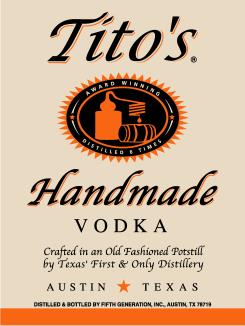
Tito’s is a small run vodka now being made in Austin, Texas. It was recently written up in Wall Street Journal Magazine. The first thing that Tito’s wants you to know about itself is that its hand-made. I am never sure what this means when it comes to certain products. It sounds more laborious than crafted. What does it matter how the grain was stirred? A machine or by hand, it can’t matter to the vodka. Right?

The WSJ Magazine article is a marketer’s dream. This kind of coverage for this kind of audience!  Who could ask for anything more? This is hand made marketing!

But the story reads as all the artisanal stories do.  It recites the new cliches:

1. This brand is made in tiny batches in an obscure place. Check.

2. It is made by some guy who used to work for a giant corporation. Check.

In the Tito’s case, the guy is Tito Beveridge, a geophysicist worked for an oil company. Every time someone tells me about an artisanal chocolate, the maker seems to be a former NASA  or airline pilot.  And I think we are supposed to marvel on how this individual is found his or her artisanal salvation.They have followed their bliss out of the big bad corporation into something kinder and gentler. I’m not sure but I think we prefer to think of our artisanal producers as large and ambling, if men, and little and pretty, if women.  Look, not a threat to anyone!  Nit wit, please. 

3.  It is always premium priced and incredibly high end, because well someone seeking their artisanal salvation is not going to look for it in price cutting or any thing so vulgar as market competition.  The artisan is, it turns out, too good for capitalism of any conventional kind. Check.

4.  There is always a long period in the wilderness when the artisan struggles to keep his or her dream alive.  What a brave, devoted soul!  And finally of course there is triumph. Because the Romance playbook tell us that all acts of self sacrifice result in an apotheosis. Virtue becomes celebrity.  (Pursue the intrinsic and the world will reward you with the extrinsic.)  Check.

5. There is an odor of vanity and self importance about the brand and it’s maker…and, sorry, it’s consumer.  We are all so very special.  (Bitter?  A little.  Being a month without a blog hurt me, clearly.)  Check.

Traditionally, marketing has been about meaning making.  And recently we have seen marketers define brands with meanings ever more subtle and interesting.  But the artisanal trend seems to run against the flow.  There is only one meaning contained in an artisanal brand, the artisanal one.

There’s no question that this myth is a potent meaning and it adds to our story telling at the bar at a time when we like to be telling stories at the bar.  But damn it if it isn’t always the same story.  For some reason, the artisanal trend gives us license to make the back story the front story, even when it isn’t very interesting and even when we have heard it before. I guess it’s better than connoisseurship ("so very peaty!") but for how long?   

Which brings me to Sailor Jerry’s.  I got to hear its creator at the recent Piers Fawkes’ PSFK recent conference in New York City, and it was pretty interesting.  Steven Grasse struck me as being a bit of a mad scientist, my highest compliment these days.  But the brand isn’t about him.  It’s about Norman Collins, the man they call the master of the old school tattooing. Here’s what the Sailor Jerry website says about him

If you really want a true classic tattoo, you’ll have to go back in time and cross the Pacific. When your tramp steamer hits the port of Honolulu, jump ashore and head set straight to Chinatown. Soon, you’ll hit Hotel Street. You’ll know this by the sudden progression of wide-eyed sailors, foul-mouthed roughnecks, and general sanctioned mayhem. And there, tucked away on a steamy side street, you’ll see the bright red neon glow of “Sailor Jerry’s”- the tattoo shop that marked the fighting men of the Pacific for nearly 40 years.

Now that’s what I call a story.  Not some NASA engineer looking for redemption but a rough neck who lived surrounded by mayhem and the low life. Not a brand but a brander. Please start your story engines now.  

References

Carrigan, Janelle.  2010.  Proof of life.  Wall Street Journal Magazine.  March.  pp. 30-31.  

McCracken, Grant.  2006.  The Artisanal Trend and 10 things that define it.  This Blog. November 9.  here.

The source for the Sailor Jerry passage here.

Acknowledgements

Thanks to Michael Margolis, I am thinking more about story telling these days.  See his website here.

Buy this product: we have writers standing by

Today Very Short List pointed us towards a site called Unhappyhipsters in which images like the one above are fetched from the pages of Dwell magazine and then given small narrative indicators that give them new meaning.

"It become their routine…"  Wonderful.

Last week, on the post on Significant Objects, I contemplated a commercial world in which new products came with narratives attached, new meanings, which we could use to reimagine our present circumstances.

I just bought a new bag from Tumi.  My last one gave up the ghost last week in Seattle.  I like the idea of getting messages from Tumi as it imagines the things that are or could be happening to me.  With a link to my TripIt file, Tumi could know where I am, even, if I allowed it, what hotel I was staying it.  With GPS location permission, I could have a rough idea of my circumstances.  All of this data makes it possible to feed me a stream of narrative suggestions that are plausible at least by time and place.

Oh, alright.  This isn’t quite right.  But the idea remains promising.  Consumer goods, thanks to brands and meaning makers in the world of marketing, have always come with meanings. And they will continue to do so.  But in addition to these quite general meanings, it is possible for the brand to communicate many more particular meanings.  As long as they some how resonate with what is happening in my life, they will be interesting and fun.  Animating, actually.

"We have writers standing by!"  When does this become a brand promise?

References

The Very Short List treatment is here.

The Unhappy Hipsters website is here.

Meaning manufacture, old and new (Significant Objects)

In the old days, most of the meanings of our objects came prefab.

This what brands did for us. Brands, and the advertisers, planners, researchers, and  marketers who made them.

Inevitably we would add meanings to our possessions.  We might finesse the ones we found there.  But mostly, anyone with the same objects had the same meanings.  Thus did our material culture make our culture material.

We have since seen the rise of custom-made meanings.  This is one of the reasons we like antique fairs, and farmer’s markets is that these objects have been stripped of their original meanings and taken on new, historical, ones.  What used to be someone’s tea cup is now our Victorian teacup.

It’s the reason we like the tourist trinkets we bring back from vacation.  These were likely hand made somewhere.  That textile just says Mexico.  More than that, it says, "our vacation in Mexico."

It’s also the reason we like artisanal goods, the chocolates, beer and bread that is so popular now.  There are no brands here. These products take their meaning mostly from the process of hand crafting and the person who made them.  These objects come with stories more than meanings and we like to tell these stories.  "Well, Frank, that’s the guy who made these chocolates, he’s got that little shop down on Cambie, Frank used to be a professional football player.  No, I am not kidding."

Of course this sort of thing has always been true of high end restaurants.  This has always been hand crafted, unbranded (at least in so far as national brands are concerned), and meanings that come with this food are all about this very particular restaurant, chef, owner, designer, etc.  Here the brand is a man or a women.

The rich like to live in a relatively unbranded world.  Kitchens, furniture, bespoke tailoring, all of this is completely custom made.  It’s fun to go due north on Madison, I think it is.  In mid town, we are looking at branded stores, but as we hit the the upper east side, the brands fall away.  Now all the shops are little and very particular.  This is no brand land.

Experiments like Etsy give us a glimpse of a democratized version of this world.  Now, the rest of us can own customized stuff. No brands.  No manufacture in the industrial sense.  What we buy from Etsy.com is unique and if its to mean something, it will be because we have invested it with meanings particular to our own lives and sensibilities.

So I was interested to note the website called Significant Objects.  (Thanks to Leora Kornfeld for the head’s up.)  This was invented by Joshua Glenn, Matthew Battles, Rob Walker and others in the summer of 2009.  Here’s how they describe what they do.  (Sorry to be vague about the founders of Significant Objects but they appear to take pains to efface their identities on the SO website.  I can’t but wonder whether they are waiting for authors to supply identities for them…or at least names.  Excellent strategy.)

Significant Objects has three steps:

1. The experiment’s curators purchase objects — for no more than a few dollars — from thrift stores and garage sales.

2. A participating writer is paired with an object. He or she then writes a fictional story, in any style or voice, about the object. Voila! An unremarkable, castoff thingamajig has suddenly become a “significant” object!

3. Each significant object is listed for sale on eBay. The s.o. is pictured, but instead of a factual description the s.o.’s newly written fictional story is used. However, care is taken to avoid the impression that the story is a true one; the intent of the project is not to hoax eBay customers. (Doing so would void our test.) The author’s byline will appear with his or her story.

The first version of Significant objects can be defined still more particularly:

Significant Objects was originally intended as an experiment exploring the relationship between narrative and value. (In fact, we didn’t think many writers would want to participate — before we launched the experiment, we listed 100 writers we knew or just admired and asked ourselves, “How do we convince/cajole/trick/browbeat these talented people into helping us with no guarantee that they’ll get anything out of it whatsoever?”) Our goal, then as now, was not simply to generate content, or to provide writers with a fun creative exercise, but instead to pair our carefully curated objects with stories that we’d curated every bit as carefully. We want the site to offer a consistently great reading experience — and we put a lot of effort into that.

The relationship between narrative and value.  How very interesting.  Economics is not very good on this relationship.  Indeed the idea that stories can create value is a little mystifying.  And this would be a good time to come to terms with this, because as I say, it is the coming thing.

I fell to thinking about a variation of the SO theme.  As it stands, in what remains of the old world of marketing, a watch comes charged with some standard meanings, crafted by the CMO, the brand, agency and its creatives.  Take for instance the Rolex that uses the Bond movie franchise to give the watch a certain quality of romance, danger, adventure, etc.

A SO approach would craft the meaning of the objects more particularly.   The brand could engage a team of writers and have them standing by to deliver stories to the owner, perhaps on a just in time basis.  What I am a buying the watch then is also a stream of stories that might come to me every day or week or month.  Tomorrow, I might get an email that reads

Today your watch is owned by a functionary, a man who lives in Ottawa and works for the Canadian government.  You have a secret.  You have embezzled $3 million from the Canadian government.  Today is actually is your last day.  You wouldn’t be here, but the embezzlement will finalize today. You are nervous.  Actually you’re sweating bullets.  Make it through today, and you can spend the rest of your life in some sunny country that laughs in the face of the Canadian extradition.  But you can’t help feeling that suspicions are flourishing.  You know people are looking at you.  Aren’t they? Every glance, every comment today will be charged with menace.  Have a nice day.

This is narrative and I believe our Rolex is more valuable for it.  As these stories change, as we enter the narratives that come with the watch, the watch becomes more and more valuable.  It serves as a portal on alternative realities and multiple selves.

References

See the Significant Objects website here.

See the Smoking Man Figurine complete with a very interesting story by Vicente Lozano here.  (this image lost in the melt down, see note below)

Note: This post was lost in the Network Solutions debacle of 2009.  It was reposted December 25, 2010.

William Shakespeare: brand consultant

Shakespeare_1It’s not too late to add this perfect beach book to your summer reading list. 

I refer to Stephen Greenblatt’s Will in the World: How Shakespeare became Shakespeare.

This book is beautfully thought, said and constructed.  Perhaps more urgently, it is useful for people in the field of marketing. 

Here’s what Greenblatt has to say about theatre before and after Will.

The authors of the morality plays thought they could enhance the broad impact they sought to achieve by stripping their characters of all incdiental distinquishing traits to get to their essences.  They thought their audiences would thereby not be distracted by the irrelevant details of individual identities.

This sounds like the brand construction strategies of the 20th century, doesn’t it?  All brands, even the very best ones, were constructed as if the message could have no subtlety or nuance  Branding, even by very gifted marketers, had an inclination to strip everything out.  Keep it simple.  Stick to genre and formula.  Say it loud.  Say it often.  This was mantra of marketing. 

Those days have passed.  We are on the verge of brands that grasp what Shakespeare got:  brands generalizing in the old fashioned way are too obvious, too crude, too stupid to enter consciousness, let alone move someone to purchase (intellectual or otherwise).

Shakespeare grasped that the spectacle of human destiny was, in fact, vastly more compelling when it was attached not to generatlized abstractions but to particular name people, people realized with an unprecedented intensity of individuation; not Youth but Prince Hal, not Everyman but Othello.

It’s almost as if the brand can’t have a place in the present day marketplace unless it is worthy of a place in contemporary culture.  It can’t be commerce unless it’s culture. 

I think it’s fair to say that is one of the things that Will wrought.  I mean, there is pretty good chance we wouldn’t be looking at this challenge to the way we exercise our will in the world were it not for that Will in the world.

Hey, but what do I know?  I make my living standing in McDonald’s drive-through lines (see last post). 

References

Greenblatt, Stephen.  2004.  Will in the world: How Shakespeare became Shakespeare.  New York: Norton, p. 34.