Author Archives: Grant

Google destroys its brand difference

Have you noticed that when you use Google search, your location is now specified?  Notice in the image to the right, my location is given as Norwalk, CT.

You don’t have to do anything.  It’s right there.  Whether you like it or not.

This is one piece of my privacy I would rather keep, um, private. So I decided to read the fine print.

It says,

The customization of search results based on location is an important component of a consistent, high-quality search experience. Therefore, we haven’t provided a way to turn off location customization…

This the Google way of saying "We don’t care what you want.  We are acting unilaterally. Oh, and by the way, f*ck you.  We know better."

And that, ladies and gentlemen, is the end of the Google brand difference.  You remember, in the early days, when Google came up as the anti-Microsoft.  It even had an unofficial motive, "don’t be evil."  Everyone said, "Oh, give it awhile.  Eventually, Google will be acting exactly like Microsoft."  And then they didn’t.  Google stayed true to it’s brand difference.

Well, until this. So the question is: what are the alternatives in search?  Thoughts welcome.

Five Telling objects (how to be your own curator)

Yesterday, I invited people to identify objects that they find telling.

I got some great answers.  (Please, it’s not to late to submit.  Send me entries as comments to grant27 AT gmail DOT com, or leave them as comments below.)  

From Richard Shear:

I would submit two things, one I own and one I admire. The former is my Macintosh 128 purchased from a Manhattan Apple dealer on the Monday morning after the now iconic 1984 Super Bowl ad.

The latter is any plate from Josiah Wedgwood’s 944 piece "Frog" service produced for Catherine the Great, and introduced with great fanfare in a custom designed London showroom in 1773.  

These are both products of unique businessmen and entrepreneurs with a keen sense of design, technology, retail merchandising, marketing, showmanship, the power of brands, and, yes, contemporary culture.

They may have been introduced 211 years apart, yet they both created the same kind of buzz, with people waiting in line anxiously anticipating the chance to see and admire.  The legacy of Wedgwood has endured.  It would be interesting to see where Steve Job’s legacy stands in the year 2195, 211 years after the introduction of MacIntosh 1984.

From Carol Saller:

The diary my father kept as a teen during WWII. His older brother was a bomber pilot, but Dad stayed on the farm.

Students love the war passages, the girl-crush passages, the mischief, and just generally the look into such a foreign time and place. (There are passages that make almost no sense to modern urban kids.)

The diary has launched conversations about the war, farm life, writing a diary or journal, 1940s culture, and how language changes and stays the same.  

For Carol’s blog, go here.

For more on Carol’s father’s war diary, 
go here

From Grant McCracken:

This is one of the few personal things to survive from my childhood.  Happily, it’s one of the most telling. It’s a toy soldier, a Scottish Highlander.  It’s made from some kind of rubber.  The left arm, the one bearing the rifle, actually swivels, something I found thrilling as a kid. On the bottom, it reads "Made in England."  

This soldier comes from a Canada long since passed. This was the (part of) Canada that admired things British, the Canada that was still very much a part of a commonwealth, the Canada not long removed from it’s status as a colony.  

How did these Canadians raise their kids?  With toys that celebrated their Scottish connection as this was played out in the service of empire.  It sounds a little sad, I know.  But it was an excellent childhood.  Any kind of service is good training.  You can change the object of the service as you go.  

From Steve Crandall

I have indirectly done this [the Prown teaching technique] when I teach and bring in a slide rule.

I worry about the high level of innumeracy among students and a slide rule represents an elegant way to immerse yourself in ‘back of the envelope’ calculations.

It gives a sense of what a logarithm is and you have to sort out the powers of ten and carry them in your head. It is also only approximate and I believe that gives a natural feeling towards understanding and analyzing errors and error propagation.

Of course these are archaic in general use, but it is a way to be playful with simple calculations and perhaps understand more deeply than students who blindly plug numbers into spreadsheets and the like.

From Carlen Lea Lesser:
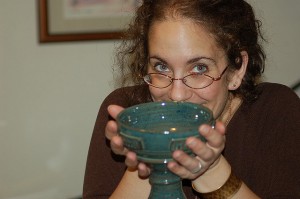
I think it’s telling that I’m having a hard time choosing just one or two things. I was going to pick the toy stuffed rabbit I’ve had since I was a baby, but I realized I don’t have any pictures of it!

Then I racked my brain a bit and settled on my "Prophets’ Cup." I had this custom made for me a few years ago for Passover.

Traditionally there is an Elijah’s cup at Passover and some have also added a Miriam’s cup. I actually wrote my own haggadah for Passover (even sold a few copies), and evolved this concept into a "Prophets’ Cup."

To me this cup represents a lot, since it’s a product of my research, scholarship, imagination, creativity, writing, experimentation and eventual collaboration with a potter to create it. I feel like this cup presents so many opportunities to have conversations and ask questions that I guess it would be the one I would use.
 

Telling objects: which one would you choose?

Jules Prown, then Professor of the History of Art at Yale, would sometimes start a seminar, I’m told, by slipping into class, and taking his seat at a table at the head of the room.  As students began to settle, Professor Prown would produce, say, a 18th century teapot from his brief case, and place it ever so carefully at the center of the table.

And then he would wait.

Students would eventually gather that the teapot was the object of study.  And they would warm to the task of making the teapot speak.  More exactly, they would begin to extract illumination from the object, discussing and when necessary, surmising the producers, the consumers, the economy and the culture from which the teapot sprang. 

The question: of all your possessions which one would you place before a group of students? What does this object say?  What illumination can be extracted from it?  It can be any object. It need not be art and a museum-worthy artifact.  Sleds, without "rosebud" decals, are most welcome.    

I am hoping the comments section below takes photos.  I have an uneasy feeling it does not. If that’s the case, send me your photos and wee essays.  I will post them both in a future entry.

I’d have to marry an *sshole like him (feminism in Japan)

Japan’s birthrate is falling.  It stands at 1.4 child per women.

This gives Japan the second lowest birthrate in the first world.

And it makes Japan a little like China.  Both have a one-child “policy.”

But of course it isn’t in the Japanese case a policy.  Because not having babies in Japan is self imposed.

In effect, Japanese wombs are on strike.

One of the factors here is that marriage rates are falling.  Fewer people get married and, according to The Economist, “women wait ever longer and increasingly do not bother at all.”

According to the NIPSSR [Japan’s National Institute of Population and Social Security Research] six out of ten women in their mid-to late 20s…are still unwed.  In 1970 the figure was two out of ten.

The Economist contemplates the several things that might cause this fall in the marriage rate and it’s corresponding “dearth of births.”  It may be a matter of wages that they will be paid as part time workers.  It may be a matter of finding a husband who makes enough or saves enough to support a family.  It quotes Masahiro Yamada, sociologist at Chuo University, who calls young women who refuse to marry “parasite singles.”  It quotes Florian Coulmas of the German Institute for Japanese Studies in Tokyo who says there are “no easy explanations” for what is happening here.

This is really very sad.  The Economist, Professor Yamada and Mr. Coulmas are just not trying hard enough.  There is a simpler answer.  It is not the whole answer, but not to include it as a contributing factor is, well, as I say it is really very sad…and proof of another kind.

Several years ago, (I will be vague on timing to protect privacy), I was doing ethnographic research in Tokyo.  (Happily, I’ve done several trips so I think anonymity is relatively protected.)

Before one interview, I found my translator in a spirited conversation with the man I was supposed to interview.  As we were leaving this man’s home, I asked my translator what the conversation had been about and she explained that she actually knew this man and he was teasing her for not being married.  She was was thirty something, attractive, professional, and in this case unamused.  She finished her account of the conversation by saying, under her breath, just loudly enough for me to hear,

And the reason I’m not married is that I would have to live with an asshole like him.

To be sure, this is one data point.  But what a data point.  There was nothing exceptional about this women.  Nothing out of the ordinary, that is to say.  That she should harbor this feminist sentiment and deliver it, first to him and then to me, so matter of factly, told me that there are lots of women in Japan who have removed themselves from the marriage market and child bearing for a simple reason: they don’t like the men they would have to marry.

That this factor didn’t make it into The Economist article or into the learned observation of Yamada and Coulmas tells us, perhaps, just how deep the problem goes.  Women get it. Men, not so much.

References

Anonymous.  2010.  The dearth of births.  The Economist. November 20, pp. 14-15.

Miracle on Highland: the return of 40 lost posts

A couple of days ago, I was bumping along on line.  I am very like a Manatee.  Not so much navigating as going from plant to plant.

My chief thought: I sure hope I don’t get slashed by a passing motor boat.  Really.

And what should I discover?  Forty lost posts, just floating there.  These were posts lost in the great Network Solutions debacle and presumed lost forever.  

I am no useful detective in these matters but it looks like a French outfit called FeedShow reproduced the posts.   

I will never speak ill of the French again.  Especially some guy called Thierry at Feedshow, to whom I am very, very grateful.  

What remains lost are the many comments on these posts.  And for this we may thank those scoundrels at Network Solutions.  

2009

Dec. 21  Christmas gift-giving
Dec. 22  Social Media, once wild, now tame
Dec. 24  Art of the trench coat
Dec. 29  That mythic beer guy
Dec. 29  7-Eleven, where brands go to die
Dec. 31  Creativity’s brief moment in the sun

2010

Jan. 6    Bud Caddell interview
Jan. 7    The Fiesta Movement by Ford, Undercurrent and Bud Caddell
Jan. 8    Local Motors
Jan. 11  Tuesday if you’re in Toronto (not reposted)
Jan. 12  You say content, I say composition
Jan. 13  Real time transformation
Jan. 14  Chief Culture Officer watch: the troubling case of Jeffrey Zucker
Jan. 15  So you’re a CCO – what would you do?
Jan. 18  Girls at Yale in the 1960s
Jan. 20  Anthropologist goes all roller derby
Jan. 22  Mind reading [not reposted]
Jan. 22  Eyelashes in the field
Jan. 26  Zappos and the idea of forced fun
Jan. 28  Meaning manufacture, old and new
Jan. 29  By their lettuce, we shall know them


Feb. 1   Buy this product: we have writers standing by
Feb. 2   Tumi and the case of the talking suitcase
Feb. 4   Recycling: Adding value by adding meaning
Feb. 5   The secret script at USA Networks (aka the unmeshed male)
Feb. 8   CCO bootcamp (not reposted)
Feb. 9   Herskovits: the Elvis of African-American studies
Feb. 9   Bootcamp (not reposted)
Feb. 11 The John-Boy Problem (recovered months ago and reposted with an Oct. 13 date)
Feb. 11 Boot camp Saturday (not reposted)
Feb. 23 Bootcamp and a week of ethnographic interviews
Feb. 23 Oh Canada (not reposted)
Feb. 26 Rusting Buicks and the destruction of wealth

Mar. 1   Edinburgh notes
Mar. 4   Truth, Beauty and D’oh!
Mar. 8   T-mobile behaving badly (not reposted)
Mar. 11 Simultaneity versus seriality (what to do now we have no attention span)
Mar. 18 Lara Lee (what a Chief Culture Officer looks like)
Mar. 20 Trend watch: from Woody Allen to Monk
Mar. 23 Jeff Bewkes and the end of influence
Mar. 23 Chief Culture Officer goes Portuguese
Mar. 25 Nooyi, Arnel and the brand debacle at Pepsi (not reposted)
Mar. 25 DNA, String theory, and what might have been
Mar. 30 Mystery of capitalism

Apr. 2   Blank looks for a new comedy and culture

Mrs. Pucci, say it’s not too late for us!

Human Target is a TV action adventure series on Fox.  Last season it was all very "boy’s own."  Lots of fight scenes, stunts, mayhem, intrique and things blowing up.  For all the special effects it was, I thought, very credible TV with writing, acting, and directing vastly better than the genre normally elicits.  

But finally it was too boy’s own, which is to say all that daring-do got in the way of complexity or nuance or anything resembling the way human behave when they are not action heroes.

Clearly, someone at FOX said, "very well, let’s give the USA Networks treatment."  And this means taking a page from the resoundingly successful playbook created by Bonnie Hammer and making our male heroes actually interact with and sometimes depend upon the women in their lives.  Think of the girlfriend and mother in Burn Notice. The assistant and girl friend in Royal Pains.  The FBI jailor and girlfriend in White Collar. And mother, sister, boss, male assistant and boy friend in In Plain Sight.  (There are actually two versions of the Hammer strategy.  I discuss the official one in McCracken 2009 and the unofficial one in McCracken 2010.  See the links below.)

And it came to pass that two women were added to Human Target.  One of them was the Mrs. Pucci (pictured) played by Indira Varma (er, also pictured).  What a difference Mrs. Pucci makes!  In a graceful, elegant way she dismantles the genre, scene in and scene out. Now we really have no idea what’s happening next.  And while we are trying to puzzle out the character, we are treated to a great actress treating us to lots of nuance and subtlety.  

But hang on!  Bill Gorman reported yesterday that the numbers for Human Target were abysmal.  Not much better that Under Covers which is now down for cancellation.  My suggest we treat this as a new year’s eve resolution: defend Mrs. Pucci from cancellation!

References

Gorman, Bill.  2010.  The Numbers of Human Target. December 23.  click here.

McCracken, Grant. 2009.  The Hammer Grammar.  This Blog Sits At the Intersection of Anthropology and Economics.  August 31.  Click here.

McCracken, Grant.  2010.  The secret script at USA Networks (aka the unmeshed male). This Blog Sits at the Intersection of Anthropology and Economics.  Feb. 5.  click here. 

Steam punk: a square inch of contemporary culture by Carlen Lea Lesser

A couple of weeks ago, I was corresponding with Carlen Lea Lesser about Steampunk and its influence on a recent Burberry line of clothing called Prorsum Line.  

I asked Carlen if she would consider writing a few hundred words on Steampunk and the line.  I have a rough idea about what Steampunk is but I wanted Carlen’s "square inch" on the topic.  She was kind enough to oblige.  

Here then is Carlen on Steampunk.

I was completely stunned as I read Chief Culture Officer and saw a reference to Steampunk and how it was an important trend to watch and understand.  I don’t think I ever would have thought to find a fringe subculture/sub-culture discussed in a book like that, but maybe I should have.

Steampunk began as a sub-genre of Science Fiction and Fantasy fiction.  It is generally characterized as a blending of either Victorian-style and modern technology or Jazz-age style and modern technology.  It’s a world of "what if?"  What if we had steam powered cars?  What if we had computers that ran on clockworks?  What if dirigibles were a common form of transportation? Dirigibles (think of the Hindenburg) are a dead giveaway that what you are reading or watching is at least influenced by Steampunk.  The films Lemony Snickett, Sky Captain and the World of Tomorrow, The Golden Compass, and even the Harry Potter films, are recent examples of mainstream Steampunk influenced films.  But don’t think this is an entirely new idea, the true father of this lived in the actual steam era: H.G. Wells.

At its heart, Steampunk today is a revival movement, but with a twist — it’s intentionally anachronistic. When the Victorians were in their Neo-classical revival phase it was hardly purist.  You can find a telling bell-jar or antimacassar on the scene to give it away.  Plus, they were a bit obsessed with clutter and could never really master that simplicity.  But it wasn’t done with a wink and a nod.   Steampunk is.  It imagines a world where the old and the new blended together.  Sometimes this is presented as just how the world evolved, and sometimes it’s presented as a post-apocalyptic rebuilding of technology and culture.  In the latter, the Steampunk blending of old and new is out of necessity and ingenuity.

Like a lot of fictional worlds, Steampunk has crossed over into real life.  Some people live this as a true lifestyle, some do it a hobby and at conventions, and some just fuse it into life as a sensibility.  This ranges from everything from inventing amazing Steampunk gadgets (working or not) to fully adopting a Steampunk fashion aesthetic.  Some people go all out with this, but many, like me, find ways to subtly work the style into a wardrobe without it, hopefully, looking like I’m wearing a costume all the time.  Maybe it’s just the cut of a jacket, granny boots, a pendant made from old watch parts, or my current favorite – an antiqued bee pendant with a working compass embedded into it.

The Steampunk aesthetic is clearly tapping into what I would call a growing sense of pragmatic optimism, and hints of it starting to appear more and more in mainstream culture.  Recently I even noticed it in Burberry’s new Prorsum line of clothing.  Burberry is not a brand I’ve ever had any interest in, which is why I was so stunned by the Fall 2011 line they recently debuted.  If you don’t know about Steampunk you might just see the military trend that seems to be working it’s way back into our wardrobes again.  When I look at it, I see a luxury brand’s interpretation of Steampunk.  Specifically it called to mind Warren Ellis’ amazing graphic novel series, Freak Angels.

Freak Angels is in the post-apocalyptic school of Steampunk, which is always amazingly optimistic.  But this line of Steampunk isn’t a dreamy utopian form of optimism. It’s a very pragmatic form of optimism.  Think of it as, "yes we blew up the world and that seriously sucks – but let’s get to the rebuilding and try not to screw it up quite so badly this time.  And if someone would invent a way to take a hot shower that would be bloody brilliant."

The Prorsum 2011 Fall line, evokes the slightly "ragamuffin fabulous" feel of post-apocalyptic Steampunk without making the wearer look like they are heading over to ComicCon.   One could say that the resemblance is superficial, but if you look a the collection as a whole and the way it’s presented, I think you’ll find that most of same cultural ingredients that lead to Steampunk are at work here too.

References

McCracken, Grant.  2010.  Square Inch Anthropology.  This Blog Sits at the Intersection of Anthropology and Economics.  December 17.  click here.

Acknowledgement

The image is from the Burberry.com website and shows a jacket from the Prorsum line.  

Sublime, rise and fall of an indispensable idea

Google’s Ngram is out.  Everyone is plugging in words.

Nick Wingfield asked Ngram to track the word "awesome."  This is the little word that could, emerging sometime in the 19th century and climbing steadily for 100 years. It spikes after World War II, and peaks around 1980, dipping briefly and oddly, Nick notes, at just around the time it was embraced by Jeff Spicoli (the Sean Penn invention in Fast Times in Ridgemont High).  

This little word changed horses in the middle of the stream. In the 19th century, "awesome" meant "capable of inducing awe."  At some point it came to mean "good, very good" as in "Dude, that’s so totally awesome." 

Why the shift?  In a world that was flatter and more democratic, awe disappeared as a social reflex.  In a world of rising technology and science, awe disappeared as a response to nature.  In a world that was increasingly explicable and routinized, awe disappeared as a response the inscrutability of the world.  I bet even our gods were less "awesome."

What’s a word to do?  Find a new home. Dream up a new meaning.  Make yourself useful some other way.  Hence the company of surfers.  It’s not the company a word usually seeks out.  The parties, the weed, the complete inability to graduate from high school.  But, hey, words go where the action is.    

Inspired by Wingfield’s study, I plugged in a world of my own.  I tried "sublime."  You will see the results to the right.  Not pretty.

Sublime hit a high point and has been sliding ever sense.  And I guess the high point was occasioned by Edmund Burke who loved the word deeply.

The passion caused by the great and sublime in nature … is Astonishment; and astonishment is that state of the soul, in which all its motions are suspended, with some degree of horror. In this case the mind is so entirely filled with its object, that it cannot entertain any other, nor by consequence reason on that object which employs it.

I think sublime fell for the same reason that awesome rose.  It fell into bad company.  It was a great and dignified term for Burke, but eventually it became a party favor, something to be used by members of the English middle class to describe cocktail dresses and garden parties. Run with a crowd like this and only bad things can happen.  

It’s a pity because this really is a good word.  It’s about how some things in the world can so astonish us that it explodes (or at least beggars) our categories of perception/conception. By this, the Burkean definition, "sublime" is a tremendous word.  As the world gets more and more turbulent and confusing, it is becoming more and more sublime.  "Sublime" actually helps us come to grips with our attempt to come to grips with the structural properties of contemporary culture.  And that, in my book, makes it totally awesome.  

References

Burke, Edmund. 1958. A philosophical inquiry into the origin of our ideas of the sublime and beautiful. London: Routledge & Kegan Paul, p. 57.

Wingfield, Nick.  2010.  Ngram for "awesome."  Facebook status update.  December 17.

Square Inch Anthropology

I just had lunch with a young professional called Gloria who wanted to talk about what might be involved if she were to prepare herself for a career as a Chief Culture Officer.

We had a good conversation and at some point in the proceedings, I found myself encouraging her to work on her "square inch anthropology."

I had never actually heard of square inch anthropology before.  It just sort of thing you find yourself saying.  

Here’s what I think I meant.  To do the study of contemporary American culture, we are obliged to break it down into square inches.

A case in point.  I was telling the young professional about a project Mark Earls, Andrew Barnett, Ana Domb, and I did last year when we were commissioned to study "cocktail culture" in the Northeast.  "Cocktail culture" makes up one square inch of my map of American culture.

We interviewed hundreds of people by the end of the Cocktail Culture project, and Gloria and I ended up talking, for some reason, about two of them, a couple of women in a bar in Brooklyn who were "dolled up" and entirely glamorous in a not too assuming way.  Gloria has some interesting thoughts on these women and we christened their style "Betty Page."  This is a square inch too.

Square inch anthropology says, in effect, "look, we don’t claim to know everything about this culture, but we do have relative confidence in one or two things within it.  In this case: Cocktail culture and the Betty Page style."  We may now make claims to knowledge without pretending any overarching knowledge or competence.

Why proceed by square inches?  Here are 5 reasons.

1) American culture is vast, endlessly various and changing all the time.  We can’t know it top to bottom.  We can’t map it end to end.  The best we can hope for is to establish small pieces or pockets of clarity.

2) We can’t be entirely certain we have something.  We are always on the look out for more data and we are perfectly happy to discover that "cocktail culture" or "Betty Page" femaleness actually isn’t anything after all, or that it isn’t the something we thought it was. Our square inches are posted as possibilities.

3) As we begin to accumulate square inches we are in a position to begin to assemble them into patterns.  If the squares are provisional, so are the patterns.  We are constantly reassembling, looking for a better configuration.  And the good thing about the squares is that they prove to be ever so slightly magnetized, which means that they will often "suggest" connections, and when we made them proximate they will come together with that wonderful magnety "snap."  

4) Square are an excellent way of getting starting, of baby-stepping your way to an understanding of American culture.  We are not claiming to know everything about this culture.  We are merely claiming to know, if a tentative, provisional way, about this square inch.

5) Square inches are an excellent medium of exchange.  As it turned out, I had a clue about cocktail culture.  Gloria in turn had some useful things to say about the Betty Page thing. Swapping square inches in this way is really fun.  And it’s generative, very gift economy. Gifting Gloria with my square inch did not diminish it.  Taking possession of her Betty Page square inch left her none the poorer.

In a perfect world, we would turn http://www.squareinchanthropology.com into a place to post things we think we know about American culture.  (Perhaps not surprising it’s available. I checked.)  Please will someone give this a go!

Acknowledgments (and thanks)

To James Michael Starr, the artist responsible for the image used in this blog.  John Wong created the image.  For more details, click here.

Don Cheadle’s reading list

Yesterday, Showtime announced a new show called House of Lies.  Don Cheadle will serve as star and executive producer.

This great news for cable.  To have an actor of Cheadle’s ability and stature, well, who could ask for anything more?

But is it good news for Don Cheadle?

Here’s how the the press release describes the show.

HOUSE OF LIES is a subversive, scathing look at a self-loathing management consultant from a top-tier firm. Cheadle will star as Marty, a highly successful, cutthroat consultant who is never above using any means (or anyone) necessary to get his clients the information they want.

I think this is Showtime’s way of signaling that they intend to use every cliche in the book.

And by book, I mean the work of Martin Kihn from which they drew their title and apparently, their approach.

Here’s a wee glimpse of House of Lies according to Kihn.

Here is the story of a nasty little man and how he rips the soul from his department, pulls its lungs out at the roots, and leaves behind a legacy of victims so vast it is as though a minijunta storms the halls and opens its grab bag of tricks—people with lives to lead . . . people with children, for God’s sake, with babies . . . are tossed into the street—your mentor is tossed into the street—your mentor’s mentor is hurled onto a rotting pile of ex-consultants . .

Golly and who would have thought if possible to take cliche one better.  Capitalism red of tooth and claw, anyone?  This takes Wall Street and ups the ante.

But of course cliches are not always a bad thing when it comes entertainment.  They do grease the rails of comprehension.  And, let’s be honest, a stereotyped, simplified and thoroughly dumbed-down notion of advertising appears not to have hurt Mad Men at all.

Mind you, the advertising cliche has quite a lot of ore in it.  There’s the sex, the drinking, the politics, the glamor, and the deal making.  It’s not clear to me that the consulting cliche leaves Showcase much to work with.  Deal making?

We know what happens to TV projects that stick to empty cliches. Audiences lose interest almost immediately.  It’s horrifying to think of an actor of Cheadle’s gifts taken hostage by a show that is itself taken hostage by simple minded ideas of its theme.

Let me make a suggestion: that Cheadle consult literature that can introduce him to the subtleties, nuances and richness of the consulting biz.  I like the book by Micklewait and Wooldridge as background reading.  See also Walter Kiechel’s wonderful The Lords of Strategy.  But the real opportunity here, I think, is to talk to consultants and to see how very smart and sighted they are.  Some of this will help correct the cliches with which House of Lies is freighted. 

References

Kiechel, Walter. 2010. The Lords of Strategy: The Secret Intellectual History of the New Corporate World. Harvard Business School Press.

Kihn, Martin. 2009. House of Lies: How Management Consultants Steal Your Watch and Then Tell You the Time. Business Plus.

Micklethwait, John, and Adrian Wooldridge. 1998. The Witch Doctors: Making Sense of the Management Gurus. Three Rivers Press.  

For the Showtime press release, see Robert Seidman’s site TV By The Numbers at http://tvbythenumbers.zap2it.com/2010/12/13/don-cheadle-enters-showtimes-house-of-lies/75293

Harnessing the Innovation Paradox

Steve Crandall and I took the train to Rochester last week.  NBC was so excited by the idea of a physicist and an anthropologist investigating the universe by train, they optioned the concept without ado.  They kept using phrases like "high concept" and "Lorre-esque" but I don’t think we said one funny thing the entire trip.  I guess that’s what writers are for.

Steve and I were off to Rochester to join Pip Coburn and Dave Bujnowski for a brain storm. As Steve and I made our way from Penn Station northward, the topics of innovation and idea generation were very much on our minds.  (Yes, and come to think of it, our preoccupation may also have had something to do with the fact that we were travelling on rolling stock that hasn’t been updated for several decades in an industry that continues to use the term "rolling stock.")  

Steve had interesting things to say about the role of serendipity at Bell Labs, a place he worked for some 20 years.  People applied themselves to Lab problems around the clock, but sometimes, and strangely, it was when they went to lunch that some of the best progress was made.  

The creative world is familiar with this paradox.  For some reason, it is when we are free to stop thinking about the problem that we sometimes manage our best work on the problem. And it is especially when we are free to think about something unrelated to our problem that our problem stops being a problem.  

This is another way of saying that we are terrible at problem solving.  We are those little wind up toys spinning our wheels and giving off that horrible, metallic, wind-down sound.  

What does lunch do?  It gives the world a chance to supply it’s "metaphoric materials." Cause that’s what’s happening, isn’t it?  We are working on a problem to do with logistical systems and someone starts talking about the organization of ganglia in the brain and we go, "But of course.  That will do, nicely.  Thank you."

I blame the Dewey Decimal system.  (And frankly it’s done so much harm in the world, I am pretty sure no one is going to mind me adding one more accusation.)   The DDS clusters like minded things together.  And that’s what we always do when trying to solve a problem.  We cluster the data, theories, methods, colleagues we think we’ll need when in fact we should be invited serendipity into our lives to give us the chance for those metaphoric materials.

This leaves us with a problem.  To harness the innovation paradox, we need ideas we can’t possibly guess we need.  We must canvass concepts that are entirely unrelated to our present problem set.  We need to find away to get away from the problem the hand and to give our deeper powers of pattern recognition a chance to work.  

In sum, we have to go somewhere, and we have no clue where.  We have to engage new ideas, but we have no clue which.

Every lunch table, especially when staffed with smart, interesting people, can serve to help us harness the Innovation paradox.  But surely, we can do a little better than this.  Surely, there is some way of narrowing the range of our stimuli in order to increase the chances of "contact."  

Your thoughts, please.

The time-warp room and other medical breakthroughs

Alzheimer’s disease or senile dementia is a disease of the brain that causes memory loss and eventually the destruction of the social self.
 
We don’t now the origins of this disease but we assume that it is caused by an external agent (aluminium?) or an internal condition (amyloid beta deposits?).
 
Perhaps we should also entertain a cultural cause.
 
Coombe End Court, a retirement center in Marlborough, Wiltshire has a "time-warp" room. It’s outfitted with a gramophone, manual typewriters, a telephone made of Bakelite, and furniture from the 1950s.  
 
That this "reminiscence room" is loved by residents is not surprising.  Who doesn’t like to see the return of an "old friend" from the object world?  What captured the attention of the gerontological community (and the magnificent website Retronaut) was that this room as lead to a "dramatic" drop in the need for the anti-psychotic drugs given those who suffer from Alzheimer’s.  Or as my friend Leora Kornfeld puts it, "parquet floors and rotary dial phones appear to accomplish what neuroleptic drugs can’t."  
 
And I fell to wondering whether these things improve the condition because it is their absence that, in some small way, helps create the condition.  
 
My argument: perhaps the object world of consumer goods and material culture serves us as an anchor or an orientation. Perhaps we are reaching something like the limit of the human capacity to endure change. Perhaps the constant reformation of the material world has the effect of unmooring us. 
 
The people who live at Coombe End Court are close to being the first generation of the species to be shot from the cannon of structural change.  Certainly Western societies have seen astonishing change take place over the last 400 years.  But I think this change was (or at least felt) the exception, and stasis was the rule.  Our world might be turned upside down by a religious reformation, a political revolution, or a technological transformation, but there was some hope that things would eventually "return to normal."
 
This condition, let’s call it the "this too shall pass" condition, said that we could hope for change to pass and some normal, if only a new normal, to emerge.  The people who live a Coombe End Court began their lives with this condition in place…and lived to see the condition rescinded. 
 
One of the symptoms of structural change is the constant reformation of the material worlds. My favorite example of this is the Razr phone that rose to prominence in the 1990s.  It was once the apple of my eye.  It is now faintly ludicrous.  That took roughly 10 years. Remember Friendster?  Neither do I.  The material and the virtual world churns with novelty.  I write this from a hotel room in Rochester.  It’s not a high end place, but all of the design decisions represented in my room will be rethought and replaced in a couple of years.  I am wearing Levi’s and a Polo shirt.  These are American standards, I guess.  But every time I go to a conference in Soho, I am reminded of how far my fashion "sense" has falled from currency, and how close I am now to self ridicule.  
 
If I lived at Coombe End Court, if I were 75, say, I might well feel like someone who had fallen into a swift running Heracletian (sp) current and was now being pulled out to an unfamiliar sea.  The world that defined me recedes from view.  Increasingly, I am obliged to live in a world I don’t much recognize.  
 
I am not saying that this cultural condition causes Alzheimer’s disease.  But it is not hard to see how it might set the stage.  After all, there is no formal reason why a time-warp room should have therapeutic effect. Why isn’t it as unrecognizable as the rest of the world?  But this room "rewinds" time and returns us to a material culture that has not been defamiliarized by new fashions, technology, social practices, and ideas.  Oh, to see that Bakelite phone again.  Suddenly I am no longer accelerating out of the world.  To use Cliff Wild’s metaphor, my rights of residency are now respected. 
 
Don’t get me wrong.  This is no "world we have lost" nostalgia.  I was born a modernist.  As far as I’m concerned, the future can’t get here soon enough.  Part of me says, "the present was great, but let’s see what else you got."  The issue here is not slowing the rate of change, or somehow removing ourselves from the torrent of change.  It’s to think of ways to redesign the self so that it is less vulnerable to the effects of change.  

References

Wild, Chris. 2010.  Retronautic Rest Home. How to be a Retronaut: if the past is a foreign country, this is your passport. December 1, 2010. click here.

Thanks

To Leora Kornfeld.

The Reclocking of America (and the death of the mall)

The English historian E.P. Thompson suggested that as industrial capitalism took hold in the West, we began to organize time in new ways.   A ritual cycle with lots of saints days and religious celebrations was replaced by a model in which leisure days were fewer and more concentrated (on the weekend, in the summer, etc.)  The West was being, in effect, reclocked.  (My term, not his.)

Surely, post-industrial capitalism is having this effect as well.  I believe we are cultivated a "just-in-time" model that says we prefer to dispatch things the moment they "come up."  We are disinclined to keep a to-do list.  

This means that when I think of something I want to say to someone, I much prefer to write an email.  I really do not want to make a phone call.  This is because I can dispatch the task as part of my immediate work flow.  More importantly, the email "stacks" at her end, allowing her "to get to it when she gets to it."  (A phone call demands she stop what’s she’s doing, to field the call or the message.)

This extends to our buying behavior.  The old model of retail says, in effect, "you come to us."  You, the buyer, must stop what you are doing and come to the mall, the high street, the retail outlet.  The trip there is time consuming.  Parking is almost always a high stress exercise.  The place is crowded.  The choices too numerous.  The undertaking mostly joyless.

How better it is to visit Amazon.com and make the purchase in our "work flow."  Amazon then takes care of virtually every thing else, and the package stacks, quite literally, on our door step.  It’s ready when we are.  Not the other way round.

In this model, we organize our time into one continuous flow.  This means, as others have noted, that we weave public and private time together, work and personal life blur.  But it also means that we dispatch in real time, stacking messages and purchases as we go.

This spells the end of retail as we know it.  We might use a traditional model and say this represents the "disintermediation" of the buying process and the elimination of the middle of the chain.  And this much is exactly what is happening.  But I think the deeper, cultural motive here, is the wish to respond to the dynamism and sheer press of our lives with a model of interaction that organizes time more intelligently.  To do everything called of us we are embracing another kind of disintermediation, dispensing with that to-do list stop and go model for something more fluid and just-in-time.  Thus does "time management" gives way to "improv."  Thus does planning gives way to something closer to an instantaneous "sense and respond" model.  Thus do we move in the direction of what Stuart Kauffman calls complex adaptive systems. 

Personal note: in a couple of hours I am taking the train from NYC to Rochester.  It takes 8 hours and it should be a complete nightmare.  If I have internet access (and what are the chances) I will tweet the experience with the hashtag "forgodsakehelpme."  I am traveling with physicist Steve Crandall, because, well, these days I try never to leave home without a physicist.  It’s part of my reclocking experience.  Steve has resolved never to travel without an anthropologist.  Not sure why.  

References

Kauffman, Stuart. 1996. At Home in the Universe: The Search for the Laws of Self-Organization and Complexity. Oxford University Press.

Thompson, E. P. 1967. “Time, Work-discipline, and Industrial Capitalism.” Past and Present. 38. (December): 56-97.

Tommy Hilfiger redeems himself (possibly)

I have always regarded Tommy Hilfiger as someone who helped himself to American culture without much reciprocating.

In fact, Tommy seemed thrice a shoplifter.  His look was a straight steal from the Preppie handbook, real and figurative.  More than that, it was a lift from Ralph Lauren. Finally, he dared himself to the Harvard H.

Tommy was, in short, completely derivative.  That’s the nicest thing you could say about him.

Recently, Hilfiger has been running an ad that does some interesting things for the Preppie look. It’s the "Feast Interruptus" spot now running.  Have a look and let me know what you think this piece does, or doesn’t do, for the Preppie look.  Perhaps Tommy has decided to make a contribution after all.

Hats off to the creative team (as nearly as I can identify them): Francis Lawrence (director), Karl Templer (fashioner), Trey Laird (creative director and CEO of the agency in charge, Laird + Partners).  

References

Roberts, Jonathan, Carol Wallace, Mason Wiley, Lisa Birnbach 1980. The Official Preppy Handbook. Workman Publishing.  

The ad in question: Feast Interruptus click here.

The Pleasures of EW

It’s clear to me now.  The point of some Hollywood movie and TV production is to give the staff at Entertainment Weekly something to write about. The movies and TV shows don’t really matter.  The reviews, these are the point of all those deal making, casting, shooting, producing, agenting.  The movie or TV show is really just an accident of the process.  Really, all this takes place to occasion EW coverage.   (It’s an expensive way to go about it, but that’s American culture for you.)

Listen as Lisa Schwarzbaum damns the latest effort by Halle Barry with feigned excitement and sly criticism:

Something awful happened to young Frankie back in 1950s Georgia to make her so broken; it’s just a matter of time, flashbacks, many costume and accent changes, some more jazz and a triggering tune on the radio before the truth can set Frankie, and the audience, free.

Owen Gleiberman:

Darren Aronofsky’s backstage ballet thriller, Black Swan, is lurid, voluptuous, pulp fun, with a sensationalistic fairy-tale allure.

Ken Tucker on Men of A Certain Age:

[T]he achievement of this series is that it makes middle-aged failure so energetically entertaining.

Leah Greenblatt.

No other major pop diva seems to enjoy surrendering her vanity to the pure fun of video-making quite like Pink does (or, really, at all).

And then there are the anonymous writers of the magazine.  They write with a knowing air, as if to say, "surely, popular culture makes insiders of us all."  There is something familiar about their tone.  And I guess we should take this as an anthropological miracle, because they don’t know us and of course we don’t know them.  Perhaps not so miraculous.  After all, we and then have popular culture in common, and that’s a lot to have in common because popular culture is our culture, plain and simple.  

Ditch the adjective and let’s get on with it.  

Wahlberg and Co were one of the biggest boy bands ever.  And NKOTB are currently prepping for a summer North American concert tour that would totally make us hyperventilate…if this were 1989.

References

Anonymous.  2010.  They’re with the band.  Entertainment Weekly.  December 10, p. 96.

Greenblatt, Leah.  2010.  Pink "Raise your glass."  Entertainment Weekly.  December 10, p. 105

Schwarzbaum, Lisa.  2010.  Frankie and Alice.  Entertainment Weekly.  December 10.  p. 90.

Tucker, Ken. 2010.  Men of a Certain Age.  Entertainment Weekly.  December 10, p. 95.

Apologies

I am on the road and don’t have time enough to find an image or links.