Category Archives: Uncategorized

Tweeting television (now locked in a box)

spreadable-media-libro-71784I have a friend who believes  every article, post, tweet he needs to read will come to him every day by new media.

And he’s right.  We  act as editors for one another.  We see something, we say something…on Twitter, Facebook, Tumbler, LinkedIn and elsewhere.

But he’s  wrong.  I bet he misses things.  I know I do.  Plus, some things can’t get into new media.  They just don’t.

Take TV.  We watch a lot of TV.  And my Netflix research winter tells me that we watch this TV with new attention to detail and a deep inclination to talk about it.  We find favorite scenes, brilliant bits of acting, very special effects, but all of this remains locked in the box.  It just isn’t  “spreadable,” to use the language of Henry Jenkins, Sam Ford and Josh Green.  (That’s their book cover above.  Highly recommended. Forgive the Italian subtitle.  Buy the book here.)

This is a classic case of the old media failing to seize the opportunities opened up by new media.  Imagine how many of the shows that failed this fall season might have made it if their early fans could have got the word out.

What we need is some tech overlay that makes clipping and sharing easy and possible.  Build it into the remote control.  Put on an IN button and an OUT button and a CLIP button and a SHARE button.

I am sure there are legal issues here, but I am equally certain Lawrence Lessig  or Jonathan Zittrain could sort them out over lunch time.  The copy right holders are, after all, deeply incented to permit the passage of small clips.  Permit?  What Jenkins, Ford and Green say about spreadable media, applies especially to every new season of television.  If it doesn’t spread, it’s dead.

In the meantime, we can resort to efforts of our own.  Here’s a clip from one of my favorite shows, Being Human.  This is Sally, a ghost, explaining how she intends to protect the house from sale.  (Remember, she’s a ghost and therefore invisible to  mortals.)

I shot this with my iPhone.  Something less that stellar quality.  But good enough for the  internet, as they say.   Some people are put off by Being Human because it’s on SyFy (they don’t like science fiction) or because the show has such a weird premise (the creatures “being human” are a ghost, a vampire, and a ghost).  But I think this scene takes us beyond odd premises into the heart of the show.  Several “barriers to entry” fall.  SyFy wants this clip to click.

God knows, we have quite a lot of content circulating on line.  The numbers are simply breathtaking.  But the fact of the matter is that TV preoccupies us.  And it’s getting better.  As it stands, this part of our culture is excluded from the conversation.  This should change.

Secret messages in Fringe

A couple of years ago, I did a post on a “secret message” I discovered in a show called Fringe.  This show has disappeared from the airways, and so, somewhat less tragically, has my post.

So I am reposting the images in question.  They were shot by me, using my DVR.  The image in question appeared on the screen for no more than a frame or two.

This could have been a technical error, but almost certainly it was a secret message from Fringe show runners, a Valentine, no less.

This sort of thing would have been unforgivably unorthodox in the world of TV just 5 years ago.  Now, it’s possible.  And for Fringe fans, a small treasure.

Here is the screen without the secret image:

Fringe secret message without

Here it is with the message in place:

fringe secret message WITH

Hard to see?  Of course, it is.  It’s a secret message.

Period Piece

Ember

Or

Silky Szeto

Silky Szeto

This is a great essay in Pacific Standard by John Gravois.  It should be read for its sheer skill and evident pleasure it brought the writer, then the reader.  But I couldn’t help looking at it anthropologically, breaking it down alphabetically, as above.  (I did the first image.  And Silky Szeto took pity on me and offered his alternative, used here by kind permission!)

A  Author spots something in the world (artisanal toast)

B  Author tracks trend to point of origin in the world (Trouble)

C Author discovers the originator (Giulietta Carrelli)

D Author discovers the origin myth which proves to have 3 layers:

D1 Carrelli as a Berkeley students conducts a culturematic experiment in the street, discovers the magic sociological properties of toast

D2 Carrelli wanders in the world before discovering a very wise man (Glenn)  on a beach who gives her essential advice (he is the Buddha CA style, hence his name)

D3 Toast and Trouble prove to be a very good solution to a deeply personal problem, Carrelli’s psychological affliction

E This is the trajectory of so much cultural meaning in American culture.  It begins as a  personal invention, created for  personal reasons, and then it finds its way by logical and diffusion stages into American culture, installing itself in our lives, as a much more public, but still resonant, meaning.  The personal becomes the public becomes the personal.  Think Z-dogs skating abandoned houses in southern California.  Think Alice Waters.  Think Lou Reed.  Think Pete Seeger.  Some film makers.  Most novelists.  All poets.

And I love how well this essay works as an essay.  This may have something to do with the double construction.  Gravois’s quest becomes a study of her quest.  Gravois gives us an artisanal treatment of her artisanal treatment.  The mythic construction. that’s evoked, not inked.  The “just so” quality of the story, how inevitable it feels.  Fragile, perilous,  but necessary.

(This is a nice thing to reckon with: necessary things that seem implausible and barely possible.  Maybe that’s the post hoc at work.  In the early 1970s Alice Waters’ revolution seems implausible.  But these days it now feels like something that had to happen.)

It’s fun to think how much American culture comes from the personal.  From individuals making cafes called Trouble and authors discovering them in essays called Toast.  Apparently, we have pipes down everywhere, there to capture innovations and bring them to the surface.  Meaning as energy.  I’m not sure we know enough about this process.  This is the social face of innovation.  We know how bags of data and thinking on technological and business innovation.  But the social stuff, that’s less clear.

Last thought

Sorry for my graphic.  I thought it would work as a kind of a road map for the post.  But really it just ends up looking like one of those combination locks on the driver’s door of a mid size, turn-of-the century Buick.  Sorry.  I really will have to talk to the guys in the lab.  Design, this is not something they know from.  Silky Szeto was kind enough to intervene with a second, better, graphic.  Thank you, Silky. See more on Silky’s splendid work here.

Head Starts: creative platforms for culture makers

Ember Status Item


I was reading a great post on fan fic and was struck by this phrase.

“When the stress of world-building goes away, it’s easier to let words flow.” http://bit.ly/1gq0nyl

And the obvious struck me.  (I’m one of its favorite targets.)  The cunning of fan fic is that it passes off the hard work of origination to someone else and allows the writer to take up residency in a ready made world.  The stress of world building does go away.

One of the things that impresses me about the 1950s is that an awful lot of people on Madison Avenue had a novel in the drawer.  And not just any novel.  Everyone was hoping to pen the great American novel.

This novel was many things, a ticket out of your career as a copywriter, an apology for working for “the man,” and, not least, an opportunity for immortality.

But it was a fantastically tough assignment.  You had to start from zero.  Before you could write a word, you had furnish your novel with assumptions, architectures, infrastructures, presuppositions, characters, events, narrative arcs.  You had to build an entire world.  And this is precisely why so many of those novels never got written.

The genius of fan fic is that you just move in to someone else’s world.  Most of the heavy lifting is done.  To be sure, you are not the captive of this prefab world.  You can change anything you want.  But your creative platform is in place.  Your readers are “half way there.”  And perhaps most important you have a community of fellow fan fic writers who are also rehabilitating Star Trek or Elementary.  This is a community of problem-solvers from whom you can draw when you are not astonishing them with your brilliance.  Competitive collaborative creativity, like.

This is the cultural version of the thing we have seen happen in the technological and start up community.  I recently heard x and y give a talk about how much more code is available to hand every time they start up another startup.

Like the post yesterday, this encourages two points.

One, that we are more productive when we work with creative materials in place, a starter kit, so to speak.  Starting from zero was an avant garde conceit.  It was why novelists were obliged to retreat to garrets and torment themselves with months of solitude.  Not us.  We just drop into any existing property, take the money and run.

Two, this is where the value is.  We have thousands of people poised to innovate and create new content.  And sometimes it’s true that another app is exactly what the world wants.  But more often, and more thrillingly, what the world wants is a creative platform, like fantasy football or fan fic, that gives us materials with which to work, a place to start, a platform and infrastructure.  We have the creativity.  We have a deep knowledge of culture and how to make it.  What we do not have is an infrastructure that takes this work into the world, there to

All those TV shows and movies have supplied this head start.  But they have done so accidentally.  I wonder if there isn’t a species of capitalism that could go at this more deliberately.  We need an industry of raw materials.  We need an economy through which culture creators can be compensated.    We need platforms through which value flows.

Acknowledgements

Art used by kind permission of Stanley Chow.  See more of his remarkable work at his website here.   See the Offbook PBS special “Fan Art: an explosion of creativity” in which his work is featured here.

It would be too cruel an irony to talk about compensating people for their work on line and then give Mr. Chow nothing so much as a “thank you very much.”  As it happens, starting today I noticed Google gmail and Google wallet now make it really easy to attach sums to an email.  So I sent Mr. Chow 5 bucks.  It’s not much.  And it makes no claim to ownership of his art.  It is merely meant as a way of saying “thanks.”  (We really need a tipping system for work on line. We really do. )

Brands Being Human

Subaru is doing great work for the SyFy’s  Being Human.  Here’s one example:

This is an insider ad.  You have to know the show to get what’s happening.  These are werewolves.  They’ve gone into the woods to “turn.”  The brand has found the spirit of the show and “had a little fun with it.”  Romantic feeling is imposed on something that will shortly turn nasty and violent.  Clever.  And this is absolutely in the spirit of Being Human which plays with genre expectation constantly and well.

Here is Being Human in action.  In this scene, Sally, the ghost, discovers that her house is up for sale and she decides to discourage home buyers with a ghostly trick.  Ooooooooooo!  In this scene, remember, she is invisible.

Generally speaking, Subaru has done a great job claiming a nest of companionable, cozy, domestic meanings for the brand.  It has attached itself to “family” as well as any brand in the biz.  (And that’s saying something, considering that so many brands are trying to make this connection.) Recall the Subaru ads that feature dogs aging and kids practicing for their driver’s license.  This is great work but it may leave the Subaru brand defined as something perhaps a little too domestic and of-this-world.

The Being Human work manages this problem beautifully.  A brand that verges on the humble and everyday becomes suddenly exotic and even daring.  The Subaru meanings expand wonderfully.

Notice how elegantly this is accomplished.  The Being Human work is site-specific and exists, in effect, only for the Being Human audience.  There is no danger  that the broader Subaru market will see this work and no danger that it will transform their “cosy” associations with the brand.  This is brand surgery.

Another thing I like about this approach is that it is the opposite of product placement.  Instead of jamming the product into the show, the show is allowed to find its way into the “brandscape,” to use John Sherry’s term.  And both the show and the brand profit.

Product placement is often an absolute tax on a show.  You know that moment when the appearance of the product suspends your suspension of disbelief.  You might as well stop watching and thousands no doubt do.  I don’t care how much the show makes from product placement.  In many cases, the artistic price is too high.  Plus, as a strategy, this is just plain dumb.  It says in effect, “People aren’t watching our ads! Ok, so let’s force them to look at the product!  We’ll make them watch us!”  You’ll make them watch you?  This is your idea of persuasion.  This is your idea of managing meanings? Really?

There’s another Subaru ad for Being Human that feels, to me, less successful.  It shows three actors acting like characters from the show.  See it here:

This execution feels wrong to me and it serves I think as a useful test of where this strategy can work and where it fails.  When the ad is merely leveraging the creative original, it feels like a pale imitation and it provokes, I think, a relative loss of value.  By which I mean, more is taken from the show than is returned to it.  The brand is merely exploiting the dramatic riches of Being Human and not taking possession of them for larger creative play.  In the immortal words of T.S. Eliot, “bad poets borrow, good poets steal.” This spot borrows where the first one steals.  This is not as bad as product placement but it isn’t a lot better.

Carmichael Lynch, the agency in question, has done great things for Subaru.  There is a cultural sensitivity at work here that really is exceptional.  And our opening “werewolf” ad breaks new ground.  Letting the brand out to play in an ad, in this way, is to let the brand out to play in the world.  And this is one of those cases, where brand and ad are working together, borrowing meanings from one another, to their mutual benefit.   Both brand and show get bigger, richer, and more interesting.

But what might be more remarkable is the fact that the Carmichael Lynch work takes Subaru almost no other automotive brand is prepared to go.  This is daring.  It is clever.  It participates in popular culture.  It makes the brand a living, breathing presence in the life of the consumer and our culture.  It takes the brand a little closer to being human.

Acknowledgments

Dean Evans, CMO, Subaru

I am hoping Carmichael Lynch will send me names of the creative team so that I can give them a mention for this really exemplary work.  Watch this space.

Abercrombie and Fitch needs a Somali intervention (oh, and a CCO)

thMike Jeffries, CEO of Abercrombie and Fitch, can expect a C-suite invasion any day now.  Some guy is going to come climbing over the side and say, “Look at me.  Look at me.  I’m the captain now.”  

The problem is simple.  Somehow A&F drifted out shipping lanes.  It lost it’s navigational signals.  Sales fell.  Wall Street got like so mad. 

This is odd because Jeffries was once indisputably a captain, not just of A&F, but retail writ large.  He seemed to know exactly what consumers wanted.  As Matthew Shaer puts it in a recent New York Magazine,

“From 1992, when [Jeffries] was hired at Abercrombie, to the early aughts, Jeffries presided over one of the more impressive runs in the history of modern American retail. And he did it by turning an all-but-moribund clothing brand, best known as a fusty safari outfitter, into a multibillion-dollar behemoth with more than a thousand storefronts and a style that competitors were tripping over one another to imitate. Unlike his peers, who tended to view the youth market with clinical detachment, Jeffries had a Peter Pan–like ability to commune with the whims of the average American teen.”

(Mr. Shaer’s excellent essay can be found here.)

But time and teens move on.  And Jeffries somehow lost touch.

A company designer gives us a glimpse why.  She told Shaer: “[Jeffries] has a tough time moving past that classic American aesthetic of jeans and polo shirts”

Retail analyst Wendy Liebmann has something like the same story to tell.  She told Shaer: “The sexy collegiate image fit into the age of Gossip Girl and 90210 but now it feels like it’s grounded in an era that’s at least ten years old. I don’t think shoppers in the U.S. and Canada have totally walked away. But, as a whole, I think shoppers have moved on.”

Erik Gordon at the University of Michigan’s business school has studied Jeffries. “If our hero has a fatal flaw, it’s that the world changed and he hasn’t.”

It’s a pretty standard problem.  Along comes a guy like Jeffries who seems to have a perfect sense of what the consumer wants.  What he does not see is that this is an illusion.  What he knows is merely what he wants.  This just happens to be what the consumer wants…for the moment.  Eventually taste and preference will change.  And when that happens, there is a sudden, cataclysmic loss of consumer interest and investor confidence.

It’s hard to feel sorry for Jeffries.  All he had to do was drive through Brooklyn to notice that the preppie look was losing share and that in fact most people preferred to look like survivors of the American civil war.  (You know, I’m just an anthropologist, but I feel confident that “preppie” and “civil war” are quite different looks.)

And this is why you hire a Chief Culture Officer, someone who spends his or her life listening to culture, monitoring consumer taste and preferences, watching for trends and, when necessary, yelling, “OMG.  Something is happening out there.”  The CEO can still “go with his/her gut” but now he/she has someone standing by to report on disruptions.  And save you from your illusions.

Everyone likes to think they have perfect pitch when it comes to retail.  And when you have a run as long as the one Jeffries has had, you are entitled to a sense of your own infallibility.  But we have to know that reading a world that thrashes with change is fantastically difficult.  And no one can be right all the time.

Or think of this way.  It has to be better to share a little power now (with your new Chief Culture Officer) than have to give it all away when someone climbs aboard up and says, “Look at me.  Look at me.  I’m the captain now.”

For my book  Chief Culture Officer, please go here.

Looking for balance in the Morrison Library

tumblr_m9chi4OD1y1rc828jo1_500One of the best places I’ve ever seen is the Morrison Library on the UC Berkeley campus. It’s a reading room outfitted with comfy chairs with books of poetry and travel literature scattered  here and there.

I was on the Berkeley campus as a tourist just nosing around, seeing what I could
 see. And I wandered into this room and thought, “So this is what heaven looks like.” When students are in the stacks, they are retainers in the service of professorial masters. It’s all rigor, discipline and nose to the grindstone. But here in the Morrison, they are free men and women. Now they can let ideas wander.

This is the world the sociologist Mark Granovetter imagined when he discovered that most social networks are redundant, filled with like-minded people. What mattered were the people who traveled between networks allowing them to communicate. The Morrison Library is this kind of conduit, encouraging ideas and students to travel.

It just so happened that I was in Berkeley to visit my girlfriend who just so happened to be staying
 at the Berkeley City Club and I was interested to hear that she was hearing in the club dining room racist language from people eating there, including, without apology – not even a Paula Deen ‘apology’ – the N word. So I couldn’t help look at Berkeley, as I snooped around, not only through the lens of the 1960s radicalism that had made it for me famous, but also through that of an old guard apparently still in place, still active, still nasty as anything ,and for all I knew, waiting for its counter-revolution!

From the point of view of the Berkeley City Club, the Morrison Library must have looked like the kind of place that would encourage loose thinking and dangerous ideas. It turns out these two institutions came into the world at roughly the same time perhaps as antidotes to one another. The Morrison Library was founded in 1928 and the Berkeley City Club in 1927.

But the contrast that really interested me was the one between the stacks and the Morrison. If the stacks represent the old order of intellectual labor and the Morrison the new, the Morrison won. In a postindustrial era and an innovation economy, what we value now 
is less the production of knowledge than the release of creativity. And the Morrison is perfect for exactly that, encouraging us to move the knowledge from one domain to another. To take a John McPhee New Yorker story about Roman numerals and apply it ever so metaphorically to a poem about the Russian steppe. Hey, presto.  A new idea, a better idea, a more creative mind is unleashed.

When the stacks lose, this ends the forced march insisted on by a Soviet professoriate, the one that rewarded those who prepared to make the epidermis of knowledge deeper 
by a cell, the one that rewarded people not for leaping between silos but for taking up residence in one of them and saying, “Shhhh, no talking!”

The Morrison victory was accomplished by revolutionary youth. People like Steve Jobs and Stewart Brand could imagine what would happen in a digital world, and machines that could remember, retrieve, organize and represent learning better than any mortal. Together the old citadels of knowledge fell and those few people who still occupy the ruins, scratching out small understandings, are increasingly bad tempered and alone. They might occupy the Senior Common Room or the Berkeley City Club. They might continue to serve as a petri dish for intellectual provincialism or indeed for racism. But their moment has passed. The academics will soon be removed from the world by a reformation of the university that will make the Henrician transformation of the Catholic church look mere by comparison. The racists, well, I don’t think they are reproducing themselves at anything like the pace they need for survival. Death will take them soon enough.

But it’s too soon to stage a celebration or declare the battle won. We are left with two problems.

1/ Now that we are all about creativity, and the recombination of knowledge, we are less good at mastering any one body of knowledge. Perhaps ‘body’ is something like ‘book.’ It’s an artifact created by the massive inefficiencies of intellectual labor and other problems that no longer matter. So don’t call it a body, call it a mastery. There has to be a place for people who really know village life in 14th century France or economic regulation in mainland China.

The trouble is we overcorrected. Now that we are all Granovetterians, skipping from silo to silo, the silos are in jeopardy. Again, there is a lot that is wrong about the way they are organized and still more that’s wrong with the organizers still in place. But we still need them. Perhaps less as silos and more as watch towers or light- houses. But we still need those solitary figures who live to make a single body of knowledge.

Maybe we should ask everyone to cultivate a specialty. There are people who can name all the alternative bands that played in Walla Walla in the late 1980s. That’s a specialty. Or we could ask people to master village
 life of the 14th century. Whatever else we know, whatever else we think about, we should know about something very particular.

And this can be our balance. We have the big picture. And we have a small one. I am thinking that the possession of a big picture will make us better at seeing the larger significance of our small study of a French medieval village. And that will be a big improvement on the present occupants of the Ivory tower who often don’t know or care less.

2/ We need to develop our idea of the Granovetterian – who and what we are when we take up the liberty and inducement of
the Morrison Library and combine knowledge in new and explosive ways. As it stands, there’s lots of brave talk about “failing fast” and “being wrong early and often.” In the worst of these clichés, we are urged to “think outside the box.” This language has been around for awhile. Take the phrase “stop making sense.” I believe this is an idea from the 19th century avant-garde that found its way into popular culture (and an album title from the Talking Heads) and the idea is now everywhere. In a time that prizes creativity and innovation, everyone is urged to go the edge of what we know and see what we can harvest from the new and strange possibilities.

What’s missing are methodologists who think about how we think outside the box. We don’t have enough skate parks or abandoned swimming pools, where the intellectual agile can assemble and wow one another with one stunt after another, pushing the envelope of possibility. This is what has always happened at certain universities and yeshivas. Kids talk and the implicit challenge is always, “Check this out. You couldn’t try. You wouldn’t dare!” And thus do the smart get smarter, and when they return to the civilian world, it’s like everyone 
is a victim of gravity untouched by any knowledge of escape artistry.

The balance here is how to combine our free flights of creativity with a clear idea of how
to put Humpty Dumpty back together again. Living in the Morrison we occupy a world filled with facts and half facts and possible facts. We address them with this interpretive frame and then that interpretive frame. We embrace an idea that is entirely emergent and have to decide is this something or merely an artifact of my thinking process. And then eventually we have to assemble facts, frames, ideas and illuminations into a something like a compre- hensive view. We need to tidy up. All of us need to be methodologists, paying attention to the way we extract order out of chaos and some of us ought to serve as methodologists who specialize in how this works.

Two balances, then. One between the global view encouraged by our Morrison liberty and the specialized knowledge of the old regime; and one between the great leaps of intuition with which we know order, the opportunities of Morrison enquiry and a new set of methods that improves our chances of ‘sticking the landing’ with leaping with Granovetter hither and yon.

This post originally appeared in MISC in the Winter Issue.

Fred Armisen and the mysteries of culture and creativity

Fred_ArmisenThis is a lovely puzzle.

Fred Armisen is very good at making comedy, on SNL and more recently on Portlandia.

But he can’t always tell what’s going to work.

Here he is in an Entertainment Weekly interview making the puzzle clear.

Sometimes you do [a sketch] that’s good on paper and all the elements are there, but for some reason when you watch it, you can see … it doesn’t make it. We did this one where we’re both ambulance drivers. […] It seemed like such a good idea on paper; we were so excited about it. But it just didn’t work. Things that seem clear to us in our mind, sometimes when they’re on the screen you’re like, ”What is happening? What am I looking at?”

This is very interesting anthropologically.  Most of the time, Armisen is right.  A sketch works as well in practice as it did in concept.  But every so often it just doesn’t work.  Actually, it fails so badly  Armisen  ends up asking, “What am I looking at.”  It seems pointless.  Dead.

A magic ingredient  is missing.  The ghost in the machine.  The god in the details.  The spirit in the sketch.  Or something.  And that’s the puzzle: what’s that something?

Photo courtesy of Tammy Lo http://www.flickr.com/photos/tammylo/240569810/

Are photos a secret ingredient of the internet economy?

KodakBuildingI’ve been asking myself the big question: “Why did FB buy What’sApp for $19 billion?”

I know I am late to the party.  But surely this puzzle is still a puzzle even if the buzz(le) has moved on.

For me, there are four answers.

1) Facebook was trying to stay in touch with its early adopters, specifically young people who are now migrating away from Facebook at speed.  Early adopters are early warning.  Where they go, the world will follow.

2) Facebook was attempting to disrupt a disrupter.  Mark Zuckerberg has read his Clay Christensen.  He doesn’t want to suffer the fate of Friendster.  WhatsApp looked like the future.  So he bought it.

3)  The third answer has to do with the power of photos. Whatsapp users send 600 million photos every day.  (http://news.yahoo.com/whatsapp-19-billion-bet-facebook-053029423–finance.html)  And Facebook knows what this means. Chris Hughes, a FB founder, thought that photos could make FB “sticky” and discovered that they made it positively magnetic.  (Photos may be the biggest reason Facebook didn’t drop from view like Friendster.)

4)  The fourth answer turns on the mysterious properties of the photograph.  (This is a topic dear to my heart.  I did research for Kodak in the US, Europe and Asia.)

We tend to think that photos matter because they are a record of the world.  But this is only the necessary condition of their significance.  The reason they really matter is that they are the single, smallest, richest, cheapest, easiest token of value and meaning online.  We mint them.  We trade them.  We accumulate them.  We treasure them.

Individually, photos are content coursing through our personal “economies.”  They are the single most efficient way to build and sustain our social networks.  We gift people with photos.  They reciprocate.  Hey, presto, a social world emerges.

Collectively, photos create a currency exchange.  They are a secret machine for seeing, sharing, stapling, opening, sustaining and making relationships.  Want to know where networks are going?  See who is giving what to whom, in the photo department.  Photos are in constant flight.  They are a kind of complex adaptive system out of which some of our social order comes.

Why did Zuckerberg pay $19 billion for Whatsapp?  He was following the photos, that secret ingredient of the internet economy.

Provocative Cadillac: rescuing the brand from bland (my latest at HBR)

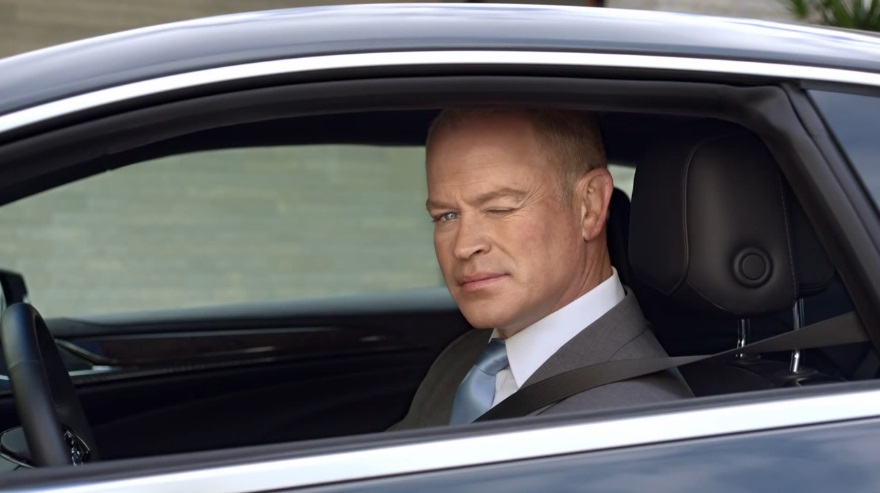
elr-ad-spot-winkCadillac’s new spot Poolside is exploding. It shows a guy walking through his beautiful home musing on American virtues, values, and accomplishments. It debuted during the Superbowl and played again Sunday night during the Oscars.

Naturally, the world went ballistic. These days, in our ideologically conflicted moment, we can’t say anything about the American experiment with provoking supporters, denigrators, and a great storm of controversy.

Poolside is a celebration of hard work, risk taking, and American exceptionalism. For good measure, it goes after the French, those lazy so-and-sos who linger in cafés and take August off. Our hero (played by Neal McDonough) scorns these continental layabouts and counts up American accomplishments, including the trip to the moon. “Got a car up there. And we left the keys in it. You know why? Because we’re the only ones going back.”

Some said, “Bravo! Finally someone prepared to give voice to the things that made this country great.” Others said that this ad is an evocation of the ugly American, materialist America, and the dreadful 1%.

The marketing question is simple. Why is this ad going where angels fear to tread? Surely Cadillac and Rogue, the agency, knew that they were going to stir things up, that Poolside was going to go all cannon ball.

For the rest of the post, please go here to the Harvard Business Review Blog where it originally appeared.

My salute to the creatives didn’t make it into the HBR post.  I note them here.

Marketing Team at Cadillac:

Craig Bierley, advertising director

Uwe Ellinghaus, CMO, Global Cadillac

Alan Batey, GM Vice President, U.S.

Creative team at Rogue:

Director
 Brennan Stasiewicz

Chief Creative Officer 
Lance Jensen

Executive Creative Director 
David Banta

Group CD / Art Director
 Kevin Daley

Copywriter
 Lance Jensen

Copywriter 
David Banta

Producer 
George Meeker

Executive Producer
 Jeff Miller

Agency Producer 
Paul Shannon

Killer Women, killer critics

Tricia-Helfer-killer-women-1-600x400I am a fan of Tim Goodman’s work at The Hollywood Reporter.

I read with pleasure his review of Killer Women.

It begins, “The ABC drama is killer bad.  No, really, it’s shoot-me-now bad. ”

Oh, delicious, I thought.  There are few things as nothing quite so satisfying as seeing justice done, especially when the culprit is a cynically bad piece of contemporary culture.

Go, Tim, go.

“It’s also one of those shows where, less than five minutes into it, you wonder what the actors were thinking when they signed on and then, immediately after that (perhaps a millisecond), you wonder if they’ve since fired their managers.”

But there’s a problem here.  And that’s that Killer Woman is actually pretty good.  Not perfect.  Not in the class of the very good work of which TV is now  capable.  But it is well crafted, interesting, and likable.

Which raises a question: What was Tim Goodman doing?

I leave it to you, reader, to have a look at the show and the review, and see if you find a discrepancy.  I think you’ll find one.

The second question: how big is the discrepancy?

If it’s a small discrepancy, we can put this down to pilot error.  Even a great critic can have a bad day.

But if the discrepancy is big, more questions arise.

The third question: is this an act of hostility?  Did Goodman seek deliberately to inflict harm on the show?

The fourth question: is this an abuse of power?

The fifth question: should THR take a sober look at the review and ask some tough questions?  Was this an act of abuse?  Is there, in Goodman’s work, a pattern of abuse?

The sixth question: are there grounds for a class action suit?

The costs of a hostile critic are astronomically high.  Careers are diminished, sometimes ruined.  Investments are lost.   Enterprises (networks, production companies for instance) may founder.  Value of the tangible and intangible kind disappears from the world.  If the critic who causes this loss is acting from genuine motives and the honorable practice of his or her profession, well, some harm but no foul.  But if the critic is deliberately inflicting harm, this will not do.

I understand that the come-back here is that reviews are so relative and personal that they cannot be objectively assessed.  There is, in short, no way to criticize the critic.  This may be true some of the time, but there are cases when the review and the  reviewed are unmistakably discrepant.   In this case, we can criticize the critic and in this case I think we must.

Minerva winner (4)

8290741611_b2251d65f3_oThis is the last of Minerva winner. (But not the least. Order is no measure of merit.)

Thanks again to everyone who participated in the contest.

Congratulations, Chase Javier Goitia for a great piece of work.

In Our Image: Pop Culture Idolatry

Chase Javier Goitia
Designer at atelier subterra

Though both Kim Kardashian and Lena Dunham arise from the same culture at large, that is to say an affluent slice of society in the United States, they represent markedly differing cohorts who exist as foils in the same space.

Kardashian is a figurehead of the old Hollywood society scene carried to exhaustion, where her public persona is a carefully orchestrated facade of public appearances, tabloid stunts, and fashion braggadocio. We understand innately that there exists a separation between who she may be as a human being and the way she presents herself to us, in fact we know that any information about her personal life is either scandalously leaked or is groomed by PR, ergo no information is trustworthy.

Dunham, by contrast, represents the derivative of that cultural paradigm, deconstructing it in her professional works as well as her public persona, which is approachable and casual even though it would be naive to assume that such a tone lacks intent. Her show “Girls” exists as a bricolage of Gen Y culture; raised on the Internet, wary of popularity, and dismissive of Hollywood’s stunts. Casting a critical eye but simultaneously enjoying mainstream events ‘ironically,’ her works elucidate the struggle of millennials to find authenticity in their lives and find their place in a world created by and for prior generations.

Kardashian is a point of crossover as her fame rests on her symbolic existence rather than on works of intrinsic merit, but her relationship with self-proclaimed genius and hipster hero Kanye West raises questions: Is there substance to Kim Kardashian that the paparazzi and reality TV cameras won’t show? If Yeezy is such a genius, how is he so easily seduced by her T&A and diva lifestyle?

Kim Kardashian’s sex tape is one in a long tradition of young women ravenous for fame, initially considered a scandal and then spun to her advantage as it helped establish her as a contemporary sex symbol. But if a Lena Dunham sex tape were leaked, would anyone care? “Girls” and “Tiny Furniture” feature such unabashed nudity by the characters she plays that there might be no scandal— her position as a feminist spokesperson allows her to admit that she enjoys sex and isn’t ashamed of her body. Young women may covet Kim’s curves but it’s Lena’s confidence and positivity that allows many twenty-somethings to identify with her; Lena’s stardom could appear reluctant if not for the fact that she helped create the environment she now enjoys.

The facade Dunham has crafted brings viewers into a purportedly private world where her insecurities and flaws are evident, where her femaleness isn’t tied to her desirability by men or her privilege, but it is her privilege, namely her family background, that has afforded her this opportunity. Dunham’s first work “Tiny Furniture” was made for less than 50k in her parents’ NYC flat, starring a cast of her friends. Nevertheless, the fact that she was able to produce a slice of her inner thoughts, and in so doing contribute a previously-absent voice to a generation, is a victory.

Kardashian flaunts her privilege loudly in the form of her beauty and wealth every time she appears on a red carpet in an outfit whose value approaches that of Brooklyn real estate, and Dunham flaunts hers subtly in candid Instagrams with comedy luminaries and young New York elite, but both manage to conceal their real selves from the public. Kim’s fame is escapist while Lena’s is populist. Both women appear to enjoy their lives and allow us to bask in the reflected glow.

The further thoughts here are that while both Kim and Lena are obviously considering the way they appear to the public, and doing so in different ways, who holds the stronger position? Because Lena uses the way she presents herself in public to analyze and dissect her insecurities, versus Kim’s plasticized version of her real self, is her glasnost actually a shrewd diversion? We know Kim has had plastic surgery and public meltdowns and is vain because that’s who she needs to be, but Lena doesn’t; she can make an introspective, self-critical show like Girls and use it for her own benefit (both as a platform and as working therapy), and isn’t that less secure, paradoxically?

What we can be certain of: both Dunham and Kardashian are public figures whose clever management of their self-presentation allow each to remain obscured from our scrutiny, but who each serve as a totem of a particular sort of fan. It is the archetypal complement between the extraverted, glam-obsessed that identifies with Kim, and the neurotic, earnest-to-a-fault that champions Lena. Our culture needs both because both those archetypes are in everyone, in varying proportions.

Which is to say: we created those goddesses in our own image.

Minerva winner (3)

BW CreamtoneThis is winner 3 of the Minerva contest.

Congratulations, Mariu Rodriquez

The What, How and Why Behind Kim and Lena.
Mariu Rodriquez

As I grabbed my binder full of random article about the different trends, artifacts and currencies of our culture, or at least the microcosm that I am part of – one filled by people’s magazine subscribers, WSJ’s marketplace readers, movie theater frequenters, and Rottentomatoes.com customer base – I thought to myself: I got this, I know her story, I watch her show and I’m fairly perceptive. Little did I know the place where both of them where about to take me.

Let’s start with the most striking differences. Kim; girly, curvy, sexy and glittery, resembles the classic full glam Hollywood style when women lived their everyday in perfect makeup. Lena, ladylike as well, presents herself in a colorful and quirky Brooklyn style.

Kim’s tone of voice is soft, she is poised, doesn’t swear much and is neutral and almost laconic about many things, from voting (her first-time vote was in Obama’s initial run) to even her haters’ nastiest comments. On the contrary, Lena is completely outspoken, spontaneous and opinionated. She speaks her mind out in an “I’ve always found paella kind of pretentious…” kind of way.

In terms of social class, it seems fair to say that Kim belongs to a “lower-upper” segment, often characterized by the need to get attention and “guard” their status through material possessions. Lena belongs to an artistic elite, both her parents are artists, a couple of her writings have appeared in the sophisticated and notable “The New Yorker,” and she even appeared in the “super snob” Vogue magazine at eleven, as part of a reportage about fashionista teens.

Another radical difference between the two is their stand on feminism. Lena is an openly feminist and Kim approved the idea of posing for Playboy because “sex is powerful and I think it’s empowering.” (Brockes, 2012)

Lastly, Kim could teach us all a master class on branding; every aspect of her persona – including her businesses – is consistent with her value proposition: “the full glam experience.” Dash – her store – does not have many items, but it is strategically stocked with products that attract girly teens that collect bottled water with the sister’s pictures in them. This is by no means a marketing trick because Kim is herself the personification of the full glam experience.

In terms of branding, Lena is not there yet. Even though her show, writings, movies and even twitter account share the same honesty and soul search, I do not think she is purposely committed to make her offering a revenue generating machine.

Loaded with differences, I am now ready to pass the torch to my deeper observer and unifier. From a personal standpoint, Kim and Lena are both relatable. Yes, Kim is financially well off and her lifestyle is completely aspirational to most of us, yet the dynamics inside her family, the sometimes rivalry and more often alliances, respect and closeness between each member are aspects one can relate to, either by experience or by wishful thinking.

Her type of show, classified by Susan Murray as a “docusoap,” is scripted and filled with artificial locations but it gives us access to real people, a family that is genuinely close and whose members at some point get tired of posing. This makes Kim as a brand, human and approachable.
(Murray & Oulette, 2009)

At the same time, Lena represents that stage in life when we need to find who we are at our very core and need our friends to share the journey with us. Be it to end a relationship, to find a job or just to go down the spiral of self-discovery, this is a stage we all can relate to as well. Aware or not, we all want to be as true to ourselves as possible.

From a sociological standpoint, they both serve as social factors in the socialization process of millennials. According to Durkheim, “individuals internalize cultural models of society and after assimilating these rules, they convert them into their own personal rules of conduct and behavior in life”. In this sense, Lena and Kim are opening the path of authenticity and family closeness for millenials to follow, and in a broader sense, are helping society rethink these values. (Farzaneh, 2013)

Perhaps in the future, we might see more closely tied families, nurtured by authentic relationships, which main challenge would be finding a technological bridge between generations.

They are also modeling our vision of entrepreneurship. Murray said that a reality star is an entrepreneur trying to establish a brand. However, I would argue that only when these stars have enough reach to impact a portion of their audience’s behavior and when its proposal is innovative enough is when they jump from being an independent business owner to being an entrepreneur.

Some wonder what is Kim’s innovation? It is definitively not a product or service, but rather an ability to cut through the judgmental clutter of being famous for nothing and build her persona around the fulfillment of accumulating experiences in life. Her show, her marriages, her brands, her latest Christmas Card photo shoot are not mere eccentricities but an urge to cease every opportunity that enriches life, her proposal is about accumulating interesting experience.

Perhaps this value proposition is made out of thin air, but it is a successful representation of what many millennials stand for today, especially when the Great Recession of 2008 made them rethink about what’s important in life.

Finally, let’s revisit the infamous narcissism of millenials. In a recent article, Emily Asfahani and Jennifer Aaker pointed out how new data is shifting this perception and showing instead that “millenials appear to be more interested in living lives defined by meaning than …happiness.” (Emily Esfahani Smith and Jennifer L. Aaker, 2013)

Meaning is about having a purpose, value, impact and connecting to a higher purpose, others, even the world. The key though is that “there are many sources of meaning…that we all experience day to day, moment to moment, in the form of these connections.” (Emily Esfahani Smith and Jennifer L. Aaker, 2013)

So yes, Kim and Lena are big time narcissists, but don’t we all need to see the light in ourselves in order to connect to the light in others, thus create meaning?

References:

1. Emma Brockes. Kim Kardashian: my life as a brand. The Guardian, Friday 7, September 2012.
2. Susan Murray and Laurie Oulette. Reality TV: Remaking Television Culture. New York University Press, 2009. Pp 67
3. Arash Farzaneh. http://suite101.com/a/the-influence-of-society-on-the-individual-a70121
4. http://www.nytimes.com/2013/01/03/fashion/on-this-hit-show-the-clothes-make-the-girls.html?_r=2&adxnnl=1&pagewanted=all&adxnnlx=1385673975-o+X83lPFl8RbTgoeTuTX9w
5. http://nymag.com/arts/tv/features/girls-lena-dunham-2012-4/
6. Emily Esfahani Smith and Jennifer L. Aaker. Millenial Searchers. The New York Times, Sunday 1, December 2013.

Minerva winner (2)

guy lanoueThis is a second winner of the Minerva contest.

Congratulations to Guy Lanoue. There is some wonderful writing here.

Gue Lanoue,
Département d’anthropologie, Université de Montréal

Apparently, there could not be two more different women claiming to represent young, hip urban women swimming in the rapid currents of pop culture: one, a gifted actress, film maker, advocate (same-sex marriage); the other a style entreprenista catering to, well, I’m not sure: a media-whoring heiress: ‘leaked’ sex tape; ‘reality’ shows where no amount of staging can ramp up the drama factor; possibly faked marriage; chemically-derived scents that fuel her fashion motor. Kim comes by this naturally, with owl-faced dad babysitting friend O.J. Simpson, and prototypical social climbing mother Kris pushing Kim and her sisters into the limelight since forever. Queen of the double play, Kim exploits the California-bling card to the hilt while calling for moral reparation for the genocide perpetrated on her father’s Armenian ancestors. Even here, that’s just on the edge of authentic as one can possibly get. It’s a safe call; far away, long ago, and nobody really cares (except Armenians).

By contrast, Lena wins the pop authenticity sweepstakes hands down: New York pop-artist father, designer and photographer mom, growing up in chic and hip TriBeCa loft – slash – movie set. Retro-tweeting about a 2002 incident involving a cheese doodle and a (her) bellybutton, Lena seems to have the avant-garde, bohemian and ironically self-referential side of pop culture sewed up. Girls (a.k.a Sex and the City 3.0, after the book and the series) combines self-absorption with hipster aggressiveness. Its protagonists’ total inability to connect with others roots them to an eternal, adolescent now. Watching this, I get nostalgic for the time when The System’s rigidity only provoked an existential life crisis after one had in fact grown up.

These successful embodiments of pop-ness have both basked beside Letterman, yet seemingly for very different reasons: Kim glories in self-parody as long as the money comes in and the cameras roll, while Lena is a mistress of the pseudo-philosophical sound bite and bare-all tattooed angst-as-armour who’s in it for the real, as long as the real is Me. Yet both in their own way are mining the same ore. In the nearly 60 years pop culture has been with us, the Beat – slash – bohemian self-doubter motif (Lena) is just as vintage as the shameless sell-out Sammy Glick trope (Kim).

Kim and Lena both cause me to question the line between persona and authenticity, even though Kim is ‘real’ and Lena is not necessarily Hannah. They are both numb: Kim is apparently completely impermeable to criticism and avoids (but invites) criticism by the uber-cool by blurring the line between artifice and real; even her pregnancy-induced weight gain was tweeted as a Disturbance in the Force that threatened her crafted faux-ista image; no Christina Aguilera you-loved-me-thin-now-love-me-fat Appeal To The Inner Me here. Lena’s inside-out combination of psychic prickliness is no less effective in shutting out the world, in creating a hermetic and eminently sellable brand to young hip wannabes who are just savvy enough to disarm criticism from the ultra-hip by putting their chameleon-like Who-Shall-I-Be-Today uncertainty out there first. The psychic body armour constructed around spinning one’s psychic wheels makes Lena her generation’s Janeane Garofalo or, depending on how much hardness you like to dial in, Sandra Bernhard. It’s easy to say Kim has got brass balls the size of Kentucky that makes her a standout in a sea of shopping channel pseudo-style, while Lena’s self-advertised emotional confusion in ballsy New York is her winning ticket, but maybe that’s all there is to it. They both seemingly put everything out there, but the trick is that what’s ‘out there’ is shallow, vain and self-centered.

This is their craft: making us suspect there’s some deep inner core inside. Lena/Hannah is only angs-itive to suburban wannabes; even her TV parents show the audience they see through her pose, just enough to suggest Lena/Hannah the screenwriter is winking at her audience. In her own way, Kim also refrains from being completely Out There; SoCal is full of swag-masters much more addicted to money and media fame than she is, though maybe not as smart or as lucky as Kim. In the end, both embody old and tired poses of flirting but never fully embracing either thesis or antithesis.

Kim in her own way is the more honest of the two: It’s About the Economy, Stupid worked for Bill Clinton and it works for her. Lena’s out-there-ism is a harder game to play, since the antithesis has to emerge from endless self-referencing; in other words, eat the heart to feed the skin. After Françoise Sagan bared her soul in Bonjour Tristesse, she had nothing left to feed the next cohort of disaffected jeunesse dorée wannabes, condemning herself to another fifty years of just hanging around: the Wallis Simpson syndrome. Just how much post-adolescent anguish can Lena generate, and for how long? Kim only has to put up with facile attacks on her gold digging image, which she easily shrugs off by a) making heaps of money, and b) winking at the culture apparatchiks to let us know that she’s an internet troll IRL: she carefully turns the criticism into gold. She may be as emotionally shallow as Lena, but she’s on the yellow brick road to riches. Unabashedly making money is a much more powerful and comforting trope than Making It By Working On Yourself. It’s ageless. If you fail, you can blame the economy.

Kim is successfully swimming in the heavily chummed currents of pop-culture commerce. Lena, however, is still splashing in a bathtub, and even her fellow walking wounded water-wing friends won’t keep her Hannah quasi-persona afloat forever. Both play on pop culture’s superficiality, but their goals are different: Money or Me. The latter is a semiotic dead end. Pop culture’s unstoppable recycling enriches our world, but an endlessly recursive self soon runs out of steam. Both now-credible, both vulnerable enough to be likeable, both able pop culture doyennes who serve up yesterday’s stale goods in a new wrapping, but my money’s on Kim for the long run.