Category Archives: Uncategorized

Minerva winner (1)

Ember Status ItemWe have four winners (4!) of the recent Minerva contest that asked entrants to compare Kim Kardashian and Lena Denham (see the post below). We are not ranking the winners. We found virtue in them all.

Thanks again to everyone who participated, both the entrants and the judges. Hats off once more to Caley Cantrell, Noah Cruickshank, Ruby Karelia, Janet Kestin, Leora Kornfeld, Adrian Ho, and Nancy Vonk for their judging work.

Here is one of the winners. (We will post the remaining three essays over the remainder of the week.)

KIM KARDASHIAN AND LENA DUNHAM: COMPARE, CONTRAST, EXPLAIN.
Ali Tilling, strategy planner at BMF Advertising in Sydney.  @hamsterwish

Once upon a time there were two women wearing two different floral dresses on two different red carpets.

We start at New York’s flashy Met Gala, May 2013. A seven-months pregnant Kim Kardashian fronts the paparazzi in a floral Givenchy number to near-universal horror.

Cut to the Emmys, September 2013. Lena Dunham (nominated in three categories) makes more noise for her teal-green floral Prada creation. Though it makes the Vogue best-dressed list, it’s reviled almost everywhere else.

The sub-text to the outcry against each dress reveals something of the complexity of these two characters.

Kardashian’s dress proved to the masses that while Kanye can get her into the Gala, he can’t buy her class; and Dunham’s that there’s a limit to hipster irony (even with her self-aware tweet of her sister’s snidely-sweet comment the day before the event, that the dress looked “like the Delia’s catalogue made a red carpet dress”).

In other words, neither woman was embracing society’s ideal of how femininity should look. Which is odd because in everyday life, that’s precisely why society embraces them. So what’s going on?

Both Kardashian and Dunham have become caricatures of often opposing cultural movements. There are the obvious clashes: east versus west coast, intellectual versus entrepreneurial, and clashes of social class. Dunham is all hipster, liberal arts graduate, filmmaking, over-mentored whiner who is wondering whether it’s cooler to acknowledge all the ways she’s typical or try to escape them.

Kardashian on the other hand has morphed from 2008’s get-rich-quick endorser of anything to 2013’s slightly classier, hip-hop groupie fashion front-row mom, She is one of Lorde’s “Royals” in money and excess, if not in coolness.

Because they are effects of different cultural milieu, each represents a different way in to ‘feminism’.

Dunham is one of very few successful TV writers, which one might imagine is the strongest of her feminist credentials: actually it’s her non-societally perfect body type that’s grabbing the headlines. Dunham is one cause among many of a key response to the west’s obesity epidemic: becoming increasingly accepting of our increasing average weight. She’s certainly a cause of its accelerating its transition from ‘ok for the rest of us’ to ‘ok for the celebrities’ – even while the equal and opposite response, of ultra-health, gathers pace and flows in the other direction.

Kardashian’s feminism on the other hand feels like an effect of the post-recession focus on entrepreneurialism and the idea that everyone can be a maker. Hers is the American Dream 3.0. Her specific talents (writing, or acting, or singing, or designing) are not obvious; her relentless hard work, self-belief and business focus are. She’s an effect of the way the early 00’s reality TV ‘everyone’s life is interesting’ experiment morphed into post-recession ‘anyone can make a go of anything.’ The Kardashian family started with some material advantages, sure, but not to the extent some celebrities are born into wealth; Kim has made the best of her opportunities, and indeed has displayed what to many is a decidedly unfeminine thirst for success, whatever the cost.

In this she is, with Dunham, an unexpected cause of a trend that’s beginning to emerge: they both encourage our slowly-growing discomfort with the notion that the hard work of feminism has been done, that equality has been achieved. Even in the entrepreneurial, maker trend there’s a decided inequality: only 7.5% of patent-holders worldwide are female , and for every 10 male entrepreneurs there are only 8 female . In Dunham’s sphere, most TV writing is done by men, and celebrated by men – leading to books like “Difficult Men: Behind the Scenes of a Creative Revolution”, celebrating male writers of the 2000’s. The world continues to be designed and written by men, but the very different actions taken by Kardashian and Dunham are starting to coax us out of our apparent apathy. Of course there are more extreme examples of this emerging trend, like Pussy Riot: but Kardashian and Dunham are more relatable examples.

Kardashian and Dunham are both effects of post-GFC narcissism. Both mine their own lives and themselves for material, though as Katherine Boyle has pointed out in the Washington Post, one is more upfront about it than the other . Girls, particularly in Series 2, sometimes comes across as an extended-play selfie, and “Keeping up with the Kardashians” is confected reality at its finest. And both Dunham and Kardashian are lucky enough to have an alter ego on whom to blame the worst excesses, though. In Girls, Hannah can explore things on Dunham’s behalf and even in Keeping up with the Kardashians, a ‘purer’ reality show, Kim and family get to decide which side of themselves they present to the camera, and especially how ‘business Kim’ is portrayed.

Dunham, Kardashian and their alter egos have focused more, in the balance of their careers, on the truths behind women’s relationships with other women. That’s then been used that as the prism through which to view women’s relationships with men. Of course with motherhood and her relationship with West, Kardashian’s focus has now shifted somewhat; but her courtship and short-lived marriage to Kris Humphries, for example, was brought to life more effectively through her sisters’ and her mother’s views on it, rather than interaction between the couple themselves. Dunham’s show is at its acerbic best in its brutal honesty about female friendship and, well, girls.

They’ve moved on the work started by Sex and the City: in its TV form, that was a predominantly male-written sisterhood united, while Dunham and Kardashian at their best represent a truer, no-holds-barred look at female friendship. As Hannah writes in Girls 2, “A friendship between college girls is grander and more dramatic than any romance” . For all their differences, the most important cultural effect that Kardashian and Dunham might leave behind is this recognition of the power, grandness and lasting interest of female relationships.

References:

Articles referenced above
Lots of copies of OK and Who magazines
Twitter
Chats with friends and some strangers in a café, to check impressions

Inspiration

SPRING-SHOWERWhere does inspiration happen? For lots of people, it happens in the shower. Yes, it’s soapy and sensual. Yes, it’s a break from the pressure of the day. But the real reason the shower is inspirational is all that water and all that sound.

The shower gives us a screen, a medium that’s message free, a perfect place on which to project and discover the ideas in our heads. Brainstorm? Sometimes a shower is plenty!

For the rest of this post, please go to MISC magazine.

Thanks to King and Blade for the image (see bottom of image for full details.)

The office party: a bad idea we cannot live without

Office holiday parties are a wreck we can’t resist. Talk about asking for trouble. And, yes, joy.337px-Gift_box

We spend all year in captivity and on our best behavior, proceeding diplomatically, saying and doing the right thing. No one doubts that this protocol is necessary. This is not the burden of our conformity or a failure of the imagination. Something as complicated and fraught as an office can’t run without drama that is tightly written, exquisitely acted and fastidiously dispatched. Shonda Rhimes, eat your heart out.

For the rest of this post, go to the New York Times here, please.

Strategies of self presentation in a digital age

Cynically speaking, the way we describe ourselves on Twitter is self aggrandizing (“self-branding” in the language of Tom Peters), but I prefer to think of it as an opportunity for endearment.  I love these people.

Mike Duda ‏ @MikeDuda  Co-founder | Consigliere Brand Capital * Marketer * Investor * Rabble-rouser * Orange Fanatic * Barely lost NYC Marathon to 34,566 runners

nick sherrard @nicksherrard as seen on CCTV

Philippa Dunjay ‏ @PhilippaDunjay  likes short walks on the beach before getting out of breath, complaining about all the sand, why is the water so salty, did you just step on a hermit crab?

Geeka ‏ @Geeka   I used to work w/ things that would kill me eventually, now I work w/ things that can kill me immediately.

CHERYL ‏ @CHERYLDANCE  CHERYL is a four-member, semi-anonymous, often cat-masked artist collective based in Brooklyn that throws life-ending dance parties.

@JonesthePoet Gary Jones  BBQ operator, poet, teacher, shaman, dog’s best friend, feeder of critters, seeker of truth, follow my poetry blog, it don’t cost nothin.

@Rick_Hewett Rick Hewett  I run a press/picture agency. Other than that you’ll find me preparing trainee Vikings (my sons) for life or out running.

Andrew Czydel  @AndrewCzydel  Indie Author and Artist. To write is human, to edit divine and to sell is the work of foul creatures that inhabit dark places hence I self publish!

Roberto Greco  @rogre  Polysomething-or-other

Matt Jacobs @mattjacobs5  Director of Integrated Marketing at AMP Agency. Hoping all of my 140 characters get offered spin-off TV shows.

Kevin Schummer @kevinschummer  There is no correct answer, just my answer.

Patricia Verdolino @BRANDQBORO  Sell your cleverness and purchase bewilderment. – Rumi

Peter Zapf @fogpilot

Mary Wynne Wynter ‏ @mwyn Paradox Huntress. Flower Whisperer. Certified by The Field. Self-wired for Intimacy. Poised for Matriarchy Rising. I Row. I Tango.

Moury Minhaz @MouryM I will do almost anything for a good laugh. I like sarcasm, I have it for breakfast, lunch, and dinner, with a side of slice and dice.

A.J. Somerset ‏ @ajsomerset Blurter of obnoxious things. Novelist (Combat Camera). Sometime outdoor writer. Sometime photographer. Shooter of clay targets. Washer of dishes. I do it all.

Mark Holden ‏ @holdenmw  Explorer, wanderer, philosopher, philanderer, creative, mystic, entrepreneur, digital native, speculator, adventurer, dreamer. Over-claimer.

Gavin Donovan Social Media guy @RegusUSA, @Arsenal fan and the greatest wedding dancer of all time. Tweets are my own.

Eric Soderlund ‏ @equalitytime  Post-Mormon Pastafarian Secular Humanist Music-Loving Pontificating Sports Fan

Katie Guiney ‏ @KTG4  gangly, gregarious girl whose ga-ga about alliteration, audrey, art, books, music, marketing, newfoundland, roger ebert, rom-coms, and the three L’s.

LorettaLightningbolt ‏ @LorettaLB  Just another singer/songwriter and promotion/ marketing manager, fighting evil with her cat.

Charlotte Hillenbrand ‏ @crashtherocks One of the Many @madebymany; 70% cocoa solids: 30% mum

Cindy Gallop  @cindygallop  I like to blow shit up. I am the Michael Bay of business.

Sean McGarry  Baltimore; Charleston Expat; Georgia Bulldog; ENTP; Gentleman Scholar; Semi Colon Aficionado.

Jeremiah Orosco  Runner, Gambler, Ultimate Piggie, Money Activator, Part-time Lion Tamer. Pour yourself a drink, put on some lipstick, and pull yourself together.

Nick Maschmeyer ‏ @636e6d Digital  Strategist at Droga 5. Will endorse any product.

Jenn ‏ @ONoesUDidnt  Currently at that awkward stage between birth and death.

Eszter Fehér ‏ @efeher  Local foreigner, marketer, namer, linguister, blogger… Hungarian.

Sara McDonald @Serifm8  I would kill for a Nobel Peace Prize.

Emily Balcetis A friend is someone who will help you move. A real friend is someone who will help you move a body. pinterest

Martin Weigel @mweigel thief | charlatan | pedant | contrarian | sceptic | amateur | plagiarist | meddler | Head of Planning, Wieden+Kennedy Amsterdam http://t.co/wzxRigOnYs

LL COOL J @llcoolj. Still learning. Queens, NY.

Scott Lachut ‏ @scottlachut  Director of Consulting @PSFK. After hours Blue Collar Bon Vivant with these dreams inside my head. I’d rather share them with you.

Natarajan Lalgudi ‏ @NatarajanL Cranially ambidextrous & experientially versatile, equally passionate about social anthropology & applied math, equally excited by cricket stats & great food

Andrew Pieterick ‏ @APieterick Student at Wisconsin. Sometimes offensive, mostly ridiculous, always unnecessary.

And the Minerva goes to:

Philippa Dunjay ‏ @PhilippaDunjay

likes short walks on the beach before getting out of breath, complaining about all the sand, why is the water so salty, did you just step on a hermit crab?

All others, please consider yourselves honorably mentioned.

[I am reposting this because I was unable to insert line breaks in the original post.]

Denial and the new, nimble, agile corporation

Ember Status ItemSome time in the last year, I spend 40 minutes and 55 slides telling a roomful of senior executives about a trend that was “on approach.”

Trend X emerged sometimes in the 1960s and was now moving towards them with something like the force of a Tsunami.

Trend X was in the process of disrupting the industry, hollowing out the client’s business model and turning their value proposition inside out.

Then something happened.

Denial happened.

For the rest of this post, please go to the HBR blog here.

Kim Kardashian and Lena Dunham: compare, contrast, explain (a Minerva essay contest)

Flock-O-MinervasAssignment 1:

Kim Kardashian and Lena Dunham.  Compare, contrast, explain.

Prize: a Minerva prize and statue

Who may enter: anyone may enter.  Just send us an essay that answers the question.  Send your answers to grant27@gmail.com.

Deadline for submissions: December 15, 2013

Fuller details:

Designers, anthropologists, strategists, ethnographers, writers, artists, activists, musicians, digitists, and other cultural creatives live or die by their knowledge of culture.  The more we know, the more adroitly we know it, the deeper our mastery of this knowledge and the forces that produce it, the more surely we will flourish.

So here’s a test of your knowledge.  Who are Kim Kardashian and Lena Dunham?  As young American celebrities, they are conspicuous parts of popular culture.  They express trends already in motion “out there.”  This makes them cultural “effects.”  But they also shape and clarify things that are beginning to emerge.  This makes them cultural “causes.”

Who are these women and what do they say about our life and times?  What are the causes (trends, events, developments) of which they are effects?  And what are the effects (trends, events, developments) of which they are causes?  What shaped them, what are they shaping?

You’ve got lots to work with.  These women have made many stylistic choices, in voice, language, clothing, emotional style, music, make-up, hair, homes, bars, neighborhoods, restaurants, rituals, ceremonies, friends, boyfriends, husbands, celebrity.  They have fashioned detailed, vivid, public personae.  X-ray these, please.  These are very different public performances.  Review them, please.  At the very least we are looking at very different visions of femaleness.  Give us the what and the how.  And the why.

We are not looking for ridicule.  Kardashian and Dunham are high profile and attract lots of comment and some derision.  That’s not our job.  Nor is this a popularity contest.  We don’t care if you like one of these women more than the other.  Your job is to write a beautifully thoughtful, balanced, dispassionate, detailed, insightful piece that might help someone in the year 2113 figure out who these women were and “what they stood for.”

The differences will be readily apparent.  The similarities perhaps not so much.  But it’s worth remembering that these women come from the same culture, they live in (roughly) the same moment.  Honor the differences but see if you can spot the commonalities.  (And marvel that American culture can produce two entirely credible woman who are so dramatically different.)

Assignment 2:

Tell me what the world looks like if you are Kim Kardashian.  Tell me what it looks like if you are Lena Dunham.  Report what their experiences, and views of the world, are from the inside out.  Feel free to comment on any or all of the following; voice, language, clothing, emotional style, music, make-up, hair, homes, bars, neighborhoods, restaurants, rituals, ceremonies, friends, boyfriends, husbands, and/or celebrity.

This is the “identity” version of the question.  Some people found Assignment 1 inaccessible.  My fault.  So, if you prefer, treat this second assignment as your question.  One way to do this is to give us a 300 word diary entry for Kardashian and a 300 word entry for Dunham.  Give us 400 words (give or take) of annotation for things in the diary entry.  As in “KK prefers to shop here at [Tiffany’s?] because…”  and “we believe this hairstyle became fashionable in the south of France about 12 months ago.  It entered the US style scene and KK’s world through the dance scene and specifically Club [X] in Los Angeles.  We believe this style matters because…”

Assignment 3:

What should the question have been here?  What was the best way to invite people to compare, contrast and explain Kim Kardashian and Lena Dunham.

In both cases:

We only want 1000 words.  Because if it’s good enough for a Oxbridge college, it’s good enough for us.  The winner will win a Minerva statue and a measure of immortality as a Minerva winner.  (Hey, it will look good on your c.v.)

The Minerva Judges:

Caley Cantrell, BrandCenter, Virginia Commonwealth University

Noah Cruickshank, AV Club

Janet Kestin, Swim

Leora Kornfeld, Harvard

Adrian Ho, Zeus Jones

Ruby Strong, Lord Byng

Nancy Vonk, Swim

Ethnography, a brief description

I just banged out a description of ethnography for a client.

Here it is:

Ethnography

The object of ethnography is to determine how the consumer sees the product, the service, the innovation.  Often, this is obscure to us.  We can’t see into the consumer’s (customer’s, viewer’s, user’s) head and heart because we are, in a sense, captive of our own heads and hearts.  We have our way of seeing and experiencing the world.  This becomes our barrier to entry.  Ethnography is designed to give us a kind of helicopter experience.  It takes up out of what we know and lowers us into the world of the consumer.

Ethnography is a messy method.  In the beginning stages, we don’t know what we don’t know.  We don’t know what we need to ask.  We are walking around the consumer’s world looking for a way in.  Eventually, as we ask a series of questions, we begin to see which ones work.  We begin to collect the language and the logic the consumer uses.  And eventually, we begin to see how they see the world.

The method is designed not to impose a set of questions and terms on the discussion, but to allow these to emerge over the course of the conversation.  We are allowing the consumer to choose a path for the interview.  We are endowing them with a sense that they are the expert.  We are honoring the fact that they know and we don’t.  (Because they do!)

Eventually, we end up with a great mass of data and it is now time to stop the ethnography and start the anthropology.  Now we will use what we know about our culture, this industry, these consumers, this part of America to spot the essential patterns that make these data make sense.  “Slap your head” insights begin to emerge.  “Oh, that’s what their world looks like!” “That’w what they care about!”  “This is what they want!”

And now we begin to look for strategic and tactical recommendations.  Now we can help close the gap between what the consumer wants and what the client makes.

(For a more technical description of the method, please see my The Long Interview. Sage.)

Understanding the Return of Gill Sans (a Minerva winner)

Minerva-CarlenLeaLesser

A couple of days ago, I posted this question:

1) Why is Gill Sans winning out over Helvetica? (If it is, and, come on, it is.) Long the visual language of public institutions in the UK (the subway, especially), it looked until recently (to me at least) a little out of touch. But now it seems to be to have all the punchy clarity of the sans-serif regime without giving away the ability to evoke something bigger than the message at hand.

I invited people to submit answers, promising a Minerva to the best essay.

The results are in and the winner is Carlen Lea Lesser. Her answer is below.

Understanding the Return of Gill Sans
by Carlen Lea Lesser

Each era seems to have a font or fonts that define it, and from then on that font carries the weight of history and all the cultural associations that go along with it. While Helvetica seems to have been the font of choice since it’s arrival on the scene in the 1950s, recent years have seen the resurgence of Gill Sans. While it may take a long time for Gill Sans to over take Helvetica — if it ever does — there does seem to be a clear trend. One way to understand interplay between these two fonts is to use the generational/socio-cultural theories of Strauss and Howe. These two historians mapped a pattern of interconnected generational (Generations) and socio-cultural (Turnings) cycles that repeat every 80-100 years and tracked back through all of American history and back through much of British history. By analyzing the times these fonts appeared and re-appeared through the lens of the four turnings, we can see that there are clear cultural reasons behind Gill Sans gaining new popularity.

Helvetica comes out of the late 1950s the end of an era of post-war prosperity and confidence; smack in the middle of the “American High” period in the parlance of Strauss and Howe. Despite being created in Switzerland, it screens the 1950s vision of modern and clean. The lines are strong, bold and clear — the ambivalence and confusion of the Great Depression and WWII are gone. One of the interesting characteristics of Helvetica is its relationship to the Bauhaus movement. Helvetica was designed to take the emotion out of type. It was seen as a “neutral” typeface that would not add any additional mean or emotions. It presents itself as strong, clear, and bold. It is a font that has the promise of this exact moment being right and true.

It is both surprising and unsurprising that Helvetica held on through the 1960s and all the way into the 2000s. No one ever really wants to let go of a High Period, especially those who were raised in one like the Baby Boomers. High Periods, like the idyllic 1950s and early-1960s of the Boomers’ childhood, are times of great security and public confidence in institutions, and lacking in individualism. In the Awakening of the 1960-1970s, Helvetica would have represented a calm center in the storm for those tossed about by the counter-culture revolution. It was the font of IBM, American Airlines, and Bell Atlantic; solid, stable companies that represented the best of America. As we moved to the Unraveling of the 1980s-1990s, those same people who needed the stability of Helvetica in the counter-culture of 1960s needed it even more, and the former Hippies turned into the Yuppies of the 1980s. Needless to say the promise of economic growth of IBM, Mattel, and General Motors was appealing to the Yuppies of the 1980s.

Then there is Gill Sans, a product of the late 1920s England. The font it a derivative of “humanist” sans-serif category of san-serif fonts, but with more line variation and legibility of many sans-serifs. It’s considered to be the most “calligraphic” of the sans-serif, which I take to mean the one you can that most lets the humanity through. It’s a font that seems to have one foot in the past and one foot in the future. It promises a future more interesting than clean, clear, and strong. It moves away from the curly-cued serifs of the Art Nouveau era and foreshadows the “Great Gatsby” era deco lines that would follow in the years to come. But it doesn’t really evoke either era. Gill Sans is really a font about hope — hope of moving out of the Crisis of the Great Depression and into that beautiful American High period.

While designed just before the Great Depression, Gill Sans really hit its peak when Penguin books adopted it for its cover fonts in 1935. By most measures the USA and the world began to recover from the Depression around 1933. It was hardly a boom time, but signs of improvement were beginning. 1935 was the height of the Art Deco era, and Gill Sans — a font developed just a few years after the Art Deco aesthetic was introduced to the world became the font of choice for what was to become of the world’s biggest publishers. Edward Tufte puts it best when he describes it is a classic and elegant looking font. It is a font that evokes the best of what the Art Deco movement was about: faith in social and technological progress (http://en.wikipedia.org/wiki/Art_Deco). A believe that the Crisis will end and not only will everything be okay again — but better than before.

While Helvetica may have persisted because it subconsciously reminded Baby Boomers of their childhood in the 1950s, a time idealized as having been when all was right and good with the world, Gill Sans is a font of faith in progress. Which do we really need right now? As we are in the heart of the current Crisis period, it is not a shock that we are seeing a resurgence of Gill Sans. Will it surpass Helvetica? Who knows. Most likely it will serve it’s purpose to act as a sign of hope that we are moving forward and then we will transition back to a Realist-style sans serif like Helvetica during the next High Period.

Bibilography:
http://typophile.com/node/30970
http://en.wikipedia.org/wiki/Humanist_sans-serif_typeface
http://en.wikipedia.org/wiki/Gill_Sans
http://en.wikipedia.org/wiki/Helvetica
http://www.linotype.com/798-12627/thegermanluminaries.html
http://www.linotype.com/798/typographyintheartnouveauperiod.html
http://www.tug.org/docs/html/fontfaq/cf_28.htm
http://en.wikipedia.org/wiki/Great_Depression#Turning_point_and_recovery
http://en.wikipedia.org/wiki/Art_Deco
http://bnmhistoryofdesign.blogspot.com/2012/10/bauhaus-and-helvetica.html
http://www.signweb.com/content/bauhaus#.Uk8Jr4ashWA
http://idsgn.org/posts/know-your-type-gill-sans/
http://athertonlin.blogspot.com/2011/04/gill-sans-meaning.html

Gill Sans


http://www.edwardtufte.com/bboard/q-and-a-fetch-msg?msg_id=00009r
http://www.webdesignerdepot.com/2009/03/40-excellent-logos-created-with-helvetica/
http://www.helium.com/items/1336072-hippy-versus-yuppy
http://www.encyclopedia.com/doc/1G2-3468303119.html
http://citeseerx.ist.psu.edu/viewdoc/download?doi=10.1.1.130.5486&rep=rep1&type=pdf
http://en.wikipedia.org/wiki/Strauss–Howe_generational_theory
http://www.washingtonpost.com/local/baby-boomers-are-killing-themselves-at-an-alarming-rate-begging-question-why/2013/06/03/d98acc7a-c41f-11e2-8c3b-0b5e9247e8ca_story.html
http://www.pbs.org/wnet/need-to-know/culture/boomtown-the-great-suburban-demographic-shift/6808/
http://www.faqs.org/childhood/Ar-Bo/Baby-Boom-Generation.html
http://www.seniorcorrespondent.com/articles/2012/07/24/the-good-ol-days.452626

Faint signals, emerging trends?

imagesAn anthropologist looks for puzzles. This is, after all, the way the future often makes a first appearance.

Two puzzles have crossed my path this week:

1) Why is Gill Sans winning out over Helvetica?  (If it is, and, come on, it is.)   Long the visual language of public institutions in the UK (the subway, especially), it looked until recently (to me at least) a little out of touch.  But now it seems to be to have all the punchy clarity of the sans-serif regime without giving away the ability to evoke something bigger than the message at hand.

There is a follow up question: will Gary Hustwit ever make a documentary about it of the kind he made for Helvetica?  I would so love to see this documentary.  The Helvetica doc is a thing of wonder.  “Gill Sans” as a follow-up doc would have lots more historical depth and charm.  No modernist hoodlum this.

2) Why is that in at least two instances in popular culture, the role of the guardian angel is occupied by a psychopath.  I refer to Dexter and the BBC show Luther, and in the case of Luther specifically to the character Alice Morgan. Strictly speaking, the last person who should serve in this capacity is a psychopath, but somehow in our culture right now, the notion is not implausible.

Anyone want to write fewer-than-a-thousand words on either topic (or for the very daring both at once) should send it to me and if it’s really good, you will win a Minerva.

Acknowledgments

Thanks to Wikipedia for the Gill Sans Demo.

Impression management, Twitter style

Flock-O-MinervasCynically speaking, the way we describe ourselves on Twitter is self aggrandizement.

But I prefer to think of it as an opportunity for endearment. 

I love these people.  

Mike Duda ‏

@MikeDuda Barely lost NYC Marathon to 34,566 runners

nick sherrard @nicksherrard as seen on CCTV

Philippa Dunjay ‏

@PhilippaDunjay  

likes short walks on the beach before getting out of breath, complaining about all the sand, why is the water so salty, did you just step on a hermit crab?

Geeka ‏

@Geeka   

I used to work w/ things that would kill me eventually, now I work w/ things that can kill me immediately.

CHERYL ‏

@CHERYLDANCE  

CHERYL is a four-member, semi-anonymous, often cat-masked artist collective based in Brooklyn that throws life-ending dance parties.

@JonesthePoet

Gary Jones  

BBQ operator, poet, teacher, shaman, dog’s best friend, feeder of critters, seeker of truth, follow my poetry blog, it don’t cost nothin.

@Rick_Hewett

Rick Hewett  

I run a press/picture agency. Other than that you’ll find me preparing trainee Vikings (my sons) for life or out running.

Andrew Czydel  

@AndrewCzydel  

Indie Author and Artist. To write is human, to edit divine and to sell is the work of foul creatures that inhabit dark places hence I self publish!

Roberto Greco

@rogre  

Polysomething-or-other

Matt Jacobs 

@mattjacobs5  

Director of Integrated Marketing at AMP Agency. Hoping all of my 140 characters get offered spin-off TV shows.

Kevin Schummer

@kevinschummer  

There is no correct answer, just my answer.

Patricia Verdolino 

@BRANDQBORO  

Sell your cleverness and purchase bewilderment. – Rumi

Peter Zapf 

@fogpilot

Mary Wynne Wynter ‏

@mwyn 

Paradox Huntress. Flower Whisperer. Certified by The Field. Self-wired for Intimacy. Poised for Matriarchy Rising. I Row. I Tango.

Moury Minhaz 

@MouryM 

I will do almost anything for a good laugh. I like sarcasm, I have it for breakfast, lunch, and dinner, with a side of slice and dice.

A.J. Somerset ‏

@ajsomerset 

Blurter of obnoxious things. Novelist (Combat Camera). Sometime outdoor writer. Sometime photographer. Shooter of clay targets. Washer of dishes. I do it all.

Mark Holden ‏

@holdenmw  

Explorer, wanderer, philosopher, philanderer, creative, mystic, entrepreneur, digital native, speculator, adventurer, dreamer. Over-claimer.

Gavin Donovan Social Media guy

@RegusUSA,

@Arsenal fan and the greatest wedding dancer of all time.

Eric Soderlund ‏

@equalitytime  

Post-Mormon Pastafarian Secular Humanist Music-Loving Pontificating Sports Fan

Katie Guiney ‏

@KTG4  

gangly, gregarious girl whose ga-ga about alliteration, audrey, art, books, music, marketing, newfoundland, roger ebert, rom-coms, and the three L’s.

LorettaLightningbolt ‏

@LorettaLB  

Just another singer/songwriter and promotion/ marketing manager, fighting evil with her cat.

Charlotte Hillenbrand ‏

@crashtherocks

One of the Many

@madebymany;

70% cocoa solids: 30% mum

Cindy Gallop  

@cindygallop  

I like to blow shit up. I am the Michael Bay of business.

Sean McGarry  

Baltimore; Charleston Expat; Georgia Bulldog; ENTP; Gentleman Scholar; Semi Colon Aficionado.

Jeremiah Orosco  

Runner, Gambler, Ultimate Piggie, Money Activator, Part-time Lion Tamer. Pour yourself a drink, put on some lipstick, and pull yourself together.

Jenn ‏

@ONoesUDidnt  

Currently at that awkward stage between birth and death.

Eszter Fehér ‏

@efeher  

Local foreigner, marketer, namer, linguister, blogger… Hungarian.

Sara McDonald

@Serifm8  

I would kill for a Nobel Peace Prize.

Emily Balcetis

A friend is someone who will help you move. A real friend is someone who will help you move a body. 

Martin Weigel

@mweigel thief

| charlatan | pedant | contrarian | sceptic | amateur | plagiarist | meddler | Head of Planning, Wieden+Kennedy Amsterdam http://t.co/wzxRigOnYs

LL COOL J

@llcoolj.

Still learning. Queens, NY.

Scott Lachut ‏

@scottlachut  Director of Consulting @PSFK.

After hours Blue Collar Bon Vivant with these dreams inside my head. I’d rather share them with you.

Natarajan Lalgudi ‏

@NatarajanL

Cranially ambidextrous & experientially versatile, equally passionate about social anthropology & applied math, equally excited by cricket stats & great food

Andrew Pieterick ‏

@APieterick

Student at Wisconsin. Sometimes offensive, mostly ridiculous, always unnecessary.

And the Minerva goes to:

Philippa Dunjay ‏ @PhilippaDunjay

likes short walks on the beach before getting out of breath, complaining about all the sand, why is the water so salty, did you just step on a hermit crab?

All others, please consider yourselves honorably mentioned.

William James would have found this ever so interesting


What Is a Moral Holiday - Ask.com

Flash Lit at the Boston Book Festival (secret document released)

FlashLit from the Boston Book Festival | IndiegogoI’ve been trying to raise money for the Boston Book Festival, specifically a project called Flash Lit.

Apparently, I’m not good at this.

I present for your delectation and criticism the document I send to several people in the marketing world.

You, reader, have several assignments.

1) Please let me know what I did wrong with this pitch.

2) If you like the sound of this project, please come make a contribution at Indiegogo.


Dear Eric,

I am on the Visioning Board of the Boston Book Festival, and they are working on a project I’d like you to participate in.  I think there is a marketing/sponsorship opportunity here, but see what you think.

The Boston Book Festival (BBF) is calling the project Guerrilla Storytelling Flash Lit.  To celebrate the Festival (in October), BBF wants to send actors into Boston bars undercover.  The idea is that the actors will be indistinguishable at first from every other patron at the bar, but eventually two actors will raise their voices ever so gradually as they play out a famous scene from a novel, play or movie.  Eventually, their voices will subside and things will return to normal.

It’s a little like a smart mob, only more literary, or at least more talkative.

The idea is to win exposure for the Festival, to make literary creativity visible outside the halls of the Festival, in a sense to return some of the creativity invented in bars to the place they got started.

The Festival will use several bars, some upscale and downtown, others downscale and around town.

I think this event works best as a subtle marketing play for the Boston Book Festival and its sponsors.  The idea is to make the event come and go like a mirage.  So no big posters or public declarations.  Everything works by word of mouth.  People planted in the crowd and the bartender will be standing by to help explain that they think “this has something to do with the Boston Book Festival and [sponsor’s name here].”

I like the guerrilla storytelling Flash Lit project for a lot of reasons.  It’s is a pretty spectacular reinvention of the commercial message, and a dandy way for a brand to enter the life of the consumer.  It helps “re-enchant the world” to use Max Weber’s language.  It’s an exercise in “experiential marketing” to use Joseph Pine’s phrase.  It is a way to generate word of mouth and to participation in the new “conversation” that is marketing (Cluetrain Manifesto).  It’s also a chance for the brand to be part of the new great wave of interest in storytelling that we’re seeing everywhere in the marketing world. In short, Guerrilla Storytelling Flash Lit feels like an opp with some oomph. It’s a way to make the brand vivid in the life of the consumer and the culture.

Our assumption here is that everyone who has been present for one of these events will have to talk about it.  And tell their friends.  Finally a meme that really does act like a virus! The less the event is explained, the more speculation will follow.  The more eager will be the buzz.

Given its breadth and sophistication, it feels like [Eric’s firm] is a natural partner for this experiment.   And I wanted to see if indeed you think [Eric’s firm] might want a first crack at sponsorship.)

There are three faces to the value being created here.

First, this investment can be justified and perhaps written off as a philanthropic gesture.

Second, it can be justified for the publicity. (Details below.)

Third, this is marketing history in the making. (I will be in place over the week the storytelling happens, in as many of the venues as I can get to, and I am happy to write this up the experiment, gratis.  If you can make it to Boston, we can do this work together)

I believe this is one of the futures of branding.   I think we can imagine a time when spirits brands routinely sponsor public events of this kind, bring new life to pubs and bars, a new heightened expectation of “what’s going to happen tonight.”  Spirits have been selling the “excitement,” “enchantment,” “magic” of night life for a very long time.  This reactivates and reinvents the claim.

I think there is a big “first mover” advantage to be had here for the brand that sponsors this event.  To be a partner in the birth of this kind of marketing, to get the early learnings, to stake out this ground, must I think deliver big benefits.

Three questions:

1.  What are your thoughts on the project?

2.  Do you think [your firm] might want to be involved?

3.  To whom should I direct the pitch?

The participation fee is  modest, around $30,000.

Anyhow, I would love to hear your thoughts and if you think [your firm] might be interested, I’d be grateful for the name of the person I can pitch.

Thanks!

Grant

Post scripts:

A description of the Boston Book Festival

The Boston Book Festival celebrates the power of words to stimulate, agitate, unite, delight and inspire. In 2012, the Boston Book Festival brought over 25,000 people to Copley Square to enjoy a day packed with presentations by such luminaries as the Nobel Prize winner Eric Kandel, Pulitzer Prize winners Junot Diaz and Richard Ford, and nearly 150 other world-renowned authors and thought leaders as well as a street fair, live music, workshops, open mic, Writer Idol, and kids’ sessions and activities.  Publishers Weekly called the Boston Book Festival “one of the best in the country” after its second year.

A description of additional benefits of sponsorship.

ON-SITE PRESENCE

• Full-page ad in 10,000 Festival Program Guides

ADVERTISING

• Logo on all print advertisements (2 million+ reach)

• Logo on 200 MBTA subway cards

• Logo on 10 MBTA subway platform posters

• Acknowledgment in 8–10 radio spots on WBUR

• Acknowledgment in 8–10 radio spots on WBZ, WODS, WBMX

LOGO PLACEMENT/NAME MENTIONS

• Logo on 10’ x 14’ banner on façade of Boston Public Library

• Logo and link placement on BBF homepage (54,000 visitors in October 2012)

• Logo featured on 1000 promotional posters distributed throughout New England

• Name mention in all BBF-generated press releases and wherever sponsored events are listed

SOCIAL MEDIA

• Name/website link on 4 email blasts to BBF list (5,000+ members)

• 6 tweets to our 6500 followers with name mentions and 2 day-of tweets driving traffic to booth

• 2 Facebook posts with name mention

HOSPITALITY

• 12 invitations to exclusive cocktail party with BBF authors/presenters Friday night before BBF

• 4 VIP All-Day Access Passes (preferred seating at all events, all day long)

• 6 VIP Single Event Passes (preferred seating at one event)

Acknowledgments

Daniel Jones of the Boston Book Festival is the creator of Flash Lit and the Indiegogo website.  The image I have used above is taken from the video on the Indiegogo website and shows Adrienne Chamberlin.  This video was created by  John Lavall and Kate Kelley of Delvo Media.  Thanks to Shanae Burch and Tyler Catanella for their performance of a passage from Hills Like White Elephants by Ernest Hemingway

Alchemy, the home kit

So you have a laboratory. You know a lot about contemporary culture. It’s time to move beyond the kitten video and create something more interesting, more provocative.

One of your options is what we will call the alchemical combination. This trick here is to take disparate pieces of culture and bring them together. The right combo and blammo. You have made culture out of culture.

IMG_0759Here’s a naturally-occurring piece of alchemy reported this morning on MTV. At an award show, Ray Dalton and Richard Simmons sang for a moment on camera. Ray Dalton is a young singer from Seattle. He was featured recently in a Macklemore video. His star is rising. Richard Simmons…um, well, we’re not sure what to say about Richard Simmons. Dance diet diva, perhaps?

These guys spent no more than a couple of seconds singing together and there were hundreds, actually thousands of tiny interactions at this award ceremony, but it is this one that got reported this morning on MTV. And not because there was a category on the Top 20 show this morning. But because there wasn’t.

In effect, Ray and Richard had forced their way out of the crush of all those other celebrities into the media coverage. Because there was something so…what?…about this combination. It’s precisely when you can’t quite say that the media feels it must.

Bring these two guys together and something happens in our heads. You get a little rush of vertigo. It looks as if we are looking at an act of photomontage where Ray and Richard have been edited in to the same frame. Because, well, it just feels like they come from different worlds. And we are not talking about differences of age and race, but because well this guys are so far apart in our culture, it’s hard to think about them at the same time.

We are a culture that produces lots of diversity. Here’s a little list I put together for Chief Culture Officer in 2008:

Synchronized swimming, Target, Simon Cowell, Facebook, Bryan Singer, Chinese Soft Drinks, Grammys, SNL, YouTube, Gucci, Wikipedia, Jeff Koons, Apple, Kanye West, Hulu, Francis Bacon, SxSW, Mizrahi, TypePad, Heath Ledger, Nike, Dexter, Karim Rasheed, Agent Dinozzo, Manolo Blahnik, Veronica Mars,  Arrested Development, LilWayne, Coen Bothers, Heroes, Hollywood Hills, Tina Fey, Reality TV, Chuck, Frank Ghery, Claire Bennet, Friendfeed, mashable, Thievery Corporation, Twitter, tagging, Henry Jenkins, Milton Glaser, Monk, LastFM, Second Life, Cherry Chapstick, Hannah Montana, Panic At The Disco, Design, Watch Men, iPhone, Xbox, Shoe Gazy, Andy Samberg, Joss Whedon, Ellen, Anime, hip hop, Ollie, Rolling, Cut And Paste, Entertainment Weekly, Matador Records, Tim Gunn, Yahoo, Damien Hurst, Audrey Hepburn, IDEO, Ashton Kutcher, Twilight, synchronous, SMS, Bollywood, Mickey Rourke, Christopher Guest, Ownage, MMORPG, Rastaman, Red vs Blue. (pp. 54-55)

How does one culture produce this much difference? Well, never mind that now. Lucky for us but it does. And the fact that it does open up these alchemical opportunities we were talking about.

We could almost take any two…and stand back. Simon Cowell and Bryan Singer. Jeff Koons and Kanye West. Second Life and Manolo Blahnik.  Entertaining both elements in the same thought is hard. Giving a crisp account of both elements (to a visiting Martian, say) would take effortful acts of exposition. (It’s also interesting to note that we are not just various but dynamic.  At least 1/4 of these elements are courting obscurity, especially Ashton Kutcher who surely will not survive his disastrous miscasting as Steve Jobs.)

Mickey Rourke, Christopher Guest. It makes my head hurt.  Have a go.  Make culture out of culture by creating a little short circuit, collapsing the distance between one this and that other that. In a perfect world, life will imitate art, and in a celebrity hungry culture, the two parties will find one another and cameras will roll. It’s not just alchemists who like to culture out of culture.

For more on how to make culture, see my book Culturematic, by clicking HERE.

Popular culture goes all Walter

As someone interested in the state of contemporary culture, I’m on the look out for evidence that things are changing…or at least that precedents have been established and long standing rules are no longer inviolable.

So I love this passage from AN ESSAY by Andrew Romano in The Daily Beast.

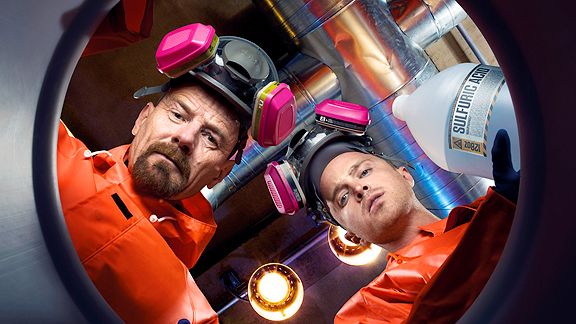
“Television is historically good at keeping its characters in a self-imposed stasis so that shows can go on for years or even decades,” says Breaking Bad’s creator, Vince Gilligan. “When I realized this, the logical next step was to think, how can I do a show in which the fundamental drive is toward change?” So Gilligan designed Breaking Bad to transform its hero into a villain—or, as he put it in his early pitch meetings, “Mr. Chips into Scarface.”

This breaks the contract that TV once fashioned with the viewer, that heroes were enchanted and protected from harm.  (The hero in Castle is always in harm’s way but will never come to grief.)  To visit a world in which heroes could go “all Walter,” we were obliged to abandon popular culture for art and literature.  (And no one wanted to go there.)

It’s also worth pointing out that as TV gets better, so does the criticism.  See this essay by Romano and the Chuck Klosterman’s GRANTLAND TREATMENT of Breaking Bad which explores Walter’s transformation with real intelligence and touch.

The trouble with Klosterman, for me, is that he works fearlessly, making a point, and then making all subsequent points depend on it.  There’s no modularity.  He doesn’t seal off sections of the argument.  He could care less about damage control.  He just keeps building and in no time, it’s all or nothing.  Naturally, many of the points are so good and so original that this carries the argument.  But in fact argument is shot through with discontinuities.  It has broken down and what we get (and like) is a kind of serialized illumination.  But, hey, I wish I wrote this badly.

Acknowledgments

Tom Asacker for pointing out the essay and the passage.

Meanings, Models and Men in Black

imagesDriving to JFK airport today, I looked at the remainders of the 1964 World Fair and thought, as I almost always do, how successfully they were used in Men in Black, the comic book and the movies.

In the World’s Fair, they are observation towers.  In the film and books, they become alien spacecraft.

To use my parochial language, this makes them “culturematics” and that’s because they repurpose culture and change the meanings of one thing (towers) into another (spacecraft).

Men in Black is filled with repurposing of this kind.  My other favorite: turning bad, incredible newspapers into a one of the few sources of information the MiB take seriously.

Ok, a third.  A creature arrives from outer space and demands a weapon from an earthling farmer.  This scene turns the warning “you may have my weapon when you pry it out of my cold, dead hand” into a negotiating position that the alien takes literally and accepts.  “That arrangement is satisfactory.”

You get the little jolt when something in your head changes meaning in this way.  Good metaphors always have that effect.  I get a little vertigo.  “Wait, those meanings that belong there don’t really belong there!?!  Oh, ok, they do. Very well.  Carry on.”   (I am not saying all metaphors are culturematics.  Because most metaphors are not experimental.)

The answer to the mystery of this meaning relocation may lie in the book I took to read on the plane: The Power of Impossible Thinking.  I am not crazy about the title (a little too Norman Vincent Peale for me) but I love the contents.  It’s by Jerry Wind and Colin Crook, both at the Wharton School.  I know Jerry a little and like him a lot which makes especially irksome the fact that I missed this book when it came out in 2006 and found it only literally a couple of weeks ago.

Power of Impossible Thinking argues that there is no real world, an assertion sure to warm an anthropologist’s heart.  What there are the models in our heads that help form what we see in the world.  So there is no economic action, no managerial initiative, no strategy, no insight, no decision, that is unshaped by the models, or as I would prefer, the meanings in our heads.

When an artist like Lowell Cunningham or a film maker like Barry Sonnenfeld reaches into your heads and reworks that World’s Fair observation towers, they have changed the meaning (or the model) in our heads.  And this is one of the reasons we write comix and go to movies, for the frisson of meaning (model) relocation, prefigurement, reconfigurement….whatever you call it.  We like that.

This makes especially puzzling the fact that when we are all “large and in charge” and working for an organization of some kind, we don’t like to hear about meanings or models.  We look at a book like Chief Culture Officer or The Power of Impossible Thinking and go, “no, really, is this quite necessary?  I don’t think so.”

So I admire that Jerry and Crook took this on.  It is a very tough sell.  Meanings and models are a little like the dark energy of enterprise world.  Yes, it’s out there but frankly managers  don’t know exactly what it is, how to think about it, or what to do about it.  And talking about it just makes  heads hurt.  This makes getting meaning or models into decision making and managerial discourse is ever so difficult!

Worse than that, I think people in their enterprise modality think of themselves having a “swift self.”  (This was an idea that came out of research I did for a book called Transformations.  More detail there.)  People in enterprise mode see themselves as being aerodynamic, the better, the quicker to assimilate data, make decisions, and act.  They love this swift self.  It’s a thrilling way to be.  But they often find that it eventually hollows them out, estranging them from family, friends, and other aspects of the self.   Still, it’s great fun while the party lasts.  In this swift self modality, the individual is  formidably capable, forging a smarter, clearer path to market share, say, or the creation of potable water in the Third World.

My favorite example of the swift self is Khalil Younes, a young man I got to know when consulting in Atlanta.  He was equal parts French, Lebanese and Harvard Business School and in his elegant, formidable way simply stared at problems til they dissolved into solution(s).

Here’s the problem.  In the swift self modality, people see themselves as a creature who cuts through the ideas and confusions that stand between themselves and satisfactory outcomes.  What Jerry and I call meanings and models, they think of things they are supposed to cut right through.  In their world, meanings and models are  the things that get in the way.  As a swift self, Khalil is reason.  He is Occam.

When Jerry and I ask Khalil to look at the meanings and models that mediate between the understandings and the world, it may well sound as if we are insisting on the impairment of this swiftness.

I think it’s likely for the swift self to reply with something like “Look, I have managed to be capable without entertaining the meanings or models you claim are active here, what are the chances this knowledge will make a difference?  On balance, I’m guessing it is more likely to interfere, taking more than it gives.”

This is not a bad argument until we get to the meat of the argument that Jerry and I are making and that is that the world is getting faster, more confusing and less scrutable.  And in circumstances like these, it makes sense to look hard at the meanings and models we use as instruments of apprehension…because when we don’t do this, we often can’t see the opportunities or the dangers now at hand.

Anyhow, I have just started the book and I will report back when I know more.   At a minimum, I think those who are Chief Culture Officers (or fellow travelers) might look to The Power of Impossible Thinking as another and perhaps a better way of communicating cultural understanding into the organization.  “Mental models” does sound a little less obscure than “meanings” and even this would be an improvement.  This might make a good Google Plus hang out at some point.  Anyhow, more to come.  I want to get this posted before I run out of internet service on board.

(Filed from 32,000 feet somewhere on the way to Austin.)