Tag Archives: ethnography

Just in Time (how to be an anthropologist in business)

As the academic world continues its slow motion descent into financial and sometimes intellectual insolvency, some anthropologists seek employment in the world of business.

The Journal of Business Anthropology asked me to describe my experience. Here is what I wrote for them.

But first, here’s an image from the field. It’s me talking to respondents who were too busy to sit for an ethnographic interview. “That’s ok,” I said. “I can interview you at the gym.” In the world of business, anthropology thy name is opportunism.

Just In Time
How to be an anthropologist in business

I assume I am talking to anthropologists who spend some, much, or most of their career outside the academic world. I assume that my job is to offer advice on one of the ways this can be done.

For starters, I should say that I don’t think of myself as a business anthropologist. My plan was to use business consulting to finance my anthropology. 

I consult half the year and write half the year. The first half pays for the second. COVID was going to make my income disappear. I don’t have much of a cushion. Bankruptcy now beckoned.  

What COVID threatened to take away, it would also give, I hoped, in the form of an opportunity to study the American family in a moment of confinement. I’ve studied this family for some 30 years, with particular attention to its material culture and build form. I look in from time to time, most recently to figure out that “what” and the “why” of the great room. 

Surely COVID would test this family and home. Surely it would force deformation and reformation. This is the first revelation of studying the American family and home. They are feverish works in progress. Americans are here, as elsewhere, fly-by-the-seat-of-their-pants inventors. 

My favorite example: an African American single mother of modest means who had used her local zoo as a place to amuse and instruct her kids (a pre-teen boy and girl). COVID closed the zoo. So she bought a guinea pig which she told me did a surprisingly good job standing in for the zoo. (I remember putting the phone down and having a good cry.)

So the intellectual opportunity was obvious: I could go see what COVID would mean to the family. What was happening to house, home and kinship under these extraordinary stresses?

But unless this study was also a commercial opportunity I was done for financially. Surely, I thought, industry would want to know what was happening in the family. And for the first time in my career, I was soliciting work instead of waiting for it. Plus I was undertaking my anthropological work for commercial return. (Normally, I merely solve the problem the client has for me…and return to an anthropology that’s entirely my own.)

The work returned many points of interest. The most striking finding was that mothers and daughters had found one another. Mothers said, “I have my daughters back.” They meant back from college and back from the preoccupations, digital, social and athletic, of being a teenager and a preteen. Mothers and daughters were, they said, “talking, sharing, connecting.” (I think this may leave us with a new degree or kind of matrifocality.) 

It turned out industry didn’t much care. No one wanted to hear what I had learned. I got some press (Wall Street Journal and Washington Post, links below). And still no one in industry cared to hear what I had to say. (FN: https://www.wsj.com/articles/how-covid-19-lockdowns-have-boosted-mother-daughter-bonds-11600804296; https://www.washingtonpost.com/lifestyle/2020/10/30/mothers-raise-kind-daughters-covid/)

Moms were clearly the heroes of these scenarios. Guinea pigs were just the beginning of their creativity. Building new relationships with the daughters were not be any means their biggest accomplishment. Mom (when it was a mom) got the family through a horrible time.

I mentioned “mom heroism” to anyone who would listen: friends, colleagues, journalists. Their response was surprise. People seemed to say, “But this is what moms do.” And clearly it is what moms do, but it remains I think odd that they should get so little credit. Even in this time of peril, even as they did heroic things, what they got was “That’s moms for you.” 

A note on method

You see things like guinea pigs standing in for a zoo, and moms rising to the occasion, fleetingly, because nothing happens in the consulting world that’s not a blur. It is only because you will go back to the same terrain, and because ethnography comes with an “extra data” opportunity, that we can use consulting work for anthropology purposes. (FN: https://cultureby.com/2006/09/ethnography_and.html.)

“Fleetingly” is pretty much our modus operandi as anthropologists in business. We are trained to dwell, interrogate, contextualize and variously worry the data until it’s thinkable and then presentable. Anything less invites the scorn of our colleagues and a certain self loathing. Indeed, “fleetingly” so contradicts our academic training that it can feel like a betrayal of private hopes and public responsibilities.

We are in effect learning to live like journalists. We are moving at speed from “story” to “story.” But anthropologists have an advantage: they are scrutinizing the world from an organizing, X-raying point of view. Systematic properties reveal themselves. And we are working not with events frothing on the surface of public life, but with more enduring materials (e.g., cultural categories). Finally, while we will work for many clients who ask a variety of questions, we return again and again to some of the same topics (e.g., American family and home). Most of the people with whom we compete in the research and consulting world practice amnesia. We gather as we go.  

To say we resemble journalists and, to that extent, disappoint our missions as anthropologists, is indeed one way to look at it. We could also see our predicament as a trade off. Certain opportunities are denied us. But others are now possible. 

Those who do business anthropology learn to work at speed. We can’t make a living unless we are prepared to capture data, work out understandings, conclusions and recommendations, and write these up, all more or less in real time. There’s no time for taping or transcription. There is precious little time to dwell. Lean in? We are pitched forward, obliged to watch topics constantly pulled away from us by the current. We can’t help feeling there are riches here if we only had time to examine them.  

The advantage is that we learn to work fast. I wrote two books during the COVID period, thanks chiefly to my consulting training. One was called the The New Honor Code (Simon and Schuster 2021). The second is The Return of the Artisan (Simon and Schuster forthcoming 2022). (I wanted to call it The Return of the Native, but apparently that was taken. I kid.)

The first book is a piece of applied anthropology. As a grad student at the University of Chicago, with Marshall Sahlins (he of sainted memory) as my advisor, I studied Elizabethan England. This was interesting fieldwork for lots of reasons. It helped me see an honor code at work. And as I began to see bad behavior break out in American culture, I wondered “is there something in the Elizabeth case we could reengineer for use in the contemporary world.” 

There is a presumption here that was new to me. Writing a book that aimed to change American culture? Surely, my job was to study culture, not reform it. But the more you study American culture, the more you see how responsive it is to individual initiative. (How else to understand Gloria Steinem, Tom Wolfe, Virgil Abloh, well, and for that matter, Margaret Mead?)

I wrote Honor in real time, piecing things together in my head as I went. This is “just in time” assembly I couldn’t imagine before consulting had transformed me. I am the graduate student who spend an entire weekend on a single paragraph, not because I was scrupulous, but because I was such a very bad writer.  

Just in time assembly means you work with available materials. In my case that meant drawing on a career thinking about American culture on the grounds that “if honor is to be restored, it will have to find a place for itself in the present sea of cultural and moral innovations.” This gave me license to treat the American avant-garde, mid century modernism, the hippy revolution, the preppie rejoinder, the artisanal movement, celebrity culture, the rise of the millennial, the Gen Z rejoinder, and changing models of American selfhood, sociality and story telling.

You’d be surprised how useful these materials can be to a man who has to come up with 60,000 words in a very months. I was. And grateful. Surely we are done with authors who offer bold new reform with no thought to the American culture it must join if it has any hope of adoption. Otherwise we’re left with an ideational accumulation, a thing of threads and patches. Patches, mostly. We inhabit a culture that’s fast losing the integration Boasians, and some of the rest of us, held dear. 

To write a book fast you need the right voice. And I think consulting gives us this too. We are writing for non anthropologists, non academics and people who are haunted by deadlines and targets. This means we learn to aim for clarity. For the Honor book, I decided to go for a kind of high-polish exposition relieved here and there by informality. 

Here’s a passage. (It is part of my description of the Tilbury speech delivered by Elizabeth I on the eve of the attack by the Spanish armada in 1588. Honor played a key role, not in evidence here.) See what you think. 

In the sixteenth-century scheme of things, England was little and vulnerable. The troops at Tilbury were hungry, underpaid, and properly terrified. By the Spanish standard, this island was poor, provincial, and home to hundreds of thousands of Catholic sympathizers who had been encouraged to rise up in support of the enemy.

Elizabeth’s Tilbury speech was theater in the service of statecraft, infinitely more compelling than the amateur production being staged in the channel by foppish aristocrats firing off conflicting instructions. (The commander of the armada, the Duke of Medina-Sidonia, had never fought at sea.) The Spanish called their armada invincible. Elizabeth had come to Tilbury to say, “No, actually, this is what invincible looks like. My courage will triumph over your titles and grandeur.” This is Elizabethan for “Bring it.”

There are a couple of rhetorical strategies the normal anthropologist would never use. The ‘word painting’ that stands in for patient review of data and argument. The total eclipse of scholarly reference. (Normally, available only to the Geertzian aristocrats among us). The sneering at foppish aristocrats. The daring, off-with-his-head, presumption of putting words in the mouth of a monarch who was the flower of Renaissance humanism and a master rhetorician. The last line is especially cringe worthy. But this was my effort to bring in the reader by being a little less, actually anti, oratorical. 

I am behaving in a way that would horrify the academically scrupulous. The idea is to sacrifice rigor for approachability and agreeability. Consulting has helped me see that this is less a choice than an obligation. Yes, there is something a little shocking about the anthropologist who fails to “ping the tower” of scholarship as he goes. But the reader unfreighted by scholarship can make better speed and accomplish real distances. Does she survive these compromises without undue harm? I guess she has to make this decision for herself. 

And this last point is a gift of consulting too: that I don’t presume to anticipate all of the needs or reactions of my reader. I look to be useful, interesting, illuminating and clear, and leave the rest to them. Yes, I am not scrupulous. We are, anthropologists are, these days sometimes perhaps preoccupied by scruple. This makes our work tough sledding for the general reader. They say, “Sorry, what? Oh never mind.”

The second book was called Return of the Artisan. It sprang from the Artisanal Economies Project (AEP) that Sam Ford and I founded a couple of years ago. Sam and I had met through Henry Jenkins’ Convergence Culture Consortium at MIT and at some point we started thinking about what we could do to help address the opioid abuse then (and still) raging in the US. 

Our idea was to make artisanal activity a way to address lost industrial employment, a bulwark against the despair that sometimes follows unemployment, and the addiction that sometimes follows despair. Could we help induct people into the artisanal economy? We hoped that even a tentative engagement there might sustain self confidence and community connection. (Artisanal economies are very social and collaborative creatures.)

Sam and I did research across the US, much of it in the Midwest and South. We put together an elementary website at http://www.artisanaleconomiesproject.org, a kind of “lazy susan” of options. We hoped people would scroll through and find something of interest, start small, and scale up. The project failed to generate much interest and it didn’t draw the funding we needed to push the project further. (We had funded the research and the website out of our own pockets and those resources were now beginning to empty out.) 

Now the issue was salvage. (Opportunism must sometimes be the business consultant’s middle name.) I had been working on the topic since 2006 and Sam suggested I think about combining that work with the AEP data, and create a book.  

Before consulting, it never occurred to me to start an organization like AEP. My engagements with the world came in the form of books and articles. The university was my exoskeleton. If I was to have any kind of influence, it would be through my students and their students. Marshall Sahlins is an exemplar here. (I am one of his influences, a modest one to be sure.)

But what if what you need to engage the world more directly? Then you are in the “start up game,” as they call it in Silicon Valley. That’s a very different kettle of fish. And yet another learning curve. And, just to mix my metaphors thoroughly, a recipe for disappointment. Creating an organization is really to reckon with the crooked timber truth of humanity. Nothing is simple. Because (new metaphor alert!) humans really are cats and, as the phrase has it, impossible to herd.  

But you can start a business. As a consulting anthropologist you have met and worked for lots of people who have created organizations. This removes most of the mystery and all of the awe. There’s lots of precedent and, if you ask for it, advice. 

Starting an organization concentrates the mind. If you make a success of it, you may also get an “equity payday” when you get “bought out.” I have preferred to treat books as the big ROI that would see me into my retirement. I’m still waiting. Honor didn’t have a natural audience. Return might.

The artisanal story was really fun to tell. Again I’ve used a convivial prose. See what you think.

It’s a shocking thing to think. We’ve become habituated to the idea of office work. For years this had been the aspiration of almost everyone with a college degree. We got so very good at committee meetings, office speak, annual reviews, feel-good picnics, and morale building exercises, it’s a wonder we got any work done at all.

So a new model of work, this catches our attention. The artisan doesn’t have a suit to wear to work. She didn’t have an office or a parking space. She didn’t lie awake at night and worry about promotions. Her annual review is going to a local cafe with a friend and asking, “So how am I doing, do you figure? Be honest.”

The Artisan book shows some of the symptoms of hasty construction. In the place of a single grand model, I identify 24 properties. These stretch from “hand made” and “human scale” to “unbranded” and “storied.” These represent a shameless piling system. I stopped when I thought I might have covered everything. Here too integration got short shift.

Even in haste, there were wonderful things to notice. There was the strange duality of the artisanal economy. Especially, as we saw it operating in Kentucky, it was, my phrase, not theirs, “a grid below and a dome above.” People see themselves and their enterprises as emphatically free standing. They do not ask for support or succor.  But they are constantly throwing off acts of generosity designed to serve the larger community. We interviewed a farmer who keeps an exotic species of sheep. He will never recover the costs of doing this, but he believes this matters to the community. In the “grid below,” advantage is calculated and pursued, steelyly, so to speak. Everything is counted. In the “dome above,” everyone gives and takes freely. No books are kept. No debts are registered. Nothing is owed.

This is direct and indirect exchange in a perfect laminate, discrete economies that operate almost without contact or mutual acknowledgement. When you ask why people give so generously to the community, the answer is various: God, church, community, caring. But usually the answer was “Kentucky.” I pursued this and was eventually told, “Kentucky is the only place that gives you a tattoo on the inside.”

Anthropologists have lots of natural advantages. It has tattooed many of us on the inside. This gives us a chance to carry our professional identity into our consulting life and, with the appropriate adaptations, serve our culture with an understanding of our culture they cannot get from any other social scientist, journalist, or helping professional. I don’t say that Durkheim, Boas, or Sapir  would look at my career and register even a flicker of recognition. But as I was leaving the academic world, I thought, “What could it hurt to pitch one more anthropologist into the world?” 

It’s a long shot but not a bad bet. And it cost the field nothing. This is one of the reasons I am sorry that the field has not supported consulting anthropologists more. Yes, of course, seen by unexamined assumptions, the consultant is the apostate. On the other hand, this experiment can advance the anthropology of American culture. And this culture needs all the friends it can get.

Bio

Grant McCracken is a cultural anthropologist. He holds a PhD from the University of Chicago. He is the author of 14 books including The Return of the Artisan to be published by Simon and Schuster in July. He was the founder and Director of the Institute of Contemporary Culture at the Royal Ontario Museum. Grant has taught at Harvard, University of Cambridge, and he was a member of the Convergence Culture Consortium at MIT. He is a co-founder of the Artisanal Economies Project. He is the inventor of The Griff, an early warning system for social and cultural change. He consults widely, and his clients include Google, Ford Foundation, Kanye West, Netflix, Reddit, Sony, Boston Book Festival, NBC, IBM, Nike, and the Obama White House.  For several publications: https://linktr.ee/grant27

Originally published:

McCracken, Grant. 2022. Just in Time. Journal of Business Anthropology. Vol. 11, No. 1. https://doi.org/10.22439/jba.v11i1.6617. 

Will “Only Murders” be funny? It depends.

Martin Short, Steve Martin and Selena Gomez to star in the new show Only Murders.

Variety tells us that the new show called Only Murders is a comedy. And it could be.

But there’s a dangerous alchemy attempted here. Bringing together distant generations is hard to do. It almost always descends into an effort to find the funny in mutual incomprehension.

And nothing is sadder.

Different generations are different cultures. Strict rules govern the comedic possibilities. It’s ok if Selena doesn’t get Steven and Martin. Cool rules. Youth doesn’t understand age as a matter of principle…and pride.

But it’s not ok if Martin and Steve don’t understand Selena. This occasions embarrassment and drives every bit of funny out of the room.

On the other hand, maybe not.

Martin Short is a genius. Steve Martin is very funny. And show runner Dan Fogelman is gifted.

So.

Maybe.

But here’s a solution. It comes straight out of the ethnographic data. Call it a gift from anthropology to Hollywood.

My interviews with Millennials tell me two things:

  1. that Millennials are often “playing” boomers, creating the impression that they like and admire them. Boomers are so clueless they don’t know they are being played. And if you can’t turn this into funny, well. Make this a running joke and you have a comedic device that will return riches.
  2. that Millennials sometimes conduct a private, coded communication with other Millennials as a way to comment on one another and Millennials. I studied an office in London where everyone sat around a table. Above table, they carried on an amiable conversation. Below table, chiefly in some social medium, Slack or Discord or something, they kept up a withering commentary.

So it’s simple, really. Let Steve and Martin not “get it” all they want, but allow Millennials this method of managing them.

Two new books!

My apologies to readers.

I haven’t posted in a while.

But I have an excuse.

Two excuses actually.

I spent the first half of 2020 scrambling to finish a book. The New Honor Code is now out. (Please support Cultureby.com by buying a copy!)

And I spent the second half of the year scrambling to finish The Return of the Artisan. This too is from Simon and Schuster and appears in the Summer of 2021. (Pre-order here: https://www.amazon.com/Return-Artisan-America-Industrial-Handmade-ebook/dp/B08LDVY6J2/. Please.)

Charlie Rose vs. George Lucas

la-et-st-charlie-rose-new-pbs-weekend-show-201-001Charlie Rose recently interviewed George Lucas. At the 16 minute mark, we see these two great men cross swords.

It’s a good talking point for those of us who are interested in the art of the interview (and especially the ethnographic, anthropological version thereof).

There are a bundle of strategies that make an interview work. One of the most important of these is not just the tone of questions we ask, but the tone of the attention we give to answers we get.

The idea, call it the “total approval rule,” is to indicate by body posture, facial expression and follow up questions that we approve of what the interviewee has said.

The idea, generally speaking, is that this initial approval will encourage the interviewee to be more forthcoming. In a perfect world, our initial performance of approval encourages answers worthy of a more genuine (less performative) approval.

(This strategy works in the real world. Today at lunch lean in and pay very careful attention to something said by your lunch partner. Nod and smile with a Southern’s grace. Hey presto, your lunch partner will instantaneously become 15% more interesting, [margin of error: +/- 3%.])

But something happens in the Lucas interview. No matter how much Mr. Rose tries to draw the great man out, Lucas will not be moved. He has a set of stock answers. He has a stock attitude. The fact that these answers are not very interesting, sophisticated or intelligent does not trouble Mr. Lucas.

He is, after all, George Lucas. (I have a friend in Silicon Valley who says that the moment you make your first handful of millions is the moment you stop growing. If you are not very careful you will always be that person, trapped in a haze of self congratulation, persuaded of your own sufficiency, your veritable perfection.) George Lucas has been a big sneeze for many years. He is the inhabitant of a celebrity culture in which every answer he cares to give is normally celebrated as completely riveting. He is now a great man grown a little tired of the pomp and ceremony of popular culture who doesn’t quite grasp that this popular culture has claimed him. It has forgiven him so many banal answers, these are the only answers he has left to give. Irony of ironies, this consummate story teller is now telling his own story badly.

But of course Charlie Rose is Charlie Rose. He is now so powerful and important in our culture that an interview with him is a little like being called to account by St. Peter. It is probably better, on balance, to bring your “A” game. You are now longer talking to 7:00 TV, those Entertainment Tonights of the world that are just happy if your mouth is moving once the film rolls.

It was interesting to watch the tension grow.

At around the 16 minute mark, Mr. Rose asked Mr. Lucas how he feels about his impending Kennedy Center award.

“Well, I could be glib.”

Something in Mr. Rose snaps, apparently, and he breaks the “total approval rule.”

“No, just be real.”

Holy toledo. This is Mr. Rose making clear that he will not stand for a rhetorical brush off. And now he dares actually instruct Lucas. He talks about the importance, the honor, of the Kennedy Center event.

Lucas is having none of this and reverts to the contempt with which Silicon Valley, Hollywood and people fashioned in the 1960s have always regarded the shadow puppetry of Washington.

“I don’t much care about awards.”

“But there are awards and there are awards,” Mr. Rose fairly explodes. He is now obliged to lecture Mr. Lucas on what the Kennedy awards are and why they matter.

Methodologically speaking, this is normally not done. It is almost the first thing they teach you in anthropology school. Don’t lecture the respondent. You are there to capture what they think. It doesn’t matter what you think.

Lucas will not be moved, “We get awards all the time.” And this draws the match to a stand off, both parties having made themselves clear.

In a sense this is a geo-cultural contest between different parts of the country. George Lucas takes the West coast position that doesn’t think much of conventional politics. Charlie Rose, a man who knows exactly that, and how much, these politics matter, begs to differ.

But this is also a study in the internal dynamics of the interview from which something can be learned. There are moments in an interview when I think we must be allowed the, let’s call it, “Charlie Rose allowance.” We can only be expected to indulge the unthoughtful (and the sanctimoniously unthoughtful, at that) for so long. And then we are allowed (perhaps obliged) to let the respondent have it, to lecture them on all the light (read “world”) they cannot see. This lets them know that we are rescinding their indulged status as respondent, the one that says, I am interested in everything you say. We are putting them on notice: up your game.

It’s a calculated call. But when the quality of the interview is at risk, we must object and evoke the Charlie Rose allowance. Sure, the respondent may respond by, gasp, unclipping the microphone and quitting the interview. But the risk is worth taking. Nothing matters more than the data. Not even the respondent.

Dark Value, a new book published today

Ember Library Mediator

Here’s the abstract for my new book:

Innovators like Airbnb, Uber and Netflix are creating dark value. They are creating features and benefits they didn’t  intend and don’t always grasp. And because this value is hard to see, it’s hard to monetize. I believe dark value is a chronic problem in the innovation and sharing economies. To observe one implication of the dark value argument: Airbnb, Uber and Netflix are charging too little.

We will examine dark value created by AirBnb, Uber, Netflix, Evernote, Fitbit, and Facebook. We will show how to make dark value visible in three steps: 1. discover, 2. determine, and 3. declare. Ethnographers, designers, VCs, creatives, planners, PR professionals, marketers, story tellers, curators, programmers, content creators, and social media experts all have a part to play. For all of them, Dark value represents a new professional opportunity and a new revenue stream.

You can buy Dark Value on Amazon here.

Why buy it? If you are a culture creative in design, marketing, planning, ethnography, advertising, curation, this is a treasure map. It will also help you find new revenue streams, as you find dark value for others.  (It now occurs to me that “A Treasure Map” should have been my subtitle.)

What will it cost you? The price is $2.99. It will take you about 30 minutes to read. If you buy a copy, please send me an email and I will put you on a mailing list for updates. I’m thinking about a Keynote deck, and you would get this for free.


Make Ethnography Better

bloggables 3 d and four part.delineato

Ethnography has grown in the last couple of decades from a moody, friendless method in the social sciences to the belle of the business ball.

But clearly it has suffered in this rise to stardom. In the wrong hands, ethnography is now a license for the methodologically slap dash. To use the immortal words of Errol Morris, ethnography is now sometimes “cheap, fast and out of control.”

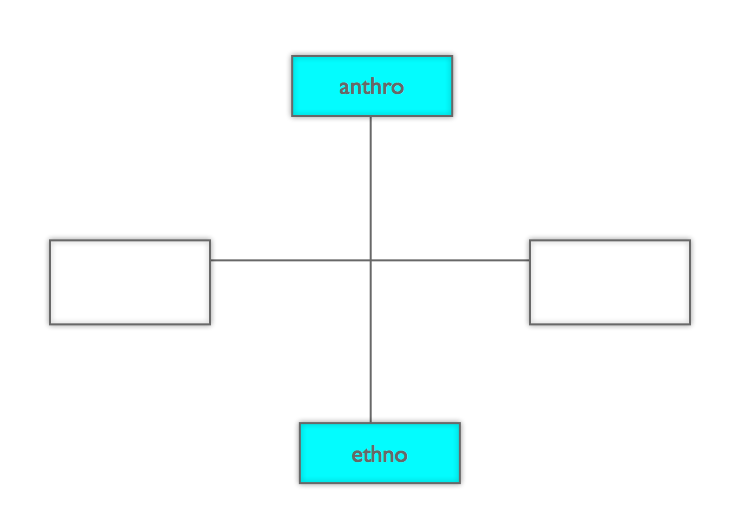
Part of the problem, I think, is that ethnography has been shorn away from anthropology. It was created by anthropologists (and to a lesser extent sociologists) and used in conjunction with anthropology (or sociology).

bloggables 3 d and four part.delineato

The advantage of adding “anthro” to “ethno” is that it allows us to put things captured in the life of consumer, user, or viewer in a larger, illuminating context. We can see, more surely, what it means. Without this larger context, ethnography devolves into simple observation, as in “this is what I saw when I was in a consumer’s home.”

Adding “anthro” to “ethno” also give us access to theoretical resources and intellectual traditions that contemporary ethnographers rarely seem to bring to bear on the problem at hand. (And I’m sure that I don’t need to say that the “problem at hand” for any ethnographer studying the ferocious dynamism of contemporary culture is usually formidable. We need any and all the powers of pattern recognition available to us. Airily dismissing the patterns made available by intellectual discipline and years of theoretical development is just dumb.)

How can we tell that someone is adding “anthro” to “ethno?” We are entitled to ask “where did you study anthropology?” (We could also use “sociology,” “film studies,” or “American culture.”) We are asking, “what do you bring to the table beside a claim to method?”

But this is only part of the problem. Too often, the researcher has no “depth of field.” He or she is incapable of seeing that this family, this home, the user, this community is a creature in motion changing in real change. Good observers have an acute sense of the historical factors at work here. They know what has happened in a very detailed way since World War II and they have a general sense of what has been happening in Western and especially American culture over the last 300 years.

bloggables 3 d and four part.delineato

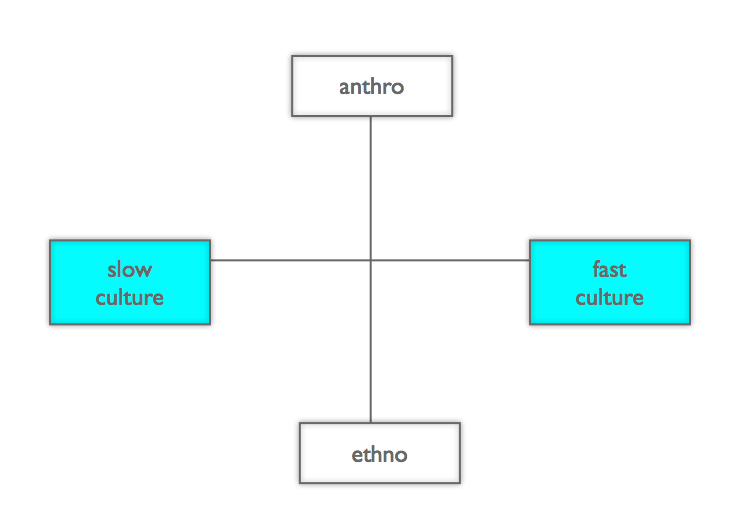
This gives us a glimpse of “slow culture” as well as “fast culture.” (For more on the distinction, see my Chief Culture Officer.) And now we are really testing the abilities of the self appointed ethnographer. Do they have depth of field? Now we are entitled to ask, “tell me about any big, enduring trend in American culture. How did it take shape over time?”) (Don’t be surprised if they are astonished by the question.)

Here’s the problem. Most of the work being done by ethnographers is being done here.

bloggables 3 d and four part.delineato

But this ethnography is stripped of the things that gives it real explanatory power.

What we need is something that heads in this direction.

bloggables 3 d and four part.delineato

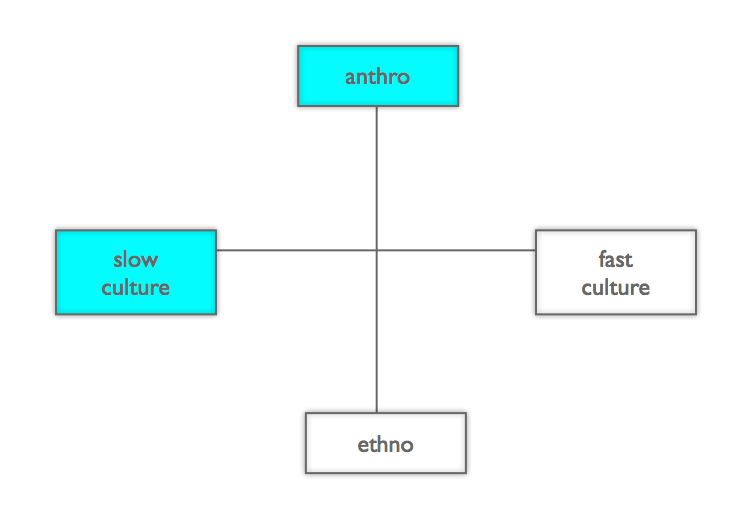
If ethnography is to evolve, we want to migrate in the direction of “anthro” + “slow culture.” We could think of this as a “Northwest passage” strategy. Until we find a way to connect these worlds, the Southeast sector must remain poorer and less cosmopolitan.

It’s not clear to me what the practical solution is. I did a couple of posts about the C-school idea a few years ago and discovered some of the following programs, any one (or several) of which might take up this challenge. (Notice that I am not saying these places have a solution, merely that they are the kind of places that might come up with one.)

The D school at Stanford (David Kelley)
W+K 12 (Wieden + Kennedy school, Victor a German Shepherd pointer)
The Miami Ad School (Ron & Pippa Seichrist)
The VCU BrandCenter (Helayne Spivak)
The Berlin School of Creative Leadership (Michael Conrad)
EPIC (Ken Anderson and Tracey Lovejoy)
UC Berkeley School of Information (AnnaLee Saxenian)
California College of the Arts 
Royal College of Arts
MIT Media Lab
Rhode Island School of Design
IIT Institute of Design (Laura Forlano, thank you Sergio)
Ethnography Training (Norman Stolzoff and Donna Romeo)
Consortium of Practicing and Applied Anthropology
Ohio State (Liz Sanders)
University of North Texas
Wayne State
Columbia Business School (Bob Morais)
Fordham Business School (Timothy Malefyt)
Savannah College of Art and Design (Sarah Johnson and Susan Falls)

As I was noting here, the Annenberg School at USC is coming up fast.

Finally, I recently had lunch with John Curran and he tells me that things are afoot in London. I will leave it to him to reveal the details. (John, please send me a link so that I can include it here.)

I am hoping readers will let me know the programs I have missed.

Craig Young: an interview in SF

I did this interview for a project called Automated Anthropologist.  (I went to San Francisco and let it be known that I was prepared to do anything anyone told me to do, within the limits of morality, legality, and being Canadian.)

With the help of Maria Elmqvist (now a Strategic Planner at Perfect Fools in Amsterdam), I talked to Craig Young.

I like this interview for a couple of reasons but chiefly it’s Craig. Really clear, forthcoming, and helpful. I paid him, so I was making some small contribution to his economy. But he went above and beyond the call. (Maria and I approached another guy for an interview and he said, “not so much” in a way that sounded unmistakably like “go f*ck yourself.”  Craig’s generosity was especially welcome.)

Another thing I liked about the interview was the glimpse it gives of city life. In this case, of the invisible distinctions of space that are perfectly clear to Craig and a surprise to the rest of us (if and when discovered by the rest of us). The world is filled with this invisible distinctions. They surround us all the time. The secret of ethnography: keep an eye out. Ask everyone.

A third point to make is methodological. Interviews a guy like Craig is difficult because you are (I am) concerned that you are (I am) going to ask something insensitive. In addition to invisible spaces, there are invisible sensitivities, and the last thing you (I) want to do is blunder into them.

Hence my tone, which is deliberately convivial, kinda loud, and bit clueless.  The cultural logic is this: if this guy (me) is incapable of certain subtleties, he may give offense, but he doesn’t mean to give offense.  (We may think of this as the “big stupid labrador” defense.) I know this is counter-intuitive, but then it is a cultural logic, not a logical logic. Ironically, the more you signal an effort not to give offense (by agonizing over choice of words and so on), the more likely you are to give offense.

A fourth point, this one moral: there are people in the research community who believe that an interview with Craig offends morally and politically. The notion is that I am taking advantage of a power asymmetry. Yes, it’s true, asymmetries raise the possibility of exploitation. And then it’s incumbent on me to see and say what my motives were. The answer is that for the purposes of Automated Anthropologist I was talking to anyone who would talk to me. Did I take more than I gave? That’s a tough one. I paid Craig. So there was an exchange of value. Only Craig can decide whether he was properly compensated. The danger is that if we decide that we shouldn’t interview Craig for political reasons, he is denied the engagement and the pay. I think it’s for Craig to decide whether he wants to do the interview, and to remove this choice from him really does enact a power asymmetry. Apparently, we know better than he does. We decide for him. But this is not an easy issue.

A fifth point: I am glad to know even a little more about Craig and what life is like in the street. The idea of having to worry about people “stealing your stuff” is a revelation. I can’t imagine this order of disorder in my life. It’s all interesting to see that there is more order than I would have expected, certain work arounds, a schedule, a support network. All of these discourage the idea I tend to have of life on the street, that it is radically unstable and always on the verge of the cataclysmic. And I guess that’s one thing to take away from the interview, that life on the street is both quite stable and always on the verge of the cataclysmic.

A sixth point: the defense of this interview, the defense of all ethnographic work, is perhaps that the other is a little less other. I don’t think I carry diminishing ideas of people who live in the street. (I don’t romanticize them. I don’t blame them.) But it’s also true that, beyond that, I don’t know what to think. Ethnography, even a very brief interview of this kind, helps give us access to one another. And this is a necessary condition, I think, of empathy and aid.

One last point, everyone with a smart phone is now in possession of a fantastically good piece of recording technology. I wish I were doing more of these interviews. I wish we all were.

Post script: thanks to Maria Elmqvist who did the camera work and participated in Auto Anthro with intelligence and a real ethnographic sensitivity.

Bud Caddell

Whenever I have the chance to talk to Bud Caddell, I take it. This’s because while I know the future is badly distributed (in Gibson’s famous phrase), I fervently believe it must be somewhere in the near vicinity of Bud Caddell.

In this 10 minutes of interview, Bud talks about the following things

00: 37:00 mark (~) that with his new company Nobl Collective, he is learning how to configure the culture inside a company to articulate it with the culture outside the company.

00:58:00 the digital disruption changes these things in succession

  1. culture
  2. how brands communicate
  3. how products are made
  4. the teams within the organization

1:39 On joining the world of advertising and why he left.

3:43 the thing about that very famous Oreo campaign (that it took 6 different agencies, and a lot of money). This was not the “safe to fail” experiments the world now holds dear.

4:20 companies are having to learn to both optimize and futurecast, and that these are opposing challenges.

6:00 there is a tension in the corporation between pushing the innovation team too far away or holding it too close. (Amazon is the case in point.)

6:43 Nobl believes that companies take human choice away from teams. The point of Nobl is to restore that choice.

10:20 Bud is concerned that, all the noise to the contrary, we are actually moving away from small startup entrepreneurialism. Bigness is not dying, it’s once more on the rise.

11:56 Bud is concerned that with this culture inside, the culture outside (i.e., American culture) could narrow and something like a 50s monoculture

11:18 organizations are inclined to treat employees like errant children or robots. The point of the exercise find their strength, not assume their weaknesses. Give them autonomy. (Because they can’t navigate the future, they can’t create value, without that autonomy. My words, more than Bud’s. Sorry!)

??:?? Nobl aims to construct core teams with 4 properties

  1. customer obsessed (prepared to “leave the building” to find out more
  2. closely aligned with one another
  3. autonomous, free to discover an idea and test it
  4. organized by simple rules

Thanks to Bud for the chance to chat.

I am hoping to do more of these interviews. My assumption is that we are all works in progress working on a work in progress in a work in progress, and that to listen to one another as we configure works1, works2 and work3 is interesting.

One last note on method. This interview might stand as a grievous example of “leading the witness.” I was shocked when listening to it again to hear that my questions were more about me and less about Bud. Yes, you have to start somewhere. And yes, inevitably you are going to speak from what you know. But the very point of ethnography and the thing it does so well is to discover things you don’t think and hadn’t ever thought to think. It’s always a chance, more vividly, to get out of our heads into that of the respondent. Or to put this another way, I was insufficiently curious in this interview.


The real message of advertising?

If the art of advertising (one of them anyhow) is closing the distance between the brand and the consumer, you can’t do much better than this.

https://www.youtube.com/watch?v=teFGIvYbkiM

Do we know you?  Yes, we know you.  This is sometimes the most urgent question advertising has to answer.

I’m told that the people responsible for this work at Digitas were  Michael Frease and Jeremy Bacharach.  Hats off to Jon Hall, Senior brand manager at Whirlpool  (See Dale Buss’ interview of Hall in Brand Channel here).  I would especially like to know the names of the people who did the ethnographies.  Really top notch work all around.

Acknowledgements

Thanks to the magnificently talented Scott Donaton.

Bosco 3.0: ethnography and design to the rescue

I’ve been thinking some more about Bosco, the kid who knows all about meth labs and not a lot else.

It’s a problem that demands anthropology, ethnography, design thinking, strategy, marketing, several of the intellectual practices we now have on tap.  (See the preliminary posts here and here.)

One approach: transfer the knowledge possessed by kids of privilege.  So that Bosco does not suffer that pernicious disadvantage of constrained horizons or what we might call a “cosmopolitan gap.”

There’s an inclination to say, “Perfect!  It’s a simple transfer.  We find out what Tommy (child of privilege) knows and send this knowledge to Bosco.”

EmberBut of course it’s not this simple.  Knowledge is not data organized according to a single scheme.  It is not something that exists independent of communities and practices of knowledge.

So it’s NOT the case that Bosco’s knowledge of the world looks like this on a grid of knowledge.  (B = the things on the grid of knowledge that Bosco grasps.)

Ember

Tommy’s richer knowledge of the world does NOT look like this:.  (Where T would stand for the [many more] things Tommy understands.)

Ember

So it’s NOT the case that all we need to do is to communicate Tommy’s knowledge to Bosco.

Instead, knowledge is variously assembled and framed so that what is knowledge in one system may not show as knowledge in another system.  Or knowledge in one system may show in another, but it takes on a new place or significance.  This is an elaborate way of saying we don’t just need to know what Tommy knows but what Bosco knows.  And then we have to build a translation table.  Not a Rosetta stone, but something more complicated and calculating.  Less a translation table, more a translation machine.

Notice that we are not taking the postmodernist bait and sliding into that sophomoric relativism that says Tommy and Bosco live in  worlds so different that communication or transfer is impossible.  This is good fun to debate in a university seminar.  But when it used to frustrate our rescue mission, specious nonsense turns dangerous too.

Off the bat, I can see two ways that cultural creatives can help.

architecture of knowledge

This is what ethnography is for, after all.  We can sit down, and capture the categories of Bosco’s knowledge, how these go together, what assumptions they rely on.  We can build a rough model of the inside of Bosco’s head.  And with this we can begin to figure out when, whether and how to begin the transfer of knowledge from Tommy to Bosco.  We noted in previous post that this transfer will have real implications for Bosco’s relationships with friends and family, but that’s not the problem we are solving here.  Our task is to discover what Bosco knows and the way he thinks and to use this to prepare the way for a transfer of knowledge.

visualization of knowledge

This is the really interesting part.  And now I am at the edge of my competence.  The idea here is to represent Bosco’s existing knowledge and to help Bosco see how new knowledge attaches.  Because as we know knowledge is adhesive.  This is why it’s easier to get knowledge if you have knowledge.  And of course knowledge is also hierarchical.  It’s hard to learn some things if you don’t already know other more general things.

This is a job for the designer, to create a visualization of what Bosco knows and to use that to introduce him to new knowledge and show how he can “attach” it to existing knowledge.  Where necessary we will build some intermediating pieces of knowledge, so that Bosco can learn something for which his existing system of knowledge does not yet have points for adhesion.  (Or we hold back knowledge until other knowledge is in place.)

Effectively, the cultural creatives will occupy a lab that might as well be called “the inside of Bosco’s head.”  We will know what he knows, what he is ready to learn, and what he has to learn to learn something new.  We will constantly be working on a grand visualization that helps Bosco assimilate new and useful Tommy knowledge.

These are thoughts only.  Your comments, please!

Chris Rock teaches a course on ethnography

photo-1America has a tradition of interviewers who can’t really interview.  I think it may start with Johnny Carson.  It got worse with David Letterman.  It may improve with the new lot on late-night.  We shall see.

Of course it’s wrong to ask comedians to interview well.  Their job is to find the funny and pitch the film.  There’s no time to ask a real question, no chance to open a view corridor on the guest.

But surely, we are a little sick of Hollywood “personalities” and would cheer the host who could occasionally crack open that polished candy coating called celebrity for a glimpse of the person within.  Is it too much to ask for the occasional question that goes the heart (perhaps even the soul) of the guest?  What could it hurt?  As prime time TV gets better, surely late-night could improve a little too.

Which brings us the Chris Rock documentary called Good Hair.   This is not late-night, but it could make a real contribution to late-night (and anyone else who wants to learn how to be a better ethnographer).

Good Hair is filled with great interviewing. The camera takes in Rock occasionally and while there is no question that he is aware of the camera and no question that he is sometimes playing to the camera, we catch him listening well (as pictured).

There are several enemies of ethnography.  One of these is self absorption.  Vain people can’t ask a question that has any hope of revelation because they only care about themselves.  They are dark stars, their curiosity never escapes the gravitation field of their own egos.  All questions bend back on the bearer.

The other enemy of ethnography is self dramatization.  Think of John McLaughlin, all bluster and tough mindedness (and no trace of nuance or thoughtfulness).  The interview is merely a platform for the McLaughlin performance, and this is now tedious.

It may be that Chris Rock is already a big enough star that he doesn’t need to commandeer the interview for his own purposes.  In any case, he doesn’t.

In Good Hair, Chris Rock demonstrates one of the really interesting moments of the interview, that moment when the ethnographer isn’t exactly sure what he’s asking and the interviewee is working hard to answer but doesn’t quite know what he/she is answering, and neither party is fully in control of the interview.

A guy like Larry King wants to keep things tidy.  The questions are crisp.  And answer are crisped.  King fields a answer and bangs off the edges, the imprecisions, the glimmers of some other meaning.  And, to be fair, this is the obligation of the old TV, to make things indubitable.

But things have changed.  Imprecision is forgivable.  It is indeed an opportunity.  You the ethnographer are not sure what you are asking.  You can just feel something out there beyond the scope of the interview.  And the interviewee, bless him/her, shares the intuition and is prepared to go looking.  Even if this means being a little vague for a moment.

There are several moments in Good Hair when the interview just floats.  Rock and his respondents are waiting for answers to form.  Sometimes, there’s silence.  What we can hear is people struggling to figure out how to think about this, how to talk about this.  These are delicious moments.  This is how you capture culture.

Clearly, it helps a lot that Rock is talking about a topic (hair) that is not much talked about. It’s a topic surrounded, he discovers, by prohibitions.  People don’t talk about it.  Even to themselves.  Coaxing this kind of knowledge out of its prohibited space is always interesting, and to get in on camera is really superb.

We are a culture enamored of ethnography.  And we are surrounded by bad interviewing and terrible interviewers.  Those of you looking for a short course on ethnography might consider watching Good Hair.

Culture Camp London 2014

Ember

I am doing a Culture Camp in London June 13.  Here’s the description.  Please join us!

Course Description

This culture camp is designed to do two things:

1) expand your knowledge of the big changes transforming culture.

2) develop your ability to put this knowledge into action.

Culture is at the core of the creative’s professional competence.  It is the well from which inspirations and innovations spring.  It’s one reason startups and corporations need the cultural creative.  This culture camp is designed to enhance your personal creativity and professional practice.

1. Knowledge of culture

We will look at 10 events shaping culture.

Half are structural changes.

1.1 The end of status as the great motive of mainstream culture.

1.2 The end of cool as the great driver of alternative culture.

1.3 The movement between dispersive cultures and convergent cultures.

1.4 The movement between fast cultures and slow cultures.

1.5 The shift from a “no knowledge” culture to a “new knowledge” culture.

Half are trends:

1.6 transformations in the domestic world (aka homeyness to great rooms)

1.7 transformations in the scale and logic of consumer expectation (from the industrial to the artisanal)

1.8 shifts from old networks to new networks (especially for Millennials)

1.9 shifts from single selves to multiple selves (especially for Millennials)

1.10 [this one is ‘top secret’ and will be revealed on the day]

2.  Using our knowledge of culture 

2.1  how to discover culture (using ethnography)

2.2  how to track and analyze culture (using anthropology)

2.3  how to hack culture (making memes)

2.4  how to build a brand

2.5 how to make ourselves indispensable to the corporation

Culture Camp is being sponsored by Design Management Institute and coincides with their London meetings.  It is also being sponsored by Truth.  (Special thanks to Leanne Tomasevic.)

The image is from Yanko Tsvetkov’s Atlas of Prejudice 2.   I am keen to stage the culture camp in Tomato Europe, Wine and Vodka Europe, Olive Oil Europe, and of course Coffee Europe.  Please let me know if you are interested in participating or sponsoring.

Culture Camp will be held 9:00 to 5:00 on June 13 at the Royal Institute of British Architects, 66 Portland Place, as below.  (Register for the Culture Camp here.  You don’t have to be a DMI or RIBA member to do so.

Ember

Ethnography, a brief description

I just banged out a description of ethnography for a client.

Here it is:

Ethnography

The object of ethnography is to determine how the consumer sees the product, the service, the innovation.  Often, this is obscure to us.  We can’t see into the consumer’s (customer’s, viewer’s, user’s) head and heart because we are, in a sense, captive of our own heads and hearts.  We have our way of seeing and experiencing the world.  This becomes our barrier to entry.  Ethnography is designed to give us a kind of helicopter experience.  It takes up out of what we know and lowers us into the world of the consumer.

Ethnography is a messy method.  In the beginning stages, we don’t know what we don’t know.  We don’t know what we need to ask.  We are walking around the consumer’s world looking for a way in.  Eventually, as we ask a series of questions, we begin to see which ones work.  We begin to collect the language and the logic the consumer uses.  And eventually, we begin to see how they see the world.

The method is designed not to impose a set of questions and terms on the discussion, but to allow these to emerge over the course of the conversation.  We are allowing the consumer to choose a path for the interview.  We are endowing them with a sense that they are the expert.  We are honoring the fact that they know and we don’t.  (Because they do!)

Eventually, we end up with a great mass of data and it is now time to stop the ethnography and start the anthropology.  Now we will use what we know about our culture, this industry, these consumers, this part of America to spot the essential patterns that make these data make sense.  “Slap your head” insights begin to emerge.  “Oh, that’s what their world looks like!” “That’w what they care about!”  “This is what they want!”

And now we begin to look for strategic and tactical recommendations.  Now we can help close the gap between what the consumer wants and what the client makes.

(For a more technical description of the method, please see my The Long Interview. Sage.)

Steve Portigal’s Interviewing Users

This is my Foreword for a new book on ethnographic method from Steve Portigal, Interviewing Users.  

–Foreword–

I was just looking at YouTube in a brave attempt to keep in touch with popular music, and I found the musician Macklemore doing a hip-hop celebration of the thrift store. (“Passing up on those moccasins someone else been walking in.”) Google results indicate that Macklemore is a product of Evergreen State University in Olympia, Washington. And this is interesting because Evergreen produces a lot of ferociously creative kids—wild things who care nothing for our orthodoxy, and still less for our sanctimony.

Now, our curiosity roused, we might well decide to go visit Evergreen College, because as William Gibson put it, “The future is already here; it’s just not very evenly distributed.” Evergreen would be an excellent place to look for our futures. But it wouldn’t be easy or pleasant. We would struggle to get a fix on the sheer volcanic invention taking place here. Our sensibilities would be scandalized. We would feel ourselves at sea.

And that’s where ethnography comes in. It is, hands down, the best method for making our way through data that is multiple, shifting, and mysterious. It works brilliantly to help us see how other people see themselves and the world. Before ethnography, Evergreen is a bewildering place. After ethnography, it’s a place we “get.” (Not perfectly. Not comprehensively. But the basics are there, and the bridge is built.)

And that’s where Steve Portigal comes in. Armed with his method of interviewing, years of experience, a sustained devotion to the hard problems that our culture throws off (not just at Evergreen State College), and a penetrating intelligence, Steve could capture much of what we need to know about Evergreen, and he could do it in a week. And that’s saying something. Steve is like a Mars Rover. You can fire him into just about any environment, and he will come back with the fundamentals anatomized and insights that illuminate the terrain like flares in a night sky. Using his gift and ethnography, Steve Portigal can capture virtually any world from the inside out. Now we can recognize, enter, and participate in it. Now we can innovate for it, speak to it, serve it.

And if this is all Steve and ethnography can do, well, that would be enough. But Steve and the method can do something still more miraculous. He can report not just on exotic worlds like Evergreen, but the worlds we know—the living room, the boardroom, the not-for-profit, and the design firm. This is noble work because we think we grasp the world we occupy. How would we manage otherwise? But, in fact, we negotiate these worlds thanks to a series of powerful, intricate assumptions. The thing about these assumptions is that, well, we assume them. This means they are concealed from view.

We can’t see them. We don’t know they are active. We don’t know they’re there. Ethnography and Steve come in here, too. They are uniquely qualified to unearth these assumptions, to discover, in the immortal words of Macklemore, those moccasins we all go walking in.

This is a wonderful book. Steve can teach us how to improve our ability to penetrate other worlds and examine our assumptions. Ethnography has suffered terribly in the last few years. Lots of people claim to know it, but in fact the art and science of the method have been badly damaged by charlatans and snake oil salesmen.

Let’s seize this book as an opportunity to start again. Let Steve Portigal be our inspired guide.

Use discount code mccracken2013 to get 20% off Steve’s book here.(http://rosenfeldmedia.com/books/interviewing-users/).

The anthropologist’s briefcase

I am planning ethnographic interviews for the new year and I’m putting together an equipment list. 

An ethnographic interview is a delicate thing.  You are trying to build trust with a perfect stranger, sometimes in their own home or workplace.  

The trick is to keep distractions to a minimum.  (Because from distractions, suspicions, detachment and alienation often come.)  

Two principles follow from this.

1.  If you can help it, you don’t want an extra person in the room, fiddling with equipment, gazing around, and otherwise distracting your respondent.  In a perfect world, you would operate everything yourself, setting it up and letting in run.  (There is lots to be said for having someone worry about the tech while you worry about the interview, so the jury is for me still out on this question.)

2.  You want as much video/audio fire power as possible in the smallest form factor possible.  You don’t want the camera, mics or lights to get in the way.  

This camera pictured here is the JVC GY HM 150U.  It has good picture and good sound.  It has time code that consumer cameras doesn’t.  It records in .mov so which means files can be sent directly to Final Cut Pro.  It has the capacity to record great chunks of testimony.  It is reasonably inexpensive (~$2100.00) and it is surprisingly small.  (This picture makes it look larger than it is.)

We are an image-crazy culture so some people think their work is done when they buy a good(ish) camera.  But sound is absolutely key.  

And that means buying a good microphone.  The Sennheiser EW ENG G2 gets good reviews on Amazon.  It’s around $700.00.

Good lighting is also important and I am just not sure what the best/smallest kit is here. Dec. 18 addition: just came across the Westcott Icelight and while not cheap, this looks little and light.  Here it is on Amazon.  

Your comments please!

Acknowledgements

I asked Rob Kozinets for his advice on this matter a couple of years ago, and I believe the Sennheiser microphone system was his suggestion.  So thanks to Rob for his advice.  All other suggestions are my own and I wouldn’t act on any of them without a “second opinion.”